

Business & Professional
ENTREPRENEUR
a.
Portrait of M. Jacob & Sons founder Max
Jacob watches over Marty Jacob and
Gregory Jacob
lout. Corr.:
ARDsu_ .-
NER67
at .1- 1 Ciga'172Z:17
BUTTERSCOTC'
CARAMEL
FIVERIa
5-110111
ENERGY
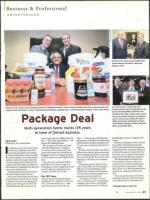
Table full of M. Jacob & Sons-packaged products is displayed by Marty Jacob, seated, president and CEO, and David Lubin, left,
company COO, and Gregory Jacob, marketing/communications specialist who is a fifth-generation member of the Jacob family.
M. Jacob & Sons' relationship with
Comerica Bank and its predecessors goes
Package Deal
of the first Detroit locations of Comerica
and M. Jacob & Sons during the latter's
125th anniversary celebration at Henry
Multi-generation family marks 125 years
at helm of Detroit business.
Bill Carroll
Special
I
to the Jewish News
n 1885, there were 21 breweries in the
Detroit area. Prohibition was still 35
years away, and people were having a
good time drinking beer and just tossing
the bottles anywhere, to be eventually dis-
carded as trash. But teenager Max Jacob,
a Jewish immigrant from Lithuania, had
an idea: Collect the bottles, sort them in
his backyard on Columbia Street, then sell
them back to the breweries.
The plan worked: Max Jacob became a
one-man bottle exchange business.
By the turn of the century, the M. Jacob
Co. had become M. Jacob & Sons, moved
to Winder Street, and was employing 40
bottle sorters working on two shifts. By
1910, Max had retired to become a real
estate mogul, with sons William, Ben and
Sam — three of his eight children — tak-
ing over the bottling business.
Max developed a lucrative real estate
career by selling homes to employees
or customers and to many people who
came to the Detroit area to work for the
fledgling Ford Motor Company (founded
in 1903), mainly at its new Highland Park
plant.
Max, who never worked on Shabbat,
attended the first Zionist Congress in
Switzerland, and later bought land in what
was then Palestine, donating to many
charities. Max died at 81 in 1945.
For 125 Years
Today, as the Jacob family generations
multiply and the company nears the end
of its 125th anniversary year — older
than Detroit stalwarts Ford, GM and
Faygo — it has become a global packag-
ing operation, with offices, manufacturing
and distribution facilities throughout the
U.S. and even a manufacturing partner in
China.
The firm creates and ships more than 3
billion bottles, plastics, green options and
other packaging components a year. Sales
have increased almost 20 percent in 2010,
shaping up as the best year in company
history.
Through the years, M. Jacob & Sons,
with its main office now in Farmington
Hills, has survived Prohibition, which
deflated beer and liquor bottle business,
the Great Depression and multiple reces-
sions and economic downturns.
"Throughout all of this, we had to
keep re-inventing and re-energizing the
company, and we had to stay flexible
explained Deborah Jacob, 62, William's
back to the late 1880s. Comerica Vice
President Ron Ruks, center, holds a photo
Ford Museum, Dearborn. David Lubin and
Marty Jacob flank Ruks.
granddaughter and now company chair-
woman.
Formerly a banking executive, she lives
in Las Vegas. "During bad times,” she
said, "we expanded into other industries.
Competitive bottle companies folded, but
we thrived because we transitioned into
new areas, such as food, pharmaceutical,
beauty and household item companies."
"We always adapted and found new
niches, thanks to the core values and
commitment to tradition handed down
from generation to generation:' added
Marty Jacob, 83, of West Bloomfield, Ben's
son and now company president and
CEO.
"The company was almost ruined by
Prohibition, then the 1929 stock market
crash, followed by the Depression, but
Package Dealon page 42
iN
December 9 . 2010
41