

World
French Cemetery
Jewish World War I soldier at last finds his resting place.
Robyn GoreII
Special to the Jewish News
I
t was a very hot summer day on July
19, 2010, in Fromelles, a charming
rural town in northern France, as a
new military cemetery was dedicated.
Among the 250 brave soldiers
now buried there is Lt. Berrol Lazar
Mendelsohn, an Australian platoon com-
mander who was Jewish and one of my
great-uncles.
The ceremony took place 94 years to
the day after the disastrous Battle of
Fromelles during World War I in which
thousands of Australian and English
troops were sent over the parapet and
many lost their lives.
Several family members and I were in
the huge crowd who attended the dedica-
tion. Prince Charles, the Duke of Kent,
the Governor General of Australia and
various church leaders took part in the
dedication. An English rabbi was there,
although not among those who spoke
during the main ceremony. He played a
poignant role later that day. The 250th
soldier was buried ceremonially. Various
soldiers' descendants read heartrending
excerpts of letters home to their families.
News media from around the world cap-
tured this historic event.
The Fromelles (Pheasant Wood)
Military Cemetery is close to where the
soldiers fell in battle. The peaceful scene
this particular day was in stark contrast
to the brief encounter in 1916 that's
recorded as the bloodiest in Australian
Army history.
Planned as a local diversionary attack
to distract German reserves from the
Somme Offensive about 50 miles away, the
Australian and British forces were met by
a very well-prepared enemy who struck
back with an inferno of violent shelling
from machine guns and small arms. Some
sections of the 5th Division (Australian)
and the 61st Division (English) were
forced into hand-to-hand fighting that
also resulted in huge casualties — thou-
sands either killed, wounded or miss-
ing. Nothing was gained by this combat,
according to military records.
My great-uncle is one of 94 Australian
soldiers so far identified among the 250
bodies painstakingly exhumed from a
34
December 9 • 2010
mass grave discovered in 2007, and one
of a very small number of Jews believed
killed in the battle. He is the only Jewish
soldier whose identity has been con-
firmed to date. Families of other Jews lost
that fateful night still await final closure.
Mass Graves
Lt. Mendelsohn was 25 when he died.
A champion swimmer in high school
and as a young adult, he worked as a
clerk before enlisting. His high school
newspaper recorded that "he had long
been connected with naval and military
affairs, while in civil life he has been
since boyhood on the staff of Perdriau
& Company." His mother, Abigail, once
wrote, "He would have preferred the
death which has overtaken him than to
have stayed behind."
Although a minyan was held a few
weeks later at his mother's home in
Mosman, a Sydney suburb, she never
had the consolation of knowing where
he was buried. His death announcement
in the Sydney Morning Herald said, "A
noble, clean and sweet life ended."
Before the German troops left the
battlefield, they buried some dead
Australian and English soldiers in mass
graves. Lambis Engeloz, a member of
the Friends of the 15th Brigade, located
the graves.
Through cooperative efforts by the
Australian Army and the Glasgow
University Archaeological Research
Division, the bodies were carefully
unearthed and their remains analyzed
using archeological and historical evi-
dence, DNA and the recording of physi-
cal attributes and associated artifacts.
Australian and English army entities
tracked down the families of the sol-
diers whose bodies may have been in
those graves. In January and February
2010, 249 soldiers were buried in the
new cemetery.
The UK Ministry of Defence and the
Australian Army worked hard to locate
suitable family members as potential
DNA donors. When my cousin, Oliver
Mendelsohn and second cousin Fred
Mendelsohn, both of Melbourne, were
notified earlier this year by military
authorities that their DNA samples had
helped identify our soldier, it was an
emotional moment.
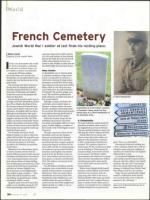
Lt. Berrol Mendelsohn
A gravestone in a new military cemetery
in Fromelles, France, marks the final
resting place of Lt. Berrol Mendelsohn of
the Australian Army.
A Compromise
The Army authorities unfortunately dis-
played less sensitivity when it came to
the original burial service in February.
That was entirely Christian in nature, not
reflecting the soldiers' religious diversity.
Despite efforts by my cousin and
others to have the Jewish soldiers rec-
ognized in this dedication ceremony
in July, a compromise eventually was
accepted. The organizers agreed to a
Jewish prayer for the ceremony, but didn't
end up including it. Following the for-
mal proceedings, Association of Jewish
Ex-Servicemen and Women (AJEX)
representatives and relatives of our great-
uncle and other Australian Jews without
identified graves held a short Jewish
service led by AJEX executive director
Jacques Weisser.
British Army Chaplain Rabbi Arnold
Saunders recited Kaddish and El Moleh
Rachamim. In true Aussie style, the
group sang Adon Olam to the tune of
Waltzing Matilda. Afterwards, my family
members and I and a couple of descen-
dants of another Jewish soldier partici-
pated in a meaningful service conducted
by Rabbi Saunders at our great-uncle's
MEmorial Australien
grave. There, we said Kaddish.
Choosing the headstone wording was
a three-continent, family effort, with sev-
eral great-nieces and great-nephews in
Australia, the United States and England
deliberating by e-mail.
An unexpected highlight of the day
came during a special reception held at
the local school for soldiers' close family
members. My sister and I were among
those who shortly afterwards had the
pleasure of shaking Prince Charles' hand
and talking to him for a few minutes.
I hope my great-grandmother Abigail
would be comforted to know that her
son is buried in Plot 2 Row F. May his
memory be for a blessing.
Robyn Gorell of West Bloomfield was born in
Sydney, Australia.