

Arts & Entertainment
Lennon
In NYC
As a new PBS documentary
(directed by a U-M grad) shows,
former Beatle got by with
"a little help from his [Jewish] friends."
Michael Fox
Special to the Jewish News
ohn Lennon and Yoko Ono left
England in 1971, a few months
after the breakup of the Beatles,
and moved to New York. They were seek-
ing a normal life in a teeming melting-
pot city, far from England's notoriously
vicious press and provincial public.
Yoko was widely blamed for the demise
of the band, it should be remembered,
and her avant-garde art and music were
slammed and dismissed in "revenge."
This was the last straw for Lennon, who
had long rebelled against the narrow-
mindedness of his countrymen.
It's well known that Lennon abhorred
injustice, but he became furious when
people close to him — like Beatles man-
ager Brian Epstein — were mistreated.
Michael Epstein (no relation to Brian
Epstein), the Brooklyn-based director of
the fascinating documentary LennoNYC,
notes that it was the Beatles' manager
who opened the musician's eyes.
"We forget how profoundly anti-Semit-
ic Britain can be director Epstein says.
"I think that larger prejudice in England,
which Brian Epstein felt, not only being
Jewish but also being gay, was something
of what Yoko experienced being Japanese
and being a strong woman. I think it's a
very, very regimented and closed society.
And John clearly was a very open-mind-
ed person with nary a prejudicial bone in
his body. You just go through his entire
life, and you see an open, inquisitive and
generous soul."
[In an interesting side note to the
Beatles' saga, the filmmaker reveals that
part of Lennon's dislike for the fam-
ily of Paul McCarney's wife, Linda (nee
Eastman), had to do with the fact that
her American Jewish father had changed
his name from Epstein.]
LennoNYC premieres Monday, Nov.
22, as part of PBS's American Masters
series. The two-hour broadcast roughly
coincides with what would have been
Lennon's 70th birthday and the 30th
anniversary of his death.
Working - Class Hero
During his career, John Lennon became a
beacon of inspiration for people at every
level of society. Director Epstein, who's in
his 40s and missed Beatlemania, was one
of those middle-class kids who looked up
to the outspoken musician.
"When I came of age in suburban
Chicago, I didn't fit in:' Epstein confides
in a phone interview. "Music was a great
refuge. While I never thought of the
Beatles or John in any religious way, John
was one of the lights, someone who acted
as a kind of guide for me. I would put
Dr. King in there. Certainly Gandhi. Not
that he would want to be put in that same
category, but also Rabbi David Saperstein
(longtime director of the Religious
Action Center of Reform Judaism):'
Growing up, Epstein was active in
Jewish youth movements. He attended
a Reform Jewish summer camp in
Oconomowoc, Wis., and served a term
as president of the Chicago Federation
of Temple Youth. He developed a strong
political conscience — and was arrested
his freshman year at the University
of Illinois (before transferring to the
University of Michigan, where he earned
his bachelor's degree) for protesting
the school's decision not to divest from
apartheid-era South Africa.
"At that point, I almost never took
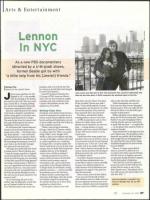
John Lennon and Yoko Ono in New York during the 70s. Lennon's relationship with
Yoko and son Sean (born in 1975) comprises the emotional heart of the film.
John's [first solo LP], Plastic Ono Band,
off the turntable Epstein says with a
laugh."I don't think anybody [I know]
was surprised I am the director of a John
Lennon documentary. They may have
been surprised that it was any good:'
The Emmy- and Peabody Award-
winning producer, director and writer
— of PBS documentaries such as None
Without Sin: Miller, Kazan and the
Blacklist and Irving Berlin: An American
Song — is being modest, of course.
Epstein's credits also include Bill Moyers'
10-part 1996 series, Genesis: A Living
Conversation.
"I don't know how many people ever
watched it, but it was as Jewish a series as
I've ever heard of, much less participated
in," Epstein says. "It was one I carry with
me quite a bit. It was really a Midrash
class. I had to find and cast people for the
various stories and tease out meaning in
biblical narratives, like you're trained to
do in Hebrew school."
LennoNYC's dramatic tension derives
from the Nixon administration's con-
certed effort to deport Lennon, ostensibly
because of an old drug charge but in
reality because of his performances and
appearances in support of the anti-Viet-
nam War movement.
When Lennon arrived in New York in
'71, he was wooed by Jewish activists
Abbie Hoffman and Jerry Rubin. But soon
the most important American Jew in his
life was a Sabbath-observant immigration
lawyer named Leon Wildes, an opera buff
with no idea who John and Yoko were.
"John's immigration case was the
first foray into what became Watergate
Epstein asserts. "John was really the first
attempt by Nixon to use the federal gov-
ernment to keep power."
Wildes tells great stories, Epstein says,
about the FBI not knowing what "shomer
Shabbas" was and wiretapping without
realizing that the attorney wasn't going
to speak with his client — or anyone else
— on the phone from sundown Friday to
sundown Saturday.
"John should have by all rights lost that
case Epstein says. "He should have been
deported very quickly. All of the things
that brought him joy and happiness at
the end of his life, none of those things
would have happened if it had not been
for Leon Wildes."
There is, of course, a great deal of
music in LennoNYC, almost all of it
recorded in New York. Lennon's ill-fated,
low-ebb visit to Los Angeles represents
an important though downbeat segment,
but the film's pulse is Manhattan.
"New York City is just the right lens,
because he arrives in New York, he lives
in New York, he wants to stay in New
York:' Epstein notes. "John doesn't fall in
love with America the way he falls in love
with New York." 111
American Masters: LennoNYC airs
9-11 p.m. Monday, Nov. 22, on PBS
stations.
November 18 • 2010
67