

Metro
Want
Peace?
Expect less of Israel,
more of its enemies,
columnist tells
Israel Bonds gathering.
"Bret Stephens:
But some enemies
cannot be appeased;
they have to be dealt
with and have to be
dealt with harshly
because what they
are about is inimical
to everything we
stand for."
Don Cohen
Special to the Jewish News
p
alestinian intentions toward Israel
are not the creation of their own
homeland, but the destruction of
ours" is how Bret Stephens, foreign affairs
columnist for the Wall Street Journal, sug-
gested Israel advocates explain the real
obstacle to a Palestinian state and peace
with Israel.
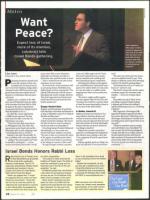
Stephens, also a member of the Wall
Street Journal editorial board, was editor
of the Jerusalem Post from 2002 to 2004.
He spoke at the State of Israel Bonds
Community Fall Event at Temple Israel in
West Bloomfield on Oct. 12.
He called the current negotiations
a "stillborn peace process" because
what Israel can offer is less than the
Palestinians can accept.
"There have been high expectations
on Washington's side, and rather dim
expectations on the Israeli side and the
Palestinian side," he said, quipping it was
"something they have in common."
Making it clear that "theoretically" he
has no problem with a two-state solution
— calling it "fair and sensible" and "what
we should be working for" — he has
serious reservations about what it would
mean today. With current Palestinian
leadership and attitudes, he believes a
Palestinian state would be hostile to Israel
— that it would fall into the orbit of Iran
and repress its own people.
He reviewed the current situations with-
in and among Hamas, Hezbollah, Syria,
Turkey, Egypt and Iran, arguing that, "The
[Obama] administration doesn't seem to
fully appreciate Israel's strategic dilemma.
They don't appreciate how fanatical and
hostile about Israel, and about the Jews,
Israel's enemies are."
Deeply Rooted Hate
Stephens said demonization of Israel from
both Palestinian nationalists and Islamists is
so deep in Palestinian society, "it is worthy of
the Nazis and then some:'
He was particularly concerned about the
attitude toward Iran claiming, "The tone in
the West isn't that we need to confront it,
but that we need to accommodate it."
Describing Iranian President Mahmoud
Ahmadinejad as a "very canny, very
shrewd individual;' Stephens counseled,
"You have to take very seriously the nature
of the regime. It typically means what it
says. We have been remiss in our history
of not taking our enemies at their word."
He urged stronger economic sanctions,
active and visible support for the "Green
Movement" opposition in Iran, closing
Iranian embassies and excluding Iran
from international sports competition.
Admitting that military action against
Iran would likely have "unintended conse-
quences," he said he didn't see such action
as a war, but rather as a military strike
targeting Iran's three nuclear production
facilities.
"We need to weigh possible negative
outcomes against what we know," he said.
"A nuclear Iran would be a massive threat
to Israel, but more importantly, a threat to
the security of the United States."
A Bolder America?
Stephens said American reticence is "in a
way, a tribute to American decency and
a tribute to American naivete. But some
enemies cannot be appeased; they have to be
dealt with and have to be dealt with harshly
because what they are about is inimical to
everything we stand for."
Stephens also counsels a more direct
approach to combating Israel's delegitimiza-
tion which, he says, is aiming to show that
"to be a supporter of Israel is a quasi-fascis-
tic belief."
Stephens regularly speaks on college cam-
puses and calls them "a very scary environ-
Israel Bonds Honors Rabbi Loss
abbi Harold Loss of Temple Israel
in West Bloomfield was presented
the Israel Unity Leadership
Award by Israel Bonds. The Oct.12
award was presented by Temple Israel's
immediate past president, Gerson
Cooper, who serves on Israel Bonds'
Metro Detroit Executive Board.
Rabbi Loss quipped that "it might
be suggested that my career has been
framed by Israel Bonds," noting that
his first trip to Israel was paid for by
redeeming the Israel Bonds he received
as bar mitzvah gifts. He accepted the
award on behalf of his wife, Susan, and
R
22
October 21 . 2010
his entire congregation.
"This award is really honoring the
tradition of Temple Israel. The State of
Israel has continued to play such an
important role in the life of this con-
gregation," he said.
He offered a prayer that "we will live in
a time when we see Israel live in peace;
and may we see it in the lifetime of the
oldest, not the youngest, in this room."
Metro Detroit Campaign Executive
Board Co-Chair Larry Wolfe told the
audience that Israel Bonds have always
been redeemed "on time and in full.
The money is secure and the rate of
return is fair, equitable and as good
as you are going to find in the market
today."
Besides the investment, he said
you also get a valuable bonus: Eretz
Yisrael [the biblical Land of Israel].
Israel Bonds may be purchased by
contacting the Michigan office, (248)
661-3500 or www.israelbonds.com .
❑
Rabbi and Susan Loss with Gerson
Cooper, left, Temple Israel immediate
past president, as the rabbi receives
the Israel Unity Leadership Award.
ment."
"We need to do a better job in the rhetori-
cal case we make for Israel;' he says. "We're
always in a defensive crouch. We're defending
ourselves? We should be pointing fingers."
"Israel always has to be an A+ nation, but
Iran is a D- nation',' he said.
"But Israel is a democratic and free nation
of ordinary people who sometimes make
mistakes — and we are wrong to expect
more."
The problem, he said, is "those of who
everything is expected [Israel], nothing
is forgiven, and of those who nothing is
expected [Palestinians, Iran, etc.], everything
is forgiven."
Mary Sugarman of Farmington Hills
appreciated Stephen's approach and shares
his concerns about Iran. "I think Iran is a ter-
rible danger. Ahmadinejad is a terribly clever
and bright person and we ignore them at our
own peril"
"I think we sometimes stay too compla-
cent',' said Debbie Levin of Southfield. "We
stay too quiet. We don't feel knowledgeable
enough, especially on our college campuses.
[Jewish students] feel they don't have the
right comebacks. If the parents don't have the
answers then neither do the young people.
We need to do a lot more education in our
community." ❑