

Health & Fitness
RESEARCH
Not For Women Only
Three guys make breast cancer walk their challenge.
Judith Doner Berne
Significant
Breast Cancer
Statistics
Special to the Jewish News
y
ou have to be a little crazy,"
says Bert Stein.
"It's a mission; it's nothing to
like," says Morrey Katz.
"Morrey's my muse. He pulls me
along," says Sye Linovitz.
No matter. Because for the past six
years, these three close friends have
trained and then walked nearly 60 miles
to raise money for, and awareness of,
breast cancer.
They compose one of the few, if not
only, all-male teams (the Mavens) in the
annual late-summer Michigan Susan G.
Komen 3-Day for the Cure walk that this
year raised about $5.4 million for breast
cancer research.
They also are among the oldest par-
ticipants: Stein is 77; Katz is 76 (they
double dated to the 1951 Detroit Central
High School prom) and Linovitz is the
baby at 71.
"Bert Stein is our second-oldest reg-
istered walker in Michigan, Morrey Katz
our third oldest and Sye Linovitz our
seventh oldest," according to a spokes-
woman for the Susan G. Komen 3-Day
for the Cure.
Although the oldest of the three, Stein,
a retired accountant, is also the fastest,
always immediately heading to the front
of the pack. "It's only because I want to
get out of the sun," he insists. "I find a
group of women. It's a different pace. No
one passes our group. We don't have a
lot of joking!'
Ahead Of The Pack
This year, which all agree was the hot-
test, Stein finished second on the first
day and 10th on the others. That's from
a field of more than 1,800 walkers, of
which 8.6 percent were male.
While Stein completes each of the two
longest days in 61/2 hours, his two bud-
dies are content to cruise along more
slowly, exchanging conversation and
jokes with other walkers.
"Morey and I are more social walk-
ers," says Linovitz, who retired as a
design analysis engineer for Ford Motor
Company. "It's one of the few places you
can talk about boobs and women will,
too."
46 October 14 • 2010
iN
• Breast cancer is the most common
cancer among American women,
except for skin cancers. The chance
of developing invasive breast cancer
at some time in a woman's life is a
little less than 1 in 8 (12 percent).
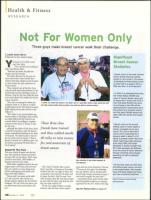
All think we would feel guilty if we didn't do it," says Bert Stein, right, pictured with
his high school buddy Morrey Katz, who lost his wife to breast cancer.
These three close
friends have trained
and then walked nearly
60 miles to raise money
for, and awareness of,
breast cancer.
• In 2010, it is estimated that across
the United States 207,090 new
cases of invasive breast cancer will
be diagnosed in women and 1,970 in
men; that about 54,010 new cases
of carcinoma in situ (CIS) will be
diagnosed (CIS is noninvasive and is
the earliest form of breast cancer);
and that about 39,840 women and
about 390 men will die from breast
cancer.
• Breast cancer is the second-
leading cause of cancer death in
women, exceeded only by lung
cancer. The chance that breast
cancer will be responsible for a
woman's death is about 1 in 35
(about 3 percent). Death rates from
breast cancer have been declining
since about 1990, with larger
decreases in women younger than
50. These decreases are believed
to be the result of earlier detection
through screening and increased
awareness as well as improved
treatment.
Sye Linovitz is the third member of
the Mavens.
The 3-Day "is harder than a mara-
thon," says Katz, a Commerce Township
resident who has run eight of them. For
a marathon, "you train for 26 miles and
it's done. For the 3-Day:' he says, "you
walk 20 miles; then the next day, you get
up and walk 20 miles; and then the next
day, you walk another 16!'
On the first night (Friday), seconds
Linovitz, who has had a knee replace-
ment and two stress fractures, "you say,
`I'll never do this again.' On Saturday,
you say, 'Maybe,' and on Sunday, after
the moving closing ceremony, you say, 'I
can't wait to register for next year!"
And indeed, Stein and Linovitz, both
West Bloomfield residents, are already
registered for the 2011 walk set for Aug.
Not For Women Only on page 47
• At this time, there are more than
2.5-million breast cancer survivors
in the United States. This includes
those still being treated and those
who have completed treatment. LI
Source: American Cancer Society,
www.cancerorg