

continued from page P12
cation beyond mere language," writes
Nathan. "It was Ruth Moos who first
taught me the simple pleasure of sink-
ing my teeth into a slightly melted
bar of dark chocolate sandwiched into
a crackly baguette. Ruth took me on
afternoon hikes in the Alps, with choco-
late baguette snacks, and in her kitchen
exposed me to dishes such as gratin
dauphinois, a local regional specialty, and
poached fish with a mousseline sauce, as
well as delicious tarts and tortes made
with plums, apples and other fruits."
At the time, Nathan knew her rela-
tives had escaped capture during the
Nazi Occupation by hiding in Annecy,
but she never knew more than that.
"They never talked about Judaism or
what happened in World War II, but
now they want to. They're going to die,
and they want people to know. The
whole tenor of France has opened up
more. Before, you didn't ask people in
France if they were Jewish; now some
people admit they're Jewish. I found a
lot of famous people who were Jewish.
And I found Jewish food all over the
country. So I spoke to people and
learned everything I could."
What she learned is that Jewish his-
tory in France goes back about 2,000
years, and even today, France has the
third-largest Jewish population in the
world; but geography is even more
important. "We weren't a global world,"
says Nathan. "There was no TV, no
newspapers. France was considered the
Promised Land long before the United
States was created, and people flocked
there. Even though the French like
to think of themselves as French, it
is an immigrant country. And Jewish
food is mostly diasporic, emerging in
many lands and in many forms." Jews
have come in waves from Spain and
Portugal, the Balkans, Eastern Europe,
North Africa and, initially, from ancient
Palestine, bringing their cooking prac-
tices with them.
And in Quiches, Kugels, and Couscous,
Joan Nathan treads the paths they laid
down. Here, a tasting.
RECIPES REPRINTED WITH PERMISSION
BY QUICHES, KUGELS, AND COUSCOUS
BY JOAN NATHAN. PUBLISHED BY KNOPF.
P 1 4 • OCTOBER 2010 •
IN platinum
such as fava or wax, kept whole or halved cross-
wise
2 large or 3 small zucchini, cut in half lengthwise and
diced into half-moons
1 packed cup fresh basil leaves
1/2 cup pasta shells
3 tablespoons olive oil
Grated Parmesan cheese
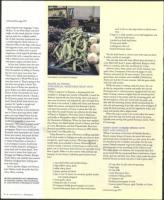
Fava beans in the market in Aubagne
SOUPE AU PISTOU
(PROVENCAL VEGETABLE SOUP WITH
BASIL)
"When I stayed at La Royante, a charming bed-and-
breakfast in Aubagne just outside of Marseille, I tasted the
delicious homemade jam from the fig, cherry and apricot
trees near the terrace, and enjoyed the olive oil made from
the olives in the orchard. I talked with Xenia and Bernard
Saltiel, the owners, and learned that Bernard is Jewish
and traces his ancestry in France to about the 13th cen-
tury, when his people became tax collectors for the king
of France in Perpignan. Then they went to Narbonne,
and finally to Montpellier, where a Saltiel helped found
the University of Medicine. When the Jews were expelled
from France, the Saltiel family moved to Greece, and lived
in Crete, Macedonia, and then Thessalonika. Ever since
Bernard's grandfather returned to France in 1892, Saltiels
have lived in the Marseille area.
Today Bernard is a man of Provence, sniffing vegetables
at the local market in Aubagne to make sure they are fresh
enough for a good soupe au pistou. This soup originated in
nearby Italy, most probably in Genoa. Provencal Jewish
versions include a selection of dried beans as well as fresh
green, wax or fava beans, fresh basil and an especially strong
dose of garlic. Make it in the summer with perfectly ripe
tomatoes. In the winter, I substitute good canned toma-
toes."
1 cup mixed white and red dried beans
1 large yellow onion, diced
2 stalks celery, diced
1 potato, peeled and diced
3 ripe or one 15-ounce can tomatoes, peeled, seeded
and coarsely chopped
7 cloves garlic, diced
3 teaspoons salt, or to taste
1/2 teaspoon freshly ground pepper, or to taste
1 pound fresh green beans and other fresh beans,
Put the dried beans in a bowl, cover with water by about
4 inches, and let sit overnight.
The next day, drain the water off and place the beans in
a pot filled with about 3 quarts cold water. Bring to a boil,
lower to a simmer, and cook, uncovered, for 1 hour.
Add the onion, celery, potato, two of the tomatoes, one
garlic clove, 2 teaspoons of the salt and pepper to taste.
Simmer, uncovered, for 20 more minutes. Then add the
green beans, the zucchini, and a handful of basil leaves,
diced, and cook for 10 more minutes. Add the pasta shells,
and cook until al dente.
While the pasta is cooking, make the pistou. You can
do this by using either a mortar and pestle, the way the
Provencaux do, or a food processor equipped with the steel
blade. If using a mortar, roughly chop the remaining basil
leaves and put in the mortar with the remaining garlic and
the last teaspoon of the salt. Grind with the pestle, and
then add the remaining tomato, slowly incorporating the
olive oil, and seasoning, if you like, with a twist of pepper. If
using the food processor, put all the ingredients inside, and
pulse until pureed with a slight chunk.
When the soup is ready to be served, adjust the season-
ings, spoon the soup into bowls and swirl in the pistou.
Sprinkle each serving with grated Parmesan cheese. Yield:
8-10 servings.
QUICK GOAT CHEESE BREAD WITH
MINT AND APRICOTS
"When I ate dinner at the home of Nathalie Berrebi, a
French woman living in Geneva, she served this savory
quick bread warm and sliced thin, as a first course for a din-
ner attended by lots of children and adults. For the main
course, Nathalie prepared rouget (red mullet) with an egg-
plant tapenade on top, something all the children loved.
The entire dinner was delicious, but I especially liked that
savory bread with the unexpected flavor combination of goat
cheese, apricots and fresh mint. Now I often make this quick
bread for brunch or lunch and serve it with a green salad."
1/3 cup olive oil, plus some for greasing
3 large eggs
1/3 cup milk
2 cups all-purpose flour
1 teaspoon baking powder
1/2 teaspoon salt
Freshly ground pepper to taste
2 ounces grated Gruyere, aged Cheddar or Comte
cheese
continued on page P16