

Arts & Entertainment
Raw Footage
In the award-winning A Film Unfinished,
Israeli filmmaker Yael Hersonski analyzes
ghetto images from 1942, probing deeply
into the making of Nazi propaganda.
Tom Tugend
Jewish Journal of Greater L.A.
Los Angeles/JTA
T
he place is the Warsaw Ghetto, the year 1942, and
the black-and-white footage shows fashionably
dressed men and women, with yellow Stars of
David as accessories, having a high time at a champagne
ball.
Later we see emaciated kids rooting through mounds of
garbage and excrement for scraps of food.
The contradictory scenes are from A Film Unfinished,
an unwitting collaboration between a Nazi propaganda
crew and an Israeli filmmaker separated by nearly seven
decades.
In May 1942, a German film crew in Wehrmacht uni-
forms arrived at the Warsaw Ghetto with somewhat vague
orders to shoot a documentary on the many aspects of
ghetto life in order to show the Jewish "folk" character.
Each day a local SS commander nicknamed the "Gold
Pheasant" would give the crew its assignments.
After 30 days the German crew disappeared. So did
its footage — staged shots alternating with actual street
scenes. It was never processed into a film or shown in
Germany.
In 1954, four reels were discovered in a vault in East
Berlin, left behind by the departing Soviet occupation
troops. Filmmakers in subsequent years would extract
some of the footage for their projects, showing only the
scenes of misery, which became accepted as authentic
depictions of ghetto life.
It wasn't until 1998 that a British filmmaker search-
ing for footage on the 1936 Berlin Olympics at a U.S. Air
Force base film vault noticed two cans of film on the floor
labeled "Das Ghetto." The 30 minutes of outtakes showed
not only that some scenes had been shot repeatedly by the
Germans, but also moments in which the Nazi cameramen
accidentally entered into each other's frames.
That same year, German authorities tracked down and
interrogated Willy Wist, a cameraman on the project.
In 2006, Yael Hersonski, an Israeli television editor and
director whose grandmother was a Warsaw Ghetto survi-
vor, started putting together the threads of the story.
Hersonski was attracted to the project for two reasons:
her interest in film archives as permanent witnesses to his-
tory and the sheer amazement at discovering the Warsaw
Ghetto footage.
"After so many years as an Israeli citizen, bombarded
with so many films and images that concerned the Jewish
Holocaust, I was shocked that I didn't know anything
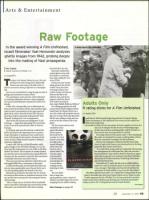
A scene from A Flhia
about this film:' she said.
Hersonski combined the
original ghetto scenes with
the outtakes to reveal their
Nazi origin, adding the testi-
mony of Wist.
During two years of pains-
taking research, she said she
verified "every document,
every page of diary, every
archive corridor and staircase
shown in the film as the
authentic ones, and the lan-
guages in which the diaries
were written were kept in
their origin: Yiddish, Polish and Hebrew."
For a closing perspective her staff
scoured Israel, Poland, England and the
United States for Warsaw Ghetto survi-
vors who could recall seeing the German
film crew at work. Of the nine that fit the
bill, five were willing to watch and com-
ment on the Nazi version of life in the
ghetto.
The four women and one man
watched the cham-
pagne ball patrons
dressed up and
fed strictly for the
occasion. In a "puri-
fication" scene, they
saw eight young
women kidnapped
off the street and
forced to enter a
mikvah naked. The
Germans, appar-
ently fascinated
by Jewish rituals,
painstakingly shot
a circumcision, a
wedding and the
koshering of chick-
The film poster
ens.
The crew didn't
have to stage man-
age the grimmer scenes: corpses of
children and adults lying in the streets;
strapping German soldiers shaking
Adults Only
R rating sticks for A Film Unfinished.
Los Angeles (JTA)
sraeli director Yael Hersonski fought long and hard to bring the Warsaw
Ghetto documentary A Film Unfinished to the screen, but she couldn't beat
Hollywood's rating board.
Last month the Motion Picture Association of America upheld a previous deci-
sion of an R rating for the film because of "disturbing images
of Holocaust atrocities, including graphic nudity' the latter in a
Nazi-coerced scene of young women in a mikvah.
The rating, which prevents anyone under 17 from watching the
film unless accompanied by a parent or adult guardian, will not
block the commercial screening of the film in theaters.
However, the designation will prevent the film from being
shown in high-school dasses as an educational tool, to the disap-
pointment of its creators and backers.
"In a world where young people are bombarded with meaning-
less entertainment, it's unfortunate that a film with real educa-
tional and historic value would be denied to them by an organi-
zation that is supposed to be working to help them',' said Adam
Yauch, head of the film's distributor Oscilloscope Laboratories
and a former Beastie Boy.
Hersonski said, "I realize that this may be a difficult film to
watch, but I wish I had had the chance to see such a film when
I was a teenager. I think high school teachers should have the
opportunity to decide whether or not to use it in their classes."
The MPAA appeals board voted 12-3 to uphold the R rating, despite fervent
pleas by Hersonski and a letter from Warsaw Ghetto survivor Hana Avrutzky.
Further arguments that the 1998 film The Last Days, produced by Academy
Award-winner Steven Spielberg and showing mass executions and extensive
nudity, received a PG-13 rating did not sway the board's decision.
- Tom Tugend
Raw Footage on page 45
September 9 • 2010
43