

Metro
Emotions Of Home
100 visit the town of David-Horodok ... and the Holocaust.
Robert S. Sher
Special to the Jewish News
-ks.,At;•.4:',i. t .;••%'•
.
I
te ;3/4 . :‘
..,..
'-‘4C.!"-
- •
' ..
"
've heard the stories and I've seen
the films, but nothing has moved me
quite like saying Kaddish on the actual
yahrtzeit date and at the place where Nazis
systematically killed Jews from my ances-
tor's shtetl of David-Horodok.
On July 28, I retraced the death march
from David-Horodok to "the pit" where
thousands of Horodokers were slaugh-
tered more than 60 years ago. The trip was
part of a weeklong mission comprised of
more than 100 Americans, Canadians and
Israelis with ties to David-Horodok. We
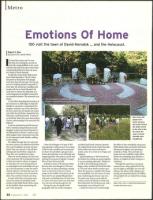
went there to witness the dedication of a
newly designed and installed memorial to
our murdered relatives. The memorial is an
obolus.
I stood silent, absorbing the heaviness of
the moment as a rabbi began to chant the
Kaddish. It was hard to comprehend. The
slaughter took place just a few miles from
the town where my own family was rooted
and, while they left Belarus long before the
Holocaust, it still felt personal. I wanted to
see firsthand where they came from and get
a better understanding of the atrocities that
followed.
It was an emotional, powerful journey.
Until I marched, along with my son and
daughter-in-law, from David-Horodok to
the killing field in Minsk, I could not pos-
sibly imagine what it must have been like
for the innocent Jewish families walking
to their deaths.
We walked through the town and took
the same journey our relatives took before
they were humiliated, tortured and mur-
dered. They were forced to take off their
clothing and stand before a large hole.
Then they were murdered en masse.
When we arrived and got our first view
of the memorial, 200 townspeople dressed
in their best stood in silence to support
us. Speeches were very moving, but not
as meaningful as the individuals who got
up to the microphone to state the names
of their relatives or friends that were exe-
cuted by the Germans. I just stood there,
silent. You could have heard a pin drop.
It wasn't until after each person men-
tioned the names of murdered family
members that Rabbi Moshe Fhima chant-
ed the Kaddish. Many wept during this
part of the program.
22
i
•
t?
September 2 • 2010
W.' ..'
% N
of those who -perished from the shteti of DaVid•
More than 100
people from
North America
and Israel retrace
the death march
to the site of the
pit where the
Jews of David-
Horodok were
slaughtered.
I was sad yet happy to be part of this
trip, planned to help preserve the location
of the horrific murders and to memorial-
ize those who perished. I got great satis-
faction showing that we are all family and
supporting those who spent so much time
putting the monument together. Seeing it
felt as if time had stood still.
In Belarus, many of the houses looked
like they have not changed in 100 years.
Some have no indoor plumbing, running
water or electricity. There are several
pumps in the middle of the streets of the
town and we saw people filling buckets
with water and taking them to their hous-
es. There were horses and carts and some
very old cars driving through the city.
During the trip, we played Jewish
geography with our Israeli contingent,
socialized and found common interests.
We visited Minsk, Pinsk, David-Horodok,
Stolin, Ruble and some small towns
nearby; some of us went on to Prague and
Budapest.
Special thanks go to Neil Gorosh and
Roz Blanck for putting our group together.
It was an amazing experience. Thank you
as well to the Israeli group leader, Ziv
Begon, whose mother left David-Horodok
in 1939 and whose family members per-
ished. His passion to complete this dream
was remarkable. Over the course of many
years of planning, his dream came true.
He made seven trips to work with the
architect and local officials in Pinsk and
David-Horodok. He led their group with a
strong hand, never losing his cool.
I would be remiss not to acknowledge
the efforts of two remarkable young men,
Rabbi Moshe Fhima and Yoshi, both from
Manchester, England, and operating a
yeshivah in Pinsk. They provided our
meals and were available to help. Rabbi
Moshe was translating from Russian to
Hebrew to English all while texting on a
cell phone!
Through this experience, our group
connected on a deep, spiritual level. On
our last night, at midnight, we were still
sitting at the dinner table, talking, remi-
niscing and remembering the Six Million
who perished. No one wanted the evening
to end.
Robert Sher, CPA, is a West Bloomfield-based
Certified Executive Coach.