

Arts & Entertainment
Collection Extraordinaire
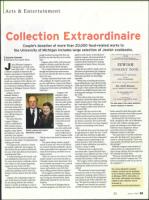
Couple's donation of more than 20,000 food-related works to
the University of Michigan includes large selection of Jewish cookbooks.
people involves knowing what they eat,
how they eat and why they eat in certain
Suzanne Chessler
ways.
Special to the Jewish News
Longone, whose father sold restaurant
supplies in Boston, eased into the work
anice Bluestein Longone is
that has directed her life for decades.
tracking down a Jewish cook-
"I'm a trained historian and always have
book from 1903 — The Temple
thought that history has many lessons
Cookbook compiled in Detroit by the
for us if we only take the time to examine
Auxiliary Association of Temple Beth El.
them;' she says.
Her search represents an academic
"I always understood that books could
pursuit because the book is needed to
solve problems. If I wanted answers that
round out a segment of the reference col-
no one could tell me, I went to the library.
lection she donated and expands as cura-
That was the purpose behind becoming an
tor of American Culinary History at the
antiquarian book dealer and building this
University of Michigan Clements Library
collection:'
in Ann Arbor.
Longone, who
Longone, and her
attended
a state
husband, Daniel, a
teachers
college
in
retired organic chemis-
Massachusetts,
mar-
try professor, amassed
ried soon after gradu-
more than 20,000 his-
ation and moved on
torical items relating to
to
Cornell University
American culinary his-
in
Ithaca,
N.Y.,
tory as she developed an
where
she
majored
antiquarian book busi-
in
Chinese
history,
ness, still operating on a
minored
in
Indian
limited basis.
history
and
worked
The Janice Bluestein
in the field of rural
Longone Culinary
sociology.
Archive, established in
"People from all
2005, includes menus,
over
the world would
advertisements, diaries,
Daniel
Longone
and
Janice
come
to our home,
graphics, maps, letters
Bluestone
Longone
and
we
talked about
and reference works. The
,
'
Longone
recalls.
food'
materials come together
"We
also
knew
that
food
was
meant
to be
for one of the most extensive scholarly
shared.
resources on the subject of American food,
"Our guests always wanted a typical
cooking and rituals.
American
meal, and I went to the library
"I'm desperate for someone to donate
(to research what that included). I discov-
this temple cookbook:' says Longone, 76,
ered a great intellectual component to the
who became the go-to person and friend
for some of the most famous food experts, study of food history, and that's how my
interest started.
including Julia Child.
"When we came to Ann Arbor in 1958,
"I treasure having the first Jewish cook-
people wanted to meet and entertain us.
book published in America in 1871, and
I thought I had to invite them back. I had
I'm crazy about charity cookbooks, which
been a scholar but seemed to be a natural
were written to raise money beginning
at cooking. I started teaching cooking
around the time of the Civil War.
classes and worked at one of the first
"There have been thousands of charity
stores selling gourmet kitchen supplies:'
cookbooks published, and it's still a big
The Longones, involved with campus
business. We have almost all of the Jewish
and political activities, enjoyed entertain-
ones:'
ing. Coming up with innovative dishes
Longone, who is planning a major lec-
additionally inspired her into the book
ture on the history of Jewish cookbooks
business.
for next spring, believes that culinary
"The University of Michigan had an
history is worthy of studying as a way of
looking at the world. Learning about other extension program, and Dan and I were
asked to teach classes on food history:'
explains Longone, who learned about all
kinds of foods and food rituals as she
traveled with her husband to teaching
assignments in Spain, France, Germany
and Turkey.
After she was asked to teach a class on
the history of gastronomy, the Longones
found many resources at Michigan State
University, and their text knowledge
expanded.
"Within days of making the decision
about selling books, I got calls from Julia
Child, James Beard and Craig Claiborne,'
she recalls. "They said the old cookbooks
would be very helpful because they were
lecturing and starting to do television in
the 1970s.
"They told me that every time they
mentioned a book that influenced them,
people wanted to know where they could
get it and asked if they could give my
name. I began to make many friends in
the food world."
Longone, who has served on the
national board of the American Institute
of Wine and Food and has been involved
with book clubs, takes pride in knowing
her famous customers and scouts books
for them as she travels. In return, longtime
customers are donating to her library
cache.
"My work has been out of my home and
by appointment or mail;' she says. "I used
to get calls from chefs late at night after
desserts were served in their restaurants."
Longone, whose volunteering at the
library started in 1983 and included a
couple of major exhibitions, was asked to
become a curator in 2000.
"I had never been a collector, but I
discovered after I started the book busi-
ness that I was a collector',' she says. "I had
saved things after becoming enamored of
the topic and anxious to learn more."
The Longone archive explores anything
America influences in terms of food and
anything that influenced America in terms
of food.
"The university became increasingly
interested in what we were doing and is
committed to making culinary history a
major topic of study by the management
and enhancement of this collection:' she
says. "It's open for people to do research."
Longone's own research has revealed
that the developers of early Jewish cook-
1.41
WI
I LS
IJCilL.7
rlanipri
A COONEBY DOOR TROPIMIAT ErFLAINED, AND
ACCORDANCE NTITJI THE RULES OF TILE JEWISH RELIGION.
JEWISH
.
COOKERY BOOK,
OV
PRINCIPLES OF ECONOMY,
♦DATTr.D rot
JEWISH HOUSEKEEPERS,
MTh 'IBC ADDITION OT AUNT USEFUL MEDICINAL. REcrrEs,
AX)
ettr Valitablt Information,
RELATIVE TO ROUEEREEFLtiO AND DOREaTIC MAN/GEXENT.
By MRS. FSTIIER LEVY,
.EstAcr forolu..)
PHILADELPHIA:
w.
S.
TURNED, No SOS CHESTNUT STREET.
/871.
The title page of the oldest published
Jewish cookbook in America
books wanted to show that people could
entertain with kosher food without guests
realizing the recipes were kosher.
She learned that The Settlement Cook
Book, compiled in 1903 out of Milwaukee,
was the work of ladies teaching immi-
grants and wanting to raise funds to get
settlement house equipment. Money
earned from that book still goes to
Milwaukee charities of all types.
"The major flurry of Jewish cookbooks
came after the Holocaust:' says Longone,
raised in a Jewish household. "There were
many people who felt they had to preserve
this heritage."
While the Longones want students of
culinary history to understand the heri-
tage of many cultures, they also appreciate
the scholarly bond they share.
"There are several books that are dedi-
cated to Dan and me:' Longone says. "We
feel very enriched by what we do, and we
do it together." El
The Janice Bluestein Longone
Culinary Archive can be accessed
at the Clements Library, University
of Michigan, 909 S. University, in
Ann Arbor. Information and images
related to the collection can be
accessed at
www.clements.umich.edu/culinary/
July 8 • 2010
35