

Spirituality
TORAH PORTION
Community Benefit
Temple Israel hosts Garden of Mitzvot.
Recalling Stops
Along The Way
Shabbat Mevarechim, Parshat
Mattot-Masei: Numbers 30:2-36:13;
Jeremiah 2:4-28, 3:4.
H
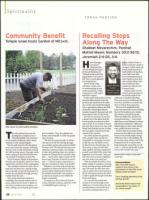
Rick Larson of Livonia plants tomatoes.
T
he white picket fence near the
parking lot at Temple Israel in
West Bloomfield is the enclosure
for the Garden of Mitzvot, where all are
welcome to visit and participate.
The site and structures for the garden
were constructed last summer, including
the fence and several raised beds. During
the 2009 growing season, 38 people volun-
teered, ranging in age from bar/bat mitz-
vah students to members in their 80s.
Tracie Fienman, Temple Israel program
director, says the garden started as a direct
appeal from members of the congregation.
"Our members realized we have a lot of
land here and there was a strong feeling
that we should use part of the property to
benefit the community through growing
healthy food: she said.
This spring, dedicated volunteers,
including a bat mitzvah student and her
mom, worked for two hours to plant car-
rots, beets, tomatoes, green peppers, zuc-
chini, cabbage, acorn squash, green beans
32
July 8 • 2010
and cucumbers. They also planted sun-
flowers and marigolds to make the garden
more inviting.
"We don't use any pesticides or chemi-
cals and we do all the watering through
our sprinkler system, plus natural rainfall:
Feinman said. "We learned from last year's
experience and have made a few changes
in what we're planting. Also, we're going to
include the [Temple Israel] summer camp
kids — they'll make signs to mark the dif-
ferent crops. Everyone is invited to partici-
pate — it doesn't require experience or a
big time commitment. We're very flexible'
Volunteers can weed, help pick the ripe
vegetables or deliver the harvest. All of the
harvest will be distributed by Yad Ezra,
the Berkley-based kosher food pantry, or
go directly to people in need within the
temple community.
To volunteer in the Garden of Mitzvot,
contact Michelle Lichtman, (248) 661-5700
or michelle@temple-israel.org . [71
enry Kissinger
plague, a lack of water or
once asked
food or even just a desire to
Chairman Mao
eat meat. At these times, the
what he thought the impact
Jewish people questioned
the French Revolution of
God's ability to bring them
1789 had on the world. Mao
to the Holy Land; they
replied that it is too early to
even contemplated return-
tell! This is a novel approach
ing to Egypt on more that
to viewing history.
one occasion! Moses must
But the truth is that
have wondered if they
Rabbi M ichael
would ever make it to the
with time, we have a bet-
Coh en
ter understanding of past
Promised Land.
Special to the
Scholars often view the
events; sometimes, it takes
Jewish News
a long time to really under-
protests and arguments of
stand their impact.
the Jewish people in the
wilderness as needless kvetching.
In this week's Torah portion, we learn
about the different places where the
They point out how troublesome the
Jews were; and there is no doubt that
Jewish people sojourned in the wilder-
ness on their way to Israel from Egypt.
there is truth in this perspective.
However, this insightful parable
It is an appropriate ending to the Book
of Numbers, which begins with the
views each step of the way as a building
Israelites leaving Mt. Sinai and ends with block of the foundation of a relation-
ship between God and His people.
them poised to enter the Holy Land.
But why it is necessary to recount
There were difficulties, and that was
not good at the time — but in hind-
a laundry list of the places that the
Jewish people encountered on their
sight, those events fashioned a relation-
ship that has endured for 3,000 years.
way to Israel. If one wanted to investi-
gate what these places were, one could Relationships are often made stronger
when conflict has been overcome.
simply look through the past 30 chap-
I believe that the message of these
ters; each place is mentioned in the
sojourns in the wilderness is that the
context of the narrative.
history of the Jewish people, though
Our rabbis answer this question
3,000 years old, is still unfolding. We
with a parable. They say that it is
are, in many ways, still on route to the
comparable to a king who once had
Promised Land. It is only by relent-
to take his own sick child to a doc-
lessly staying the course that we will
tor that lived in a faraway place. On
arrive — and one day be able to make
their return as they retraced their
sense of the travails of the past.
steps together, the king reminded his
recently cured child of the events that
Michael Cohen is rabbi at Young Israel
happened at each location. "Here you
had a fever, here you had a chill, here
of Oak Park.
you were weak so we rested, etc."
What the parable describes is not a
Conversations
matter simply of nostalgia, a yearning
Why is the 25th sojourn
for the past, but a deeper understand-
related to the victory of the
ing of the trials that have been over-
Hasmoneans on the 25th of the
come to achieve the current station in
Hebrew month of Kislev?
life. By reliving the journey, the child
is able to appreciate the gift of life that
Can a troubling experience bring
he has been given.
spiritual growth?
So it was with the travels and
travails of the Jewish people in the
Should the Divine hand of God
wilderness. At each location, the rela-
recognizable in the history of
tionship between God and the Jews
the Jewish people?
was tested, sometimes there was a
❑