

Seeking A New Model For Prosperity
Community entrepreneurs share "the language of business."
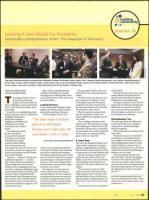
Left photo: TechTown panelists included Charlie Rothstein, founder of Beringea; Anmar Sarafa, CEO of Steward Capital Management; Josh Linkner, founder/chairman of
ePrize; Saber Ammori, CEO of Wireless Vision. Center photo: Josh Levine of Huntington Woods converses with Michael Shallal of West Bloomfield. Right photo: Saber
Ammori shares views with Jack Miner of West Bloomfield and Francine Wunder of Beverly Hills.
VANESSA DEN HA-GARMO
EDITOR I CHALDEAN NEWS
T
he budding Chaldean News/
Jewish News partnership
included a discussion about the
future of Michigan, economic growth and
jobs by a June 16 panel focused on entre-
preneurship.
In April, the two Southield-based pub-
lications launched a historic collaboration,
"Building Community," in
which both newspapers
highlight the similarities and
challenges the two ethnic
communities face in Metro
Detroit.
The collaboration called
for three educational
forums; the first was held
at TechTown on the Wayne
State University campus
inside the Detroit building
that once housed the team
that designed the Chevrolet Corvette. The
conversation centered on engaging entre-
preneurs and creating economic develop-
ment within Michigan.
The panel — composed of Jewish and
Chaldean entrepreneurs — included
Josh Linkner, founder and chairman of
Pleasant Ridge-based ePrize; Charlie
Rothstein, senior managing director and
co-founder of Beringea (Michigan's largest
venture capital fund); Anmar Sarafa, chief
investment officer of Bloomfield Hills-
based Steward Capital Management; and
Saber Ammori, CEO of West Bloomfield-
based Wireless Vision. R.J. King, editor of
Detroit-based DBusiness magazine, mod-
erated the discussion.
Topics of the evening kept flowing,
including: diversifying our economy,
emerging sectors, retaining talent, invest-
ment capital, the future of the state and its
economic stability.
Looking Forward
As the world changed, Michigan stayed
stagnant and did not embrace new busi-
ness models, according to the panel.
"The best thing we can do:' said
"The state needs a business
plan that will attract
business and create jobs. We
need leaders with a vision."
Anmar Sarafa, Steward Capital Management
Linkner, "is to emerge beyond old busi-
ness models and look at new models that
are based on creativity and innovation.
This region is primed for growth. We have
talent, a city with a soul and rich entrepre-
neurial heritage. As we leap forward into
future, we need to look at digital media,
the film industry and alternative energy
and make a new Detroit."
Diversifying the economy does not
mean we discount the auto industry,
asserted Rothstein. The auto companies
are getting into alternative energies and
the region is leading the nation in alter-
native energy products such as batteries
manufactured by companies like Al23
Systems in Livonia.
The panel agreed that the state needs
better leaders who understand business
models.
"We have to look at the state as a very
large corporation:' said Sarafa. "There
is something wrong with the business
model. The state needs a business plan
that will attract business and create jobs.
We need leaders with a vision."
When the question was posed about
what the next governor needs to do,
Ammori talked about capitalism and the
free market.
"We are stifling our business in this
state he said. "We need to get our compa-
nies healthy again. I believe in the trickle-
down effect. We hear about a turnaround
and job creation, but in order to have that,
we need to get our companies healthy
again so they can create jobs."
A Game Plan
The vision that Michigan's business lead-
ership needs to adopt must encompass
talking to college graduates and asking
them what they want and what they need
in order to stay in the state, Rothstein said.
More than a business-minded team of
people, the state needs a viable metro-
politan city. In order to attract businesses
and young talent, a thriving big city is
imperative. "We need an urban core said
Linkner.
"If you look at the most successful
regions around the world, they have two
things going for them;' said King. "They
have great places to live, and they have a
high percentage of college graduates and
above. That is where Detroit needs to get
to."
"Detroit needs to be fixed or forgotten:'
said Rothstein.
Thriving cities also have a mass-transit
system, which has been discussed for
decades by the leadership of Southeast
Michigan, but never implemented.
The capacity audience of more than 60
people with varied business backgrounds
offered their own input into the discus-
sion. Concerns about misconceptions
about the region as well as how to launch
a new business were addressed.
Strengthening Ties
The panel agreed that the collaboration
between the Jewish and the Chaldean
communities in Southeast Michigan
should be expanded.
"We are ambassadors of a shared vision:'
said Linkner.
"We all need to go out to communities
and talk about our similarities instead
of our differences. We need to talk more
about building bridges instead of destroy-
ing them. We have a common vision of
education and business success. We need to
celebrate those similarities and find oppor-
tunities to work as a team."
"We are bounded by the same work
ethic:' said Sarafa. "We share the language
of business. We are able to speak it the
same way; we are able to pursue it the same
way. And I think that is one thing that binds
both communities together. It is one reason
this collaboration has been so successful
thus far."
Our fourth two-page monthly spread, devel-
oped by the Farmington Hills strategic commu-
nications firm Tanner Friedman, appears today
on pages 22-23.
4!
July 1 • 2010
21