

Grabbing The Middle
JTS head charting new course for Conservative outreach.
Gary Rosenblatt
The Jewish Week
New York
C
all it chutzpah or commitment
— or a combination of both.
Even as the Conservative
movement is losing members left (to the
Reform) and right (to the Orthodox),
the chancellor of the Jewish Theological
Seminary is setting his sights not just
on survival, but also on expanding the
school's focus, "carefully but boldly:'
throughout North America.
Arnold Eisen, completing his third year in
his post as head of the educational and spir-
itual center of the Conservative movement,
is launching a campaign to roll out "a new
JTS mission that defines our purpose and
sets our future direction:' with an emphasis
on "learning, leadership and vision:'
Considered too low-key until now by
some critics, Eisen plans to enlarge his
duties as a spokesman for "what Judaism
has been and can be," and take on the role
of "intellectual leadership:'
In an exclusive interview before the JTS
commencement on May 17, at which he
formally announced his vision, the chan-
cellor explained its development and goals
with passion and conviction, including
providing his own view of what he consid-
ers the most important point.
"Here's the vision headline he said
toward the end of our 90-minute discus-
sion: "This great institution, long known
for its distinguished scholarship and inno-
vation:' like establishing Camp Ramah
and the Jewish Museum, "now will bring
its resources of learning to bear in new
ways on the needs of the North American
Jewish community"
Eisen acknowledges that the
Conservative movement, once the larg-
est of the four Jewish denominations,
has shrunk and that its numbers con-
tinue to decline. But while some say the
movement's demise is inevitable, if not
imminent, Eisen says he remains an opti-
mist and chooses to measure success "by
quality rather than numbers:' looking to
"the potential for major achievement"
"Instead of counting our losses, let's
seize the moment:' he insists, while agree-
ing that the moment is one of urgency and
in need of a large dose of innovation.
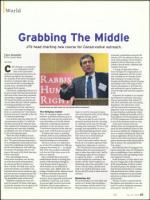
Arnold Eisen has high hopes for the Conservative movement.
The Religious Center
Eisen, 59, a longtime religious studies
professor at Stanford University prior to
coming to JTS, and only the second of its
seven chancellors not to hold rabbinic
ordination, is banking his reputation
and legacy on this new plan to reach
"Conservative Judaism and the vital reli-
gious center of North American Jewry"
He defines that center as including
Orthodox, Reform and unaffiliated Jews
who are serious about deepening their
Jewish knowledge and commitment.
The key to success is to make better
use of what JTS, established in 1886, has
long been best known for — its scholar-
ship. "First-rate, excellent scholarship"
is at the core of his vision, soon-to-be
policy, of outreach.
Eisen noted that the Conservative
establishment already is reaching Jews
outside of the movement through its
Camp Ramah, about 20 percent of
whose families are not affiliated as
Conservative, and a slightly lower per-
centage of families whose children attend
its Solomon Schechter day schools.
With an estimated 20 percent of
American Jewry apparently uninterested
in affiliation of any kind, and another
20 percent highly involved (and mostly
Orthodox), Eisen's target audience is
what he calls "the big middle which he
hopes to reach by stressing the impor-
tance of a balanced center, and by adding
thoughtful, relevant content.
"They are in play:' he says of the 60
percent of American Jews he is focusing
on, "and they can be won over through
meaning and community." JTS has a vital
message, and responsibility to serve a
post-denominational generation, which
Eisen describes as "younger Jews who
don't want to see a denominational
adjective before the word `Jew"'
Several Conservative rabbis, who pre-
ferred not to be named, expressed views
ranging from enthusiasm to cynicism.
One welcomed the vision statement for
"defining what the Conservative move-
ment is rather than what it isn't:' and for
"attempting to place JTS in a position
to capture the center — a real effort
to reach beyond our constituency." But
another said the vision's emphasis on
scholarship rather than spirituality is out
of sync with the times, and that essen-
tially it was window dressing to couch
the fact that JTS needs to make financial
cutbacks.
Balancing Act
The practical plan is to train rabbis and
cantors to be leaders who can balance
their knowledge with the needs of con-
temporary Jews, and to focus on more
systematic coordination among the five
schools of JTS: the rabbinical school, can-
torial school, graduate school, Davidson
Graduate School of Education and List
College of Jewish Studies, affiliated with
Columbia University.
A 30-page strategic plan outlines
broad strategies for reorganization and
extended engagement with the commu-
nity, including service through scholar-
ship; making use of campus synergy
through interdisciplinary shared learning;
partnerships with a wide range of other
schools and programs in New York City;
and reaching new types of students, pri-
marily through adult education programs
at JTS.
In general, the emphasis is on respond-
ing to financial constraints with innova-
tion and partnerships, both within JTS,
with other institutions and with funding
foundations. The subtext here is that
with the Conservative movement long
plagued by a lack of coordination among
its many branches, including the United
Synagogue, Rabbinical Assembly and JTS,
Eisen appears to be broadening the scope
of JTS by bringing more of the education-
al arm of the movement under its wing.
In the end, it remains to be seen
whether Eisen can reinvigorate his move-
ment. His most ambitious project to date
has been an initiative for congregations to
focus on mitzvot, blending text study with
practical application. He says it has had
much success, with several dozen congre-
gations sponsoring weekly discussions on
what it means to be commanded in the
21st century.
Eisen likes the idea of synagogues tak-
ing on a particular cause, be it feeding the
poor or establishing a chevra kadisha, or
Jewish burial society, and making it their
own "signature" mitzvah.
In the meantime, it is clear that he sees
the new strategic plan as the centerpiece
of his chancellorship. It reflects, as does
the mitzvah project, his attempt to com-
bine the head and the heart in reaching
both professional Jews (rabbis, cantors,
teachers) and laymen in a mix of study
and action to deepen one's Jewishness
and humanity.
"We dare not fail to respond with all
the boldness and experience at our com-
mand," he said in closing his commence-
ment speech. "Let's get to it" El
iN
May 27 • 2010
27