

1
Arts & Entertainment
Music & Lera
Composer-pianist-poet Lera Auerbach is a highlight
of this year's Great Lakes Chamber Music Festival.
Suzanne Chessler
Special to the Jewish News
C
omposer and pianist Lera
Auerbach has not appeared in
Michigan before this season,
but she has appeared as composer-in-
residence with numerous festivals and
orchestras.
The virtuosa takes on that role and
introduces her talents locally with the
17th annual Great Lakes Chamber Music
Festival being held June 5-20 at different
Metro Detroit and Ann Arbor locations.
Auerbach, also a poet in Russian and
English, links comfortably with this year's
festival theme — "The Poet Speaks:
Featuring the Music of Schumann and
Barbee'
"This is going to be very exciting for me,
especially because people who commis-
sioned my work — Alan Bloch and Nancy
Berman for the Philip and Muriel Berman
Foundation — will be at the festival," says
Auerbach, who has composed sympho-
nies, concertos and ballets.
"The festival will include my perfor-
mances as a pianist, performances of my
music without my performing and my
participation in talks. I hope these will be
powerful and communicative experiences
for audiences."
Auerbach, 37, will be part of the
world premiere of her transcription of
24 Preludes for viola and piano from
Shostakovich, which will be performed
7:30 p.m. Thursday, June 10, and 10:45
a.m. Friday, June 11, at Temple Beth El.
The secular festival, with 20 concerts this
season, was launched as a joint project of
Temple Beth El in Bloomfield Township and
St. Hugo of the Hills Catholic Church and
Kirk in the Hills, both in Bloomfield Hills.
The Detroit Chamber Winds & Strings,
the musical ensemble that administers the
event, also participated from the beginning.
"I'm very grateful that Kim Kashkashian
will be the violist for this work:' Auerbach
says. "She is someone whom I admired for
many years, but we only met in person last
summer at a festival in Switzerland."
Auerbach's music and poetry are on the
program at 8 p.m. Saturday, June 12, at
the Seligman Performing Arts Center in
Beverly Hills, and her music fills the hall
at 7:30 p.m. Monday, June 14, at Kirk in
the Hills.
"I sent a catalog of my pieces to the
directors of the festival, and together, we
went through the process of selecting
which would be the best for the Great
Lakes concerts," Auerbach says.
"My music tends to be varied in its
scope of emotions because it reflects how
life is full of very contrasting experiences.
Even within a cycle of preludes, each pre-
lude is a different world. I hope that each
one, as contrasting as it may be, can reach
the listener."
This year's roster of performers includes
James Tocco, the Detroit-raised pianist
who has been artistic director of the
festival since its inception, and Leonard
Slatkin, music director of the Detroit
Symphony Orchestra.
Also appearing will be violinist
Yehonatan Berick, baritone Daniel Gross,
pianist Joseph Kalichstein, soprano Rachel
Gottlieb Kalmowitz, cellist Paul Katz and
soprano Lauren Skuce.
Uriel Vanchestein, composer and
clarinetist, has been selected for the Stone
Composer Fellowship and will have his
String Quartet debuted.
Auerbach, whose music is characterized
by stylistic freedom and the joining of
tonal and atonal sounds, started playing
the piano when she was 2 and composing
when she was 4.
"My mother was my first teacher and
showed me how to read and notate music
so I could write down my own improvisa-
tions," Auerbach recalls. "It was a blessing
because notating music became very
natural to me, as natural as writing words.
"I came to the United States on my first
tour in 1991 and decided not to go back
to Russia. I went on to graduate from the
Juilliard School as both a pianist and com-
poser."
Auerbach, who also graduated from the
piano soloist program of the Hannover
Hochschule for Musik in Germany, learned
poetry with her mother's instruction. After
memorizing adult verses before she was
11, Auerbach later found herself doing the
writing.
"I used to write only in Russian but
started in English about a year ago, which
surprised me:' she says. "I'm now in the
process of putting together my first collec-
tion in English.
"The subjects are varied, but one of the
most important subjects is time — what
it's done to us and our memory and
terpret his own work."
whether we can perceive ourselves out-
When Auerbach visits Michigan, she
side of time. Music also happens to be an
hopes to be joined by her husband, Rafael
important subject throughout the poems."
DeStella, a double bass player. With any
Auerbach, whose poetry is written as
free time, she enjoys reading, hiking,
she becomes inspired and is required-
swimming and attending to her two dogs.
reading in schools
throughout Russia,
composes at the piano
and away from it.
Looking back on per-
formances reaching °-
from Tokyo's Opera City
to Copenhagen's Royal
Danish Theatre, she also
holds recognition as
Poet of the Year by the
International Pushkin
Society
"I like to be near
the piano when I'm at
the initial stages of a
composition': she says.
"Sometimes, I will be in
the same room with the
piano but not touching
the instrument. There's
something about the
instrument that I find
very comforting."
Auerbach's Judaism is
expressed through her
pieces, including her
recordings. Tfilah is a
prominent work.
"I have lots of music
with Hebrew-Jewish
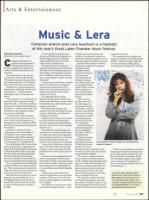
Lera Auerbach: "Concert audiences need something
connotations:' she says.
magical
to happen."
"I think that's because
it's part of who I am.
If you listen to the 24 Preludes I wrote
"I believe concert audiences need some-
for violin and piano, there are parts that
thing magical to happen, something that
resemble Hebrew melodies.
goes to their hearing, emotions and soul:'
"I'm currently writing an opera for
she says. "People in an audience should
Vienna with my own libretto based on
feel something changed in them. Maybe
the life of Nikolai Gogol. Although looked
some memories were brought back or
upon as the father of Russian literature
there is consciousness of places they were
and put on a pedestal, some of his writ-
not daring to go." ❑
ings are quite anti-Semitic, which was
rather normal at the time. He would
describe Jewish pogroms but not with a
The Great Lakes Chamber Music
sense of empathy for the Jews.
Festival runs June 5-20 at various
"The opera has a trial for the climax
Metro Detroit and Ann Arbor ven-
with Gogol being judged by a jury that
ues. $32-$45 single tickets. For a
has everyone wearing his mask. In a way,
complete schedule and ticket prices,
he's being judged by himself. The trial is
call (248) 559-2097 or visit www.
similar to his life because he tried to rein-
greatlakeschambermusic.org .
May 20 2010
57