

Community
AGING
Trend Lines
Panel spotlights needs to ably serve our growing senior population.
Con. Resta.,
AcIAA
"7!''!777"
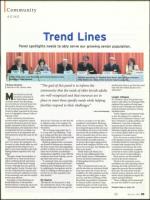
ewish Senior Life's Carol Rosenbe g and Frederick Blechman flank
ederation's Linda Blumberg
Ruthan Brodsky
Special to the Jewish news
M
etro Detroit has the old-
est Jewish community in
the United States outside
of Florida, stated Carol Rosenberg,
executive director of Jewish Senior Life
Metropolitan Detroit and moderator
for the local panel discussion "The New
Trends In Aging" sponsored by the sister-
hood of Congregation Shaarey Zedek of
Oakland County.
Jewish community administrators,
decision makers and geriatric experts
presented information about the demo-
graphic movement in Metro Detroit's
Jewish population, the implications those
developments have for providing com-
munal services to the population and
their perspective about the needs for the
future.
"The goal of this panel;' Rosenberg
said, "is to inform the community that
the needs of older Jewish adults are well
recognized and that resources are in
place to meet those specific needs while
helping families respond to their chal-
lenges."
The major change that took place in
June 2009 was to create Jewish Senior
Life by combining Jewish Apartments
& Services and Jewish Home & Aging
Services. Although these two agencies
worked together closely, it became obvi-
ous that combining their expertise and
services would open additional services
to the community and make the unified
service more efficient.
According to Linda Blumberg, the
Jewish Federation of Metropolitan
Detroit's director of planning, 24 percent
of the local Jewish population is older
Or. TRcodoreFRcc:s
Geriatric psychiatrist Dr. Theodore Ruza, Brown Adult
► a Care Program's
Peter Ostrow and Jewish Family Service's Yuliya Gayda enko
"The goal of this panel is to inform the
community that the needs of older Jewish adults
are well recognized and that resources are in
place to meet those specific needs while helping
families respond to their challenges."
— JSL's Carol Rosenberg
than 65 and 14 percent are older than 80.
In addition, many of the caregivers for
the oldest population are older than 65
themselves.
"We are losing young people, the 21
to 35 year olds," says Blumberg. "They
go to college and they don't come back.
That doesn't bode well for support for the
older population in the future!'
Blumberg explained that a committee
was formed at Federation to determine
the future needs of the older population
and how to deliver services to them. The
intent was to facilitate an individual's
independence regardless of age. With few
exceptions, that means helping a person
age where they want to age.
"A communal vision was reached that
a more centralized system would work:'
Blumberg said. "Realigning the services
by combining the two agencies was the
result. It is helping to eliminate gaps in
services for our older population and
their families."
On Course
"My objective for this panel is to help
the community be aware of the changes
that have taken place with our agencies
YOfts
swro coo raw
A A /
Porto. Ostrow
'17a.
so that we can better serve the elder
population:' said Frederick Blechman,
Jewish Senior Life's first president. "We
have integrated agencies that were once
the foundation of services to the Jewish
community. We are building systems so
that we streamline these services into a
centralized, seamless delivery network,
which provides accessible and qual-
ity services that support aging and the
needs of adult caregivers who live in the
area or are out of town. One Number, One
Door is our motto."
Jewish Senior Life Detroit con-
tinues to work collaboratively with
Jewish Family Service of Metropolitan
Detroit, the Jewish Community Center
of Metropolitan Detroit and JVS in
Southfield.
"My co-chairperson and I came up
with the idea that our sisterhood should
know more about the services that are
available to the older population and the
changes that are taking place in those
services:' said Nancy Goldberg of West
Bloomfield, vice president of education
for Shaarey Zedek's sisterhood. "Raga
Goldenberg and I are both social work-
ers and we felt it's important that people
should know where to go when they need
help with their elderly parents or for
themselves!'
Longer Lifespan
Dr. Theodore J. Ruza, D.0, geriatric psy-
chiatrist with offices in Farmington Hills,
explained that people are living longer
today because technology has improved
medical treatment and disease is being
identified earlier.
"Earlier diagnosis and treatment helps
to slow the progress of a condition or
disease such as Alzheimer's disease," said
Ruza. "Dementia is a global problem and
Alzheimer's is one form of dementia.
A person doesn't die from Alzheimer's
itself, but from other diseases because
Alzheimer's attacks the immune system.
It is a chronic illness with no cure and as
it progresses it becomes worse."
Ruza, who serves as medical director
of the Inpatient Geriatric Psychiatric unit
at Botsford Hospital in Farmington Hills,
is hopeful that someday there will be a
vaccination for the disease. But in the
meantime, he recommends a complete
assessment to detect subtle changes for
those who may be having challenges.
Ruza's services are also available at
several of the Jewish residences.
"Based on the assessment, recom-
mendations are made regarding medical
planning, the living environment and
supportive resources that are available
Ruza said. "We work closely with the
patient's primary physician and the com-
munity service programs to support the
patient and their families."
"Nancy Goldberg and I brainstormed
for some time before we came up with
Trends Lines on page 36
May 20 2010
35