

I
World
Good Neighbors
Palestinian village and Israeli town build rare partnership across line.
Sue Fishkoff
Jewish Telegraphic Agency
Wadi Fukin, West Bank
M ohammed Mansara, a 70-year-
old farmer who goes by the
name Abu Mazen, indicates
with a sweep of his arm the fruit trees and
vegetables he grows on his small plot of
land in this Palestinian village in the West
Bank, population 1,200.
Then he points to a small green hill on
the western side of the village topped by
a tidy cluster of red-roofed homes. That is
Tzur Hadassah, an Israeli community of
about 5,000 Jewish residents.
"Tzur Hadassah has such nice people,' he
says in Hebrew."They are great neighbors:'
Mansara could walk from his home to
Tzur Hadassah in about half an hour, but
it's illegal. Wadi Fukin sits smack on the
Green Line, the demarcation between pre-
1967 Israel and the West Bank. A portion of
the West Bank security fence is slated to go
through the valley, cutting off Wadi Fukin
from Tzur Hadassah and from much of
what remains of its agricultural land.
Similar stories repeat all along the
Green Line, as Israelis and Palestinians
jostle over the route of the fence.
What makes Wadi Fukin's case differ-
ent is that it has strong allies across the
Green Line: Tzur Hadassah residents who
buy fresh produce from village farmers,
and Friends of the Earth Middle East
(FOEME), an Israeli-Palestinian-Jordanian
environmental organization that is chal-
lenging the route of the security fence here
in Israel's Supreme Court.
Three hundred Tzur Hadassah residents
have signed a petition against the fence
being built in their valley.
Wadi Fukin and Tzur Hadassah have
had a relationship since 2001, when they
became two of the first members of
FOEME's Good Water Neighbor project.
The project, which now works with two
dozen towns and villages, brings together
Palestinian and Israeli communities to
protect their shared water resources, fos-
tering peace and long-term cooperation
based on shared environmental interests.
Tzur Hadassah resident Tamar
Gridinger says FOEME's project prompted
her to visit Wadi Fukin for the first time
several years ago. They learned that
FOEME had brought in permaculture
28
May 20 • 2010
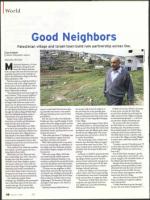
Mohammed Ma a
Wadi Fukin has close
ties with residents of a
neighboring Israeli town.
experts to help Wadi Fukin farmers give
up pesticides and return to the sustain-
able agricultural practices used by their
grandfathers.
Now she and 25 other Tzur Hadassah
families pre-buy a month's supply of fresh
produce from the village and pick up their
allotment every week. (Israelis may cross
the Green Line into the West Bank, but
Palestinians need a special permit to cross
the line into Israel.)
"Both sides gain from it:' Gridinger says.
"We get inexpensive, organic fruit and
vegetables, and they earn money"
Wadi Fukin farmers invite co-op mem-
bers to an annual hafla, or celebration, in
the village, and Tzur Hadassah residents
have helped villagers navigate the Israeli
bureaucracy.
When one young villager with leuke-
mia needed weekly medical treatment
at Jerusalem's Hadassah Hospital, co-op
members would pick him up and drive him
across the checkpoint reserved for Israelis,
saving him hours of waiting at the border.
"I'd never met my neighbors in Wadi
Fukin before, and now they have become
my friends:' says Gridinger, showing off a
scarf Mansara brought back for her from
Mecca, where he recently went on a haj
(pilgrimage)."Not because of the 'great
principles' of the project. Abu Mazen is
just a friend:'
Relations between Wadi Fukin are
not as good with its Israeli neighbor to
the east: Betar Ilit, a fast-growing ultra-
Orthodox settlement of some 35,000 resi-
dents on Mansara's side of the Green Line,
built in part on land originally belonging
to the village.
Since construction began at Betar lit in
1985, Wadi Fukin's 11 natural springs have
dried up, and when Betar Ilit's sewers back
up, Mansara says, the effluent pours down
the hill into the village fields. The Israeli
government has sent notices to Betar Ilit
to resolve the problems.
"The main spring is just a trickle now:'
Mansara says, showing visitors an empty
reservoir where water used to flow."The
water would go into a channel and then to
the fields. Now the channel is filled with
garbage."
On March 17, UNESCO declared that the
territory of Wadi Fukin and the neighbor-
ing village of Battir represent "the best
preserved and continuously managed cul-
tural landscape of its type in all the West
Bank': and merit protection as a World
Heritage Cultural Landscape.
To farm, the villagers use terraced agri-
culture, where water from natural springs
is channeled into more than 70 manmade
pools and used later to irrigate the fields.
"The farmers of Wadi Fukin have been
using the same agricultural system for
over 2,000 years:' says Gidon Bromberg,
FOEME's Israeli director.
FOEME will use the UNESCO document
to back up its case that the West Bank
security fence should not go through the
valley. Lawyers for the village are arguing
on environmental grounds — a first in a
security fence dispute, Bromberg says.
The section of the fence proposed
for Wadi Fukin is a secondary barrier,
Bromberg says. The primary security
fence already stands east of Wadi Fukin,
circling the Gush Etzion settlement bloc.
The Wadi Fukin section is slated to stop
just south of the village, meaning villagers,
or anyone else, could walk around it and
enter Israel.
"It makes a mockery:' Bromberg says. "If
you have this open area a kilometer south
of Wadi Fukin, why do you need a fence
here at all?"
Even if Wadi Fukin manages to get the
court to change that, it may only be a tem-
porary stopgap in the inevitable demise of
the village's agricultural lifestyle.
Mansara farms because his father, his
grandfather and his grandfather's father
all farmed this land. But none of his five
sons have gone into the field. They are
doctors, lawyers and engineers, and have
moved away from the village.
About a dozen farmers remain in Wadi
Fukin, and Mansara is glad his children
aren't among them.
"I didn't want them to go into farming':
he says. "You can't make a living from it:'