

01111 141 I) 11111
III.
III
V
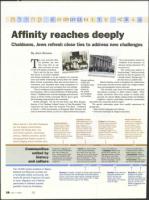
Affinity reaches deeply
Chaldeans, Jews refresh close ties to address new challenges
By Alan Stamm
he most powerful bibli-
"We could substitute 'Jewish' for
cal symbols, the ones
`Chaldean' in the narration," an
that come alive in any
attorney told her afterward. "It's
place and time, fit mod-
our story, too."
ern life with ageless immediacy.
The overlap also surfaces in
CHALDEAN CULTURAL CENTER
That's why the fig tree, which
family settings. "I told my recently
still thrives in ancestral Chaldean
married son that I'm going to be
JEWISH FEDERATION OF METROPOLITAN DETROIT
and Jewish homelands, is an apt metaphor for entwined
a Jewish mother," Romaya says. "I
roots and fruitful relationships among these two sizable
use
that term in a positive way."
Strong traditions
Metro Detroit communities. Each has survived harsh en-
Historic
kinship
creates
a
foundation for collaboration
of faith are
vironments, each flourished after being transplanted to
in
the
areas
of
social
services,
health care, refugee resettle-
among the many
American soil and each now nourishes their new settings.
ment and immigration reform advocacy.
similarities
shared by
"There's a resiliency in the immigration experience," says
This interfaith unity shows how immigrants and their
the
Jewish
Scott Kaufman, CEO at Jewish Federation of Metropolitan
descendants contribute to Metro Detroit vitality. While
and Chaldean
Detroit. "Chaldeans have overcome language and economic
similar enrichment flows from people of various back-
communities.
issues, as did the Jewish community. They've done a good
grounds, the natural affinity uniting Jewish and Chaldean
job of keeping young people in the community."
neighbors nurtures particularly productive partnerships
Similar heritages "are the ties that bind," says Mary Romaya,
that uplift each community and the region.
director of the Chaldean Cultural Center in West Bloomfield. That
The special relationship arises from parallel experiences by
connection was clear when she screened "Our Story — Chaldeans
groups that:
in Detroit," a 2004 documentary, at Honigman Miller Schwartz and
• Share Semitic languages and cultures.
Cohn in downtown Detroit, as part of a cultural awareness program.
• Overcame challenges as religious minorities.
Ancient Chaldea:
Tribes settle in fertile,
marshy basins of the
Euphrates and Tigris
rivers — an area now
comprising roost of Iraq
and part of Syria, It is
originally called mat Kaldi
— "land of Chaldea,"
Metro Detroit's 121,000 Chaldeans
are the largest concentration
outside the Middle East. The
community's growth, spanning a
century, reflects economic, social
and geopolitical factors similar to
those bringing Jewish families here.
17TH-5TH CENTURIES B.C.
mum ies
united by
history
and culture
Geography, language an
history connect Chaldeans
and Jews in Metro De-
troit. Across 3,000 years,
respect and affinity have
strengthened links between
these ancient and modern
neighbors.
Legendary names:
Nebuchadnezzar II, the
best-known Chaldean
king, rules for 72
years, infiltration and
internal conflicts mark
the history of an area
called Babylonia and
later Mesopotamia,
known as the cradle of
civilization."
6TH-5TH CENTURIES 8.C,
28
April 1 • 2010
Papal welcome: After
a split over theological
philosophies, Chaldeans
join the Eastern Rite
of the Roman Catholic
Church. They're under
papal authority from the
Vatican in Rome, but retain
their historic rituals and
language for mass and
other ceremonies.
1ST CENTURY A.D.
• Roots: As descendants
of the prophet Abraham,
who came from the Chal-
dean city of Ur, both groups
consider themselves "Chil-
dren of Abraham." Early
Sumerian/Chaldean kings
also are listed as leaders
1762-1783
The 72,000 Jewish residents in Wayne,
Oakland and Macomb counties are
a remarkably stable community, with
nearly 90 percent living here 20 years
or more. Migration out of Detroit,
particularly to Oakland suburbs,
parallels moves by Chaldeans.
Reiigion: The Chaldean
Catholic Church descends
from the historic Church
of the East, which united
Chaldea and Assyria.
According to legend, the
Apostle Thomas converted
Chaldeans around
45 A.D. on one of his
missionary journeys.
1840s
Pioneers: A handful of Jewish fur traders and merchants
come from New York and Montreal in the 18th century.
Detroit's first known Jewish settler, Chapman Abraham,
does business from 1762 until at least 1783. A larger
influx from Germany began in the 1840s.
in the Old Testament.
• Language: Hebrew was
derived from Aramaic, the
language spoken by Jesus
still used by many Chal-
deans. Both are known as
Semitic languages, a word
that also describes the
1850
Worship: Twelve German
American families form
Beth El Society, the
state's first Jewish
congregation, in a Detroit
home in 1850.
1445
cultures and ethnicities
of varied people united by
Middle Eastern origins.
• Monotheism: Judaism
and Christianity are based
on belief in one God.
• Persecution: Each group
has been a repeated target
1861
1877
1
Diversity: In 1861, 17
followers who prefer
traditional Judaism
withdraw from Beth El to
start the Shaarey Zedek
Society. Its first of six
Detroit synagogues was
built in 1877.