
Arts & Entertainment
A Frank Look At
The Motor City
Eric Herschthal
New York Jewish Week
I
n 1955 and 1956 Robert Frank traveled
the U.S. taking photographs for his
groundbreaking book The Americans,
published in 1958. With funding from a
prestigious Guggenheim grant, he set out to
create a large visual record of America.
The money and freedom it bought sent
him on a two-year, 10,000-mile journey
through 30 states across the country, in a
used blue Ford. With his 35-mm Leica, Frank
caught Americans in places as far-flung as
Miami Beach, Fla.; Butte, Mont.; Savannah,
Ga.; and Chicago. He took more than 27,000
photographs of blue collar Americans, and
Detroit was one of his early stops.
Inspired by autoworkers, the cars they
made, along with local lunch counters,
drive-in movies and public parks such
as Belle Isle, Frank transformed everyday
experiences of Detroiters and others into
an extraordinary visual statement about
American life.
A new exhibit at the Detroit Institute of
Arts "Detroit Experiences: Robert Frank
Photographs, 1955" showcases more than 50
rare and many never-before-seen black-and-
white photographs taken in Detroit by Frank.
It will be on view through July 4. The DIA
exhibition includes nine Detroit images that
were published in The Americans, as well as,
for the first time, an in-depth body of work
representative of Frank's Detroit, its working-
class culture and automotive industry.
Frank — born into a Jewish family in
Zurich, Switzerland, in 1924 — was drawn
to Detroit partly by a personal fascination
with the automobile, but also saw its pres-
ence and effect on American culture as
essential to his series. He was one of the few
photographers allowed to take photographs
at the famous Ford Motor Company River
Rouge factory, spending two days tak-
ing pictures at the factory, photographing
workers on the assembly lines and man-
ning machines by day, and following them
as they ventured into the city at night.
Whether in the
disorienting
surroundings
of a massive
factory or during
the solitary and
alienating moments
of individuals in parks
and on city streets, Frank
looked beneath the surface
of life in the U.S. and found
a culture that challenged
his perceptions and popular
notions of the American Dream.
Frank, the child of a successful
businessman in Zurich, nonetheless
lived much of his early life under the
threat of Nazi persecution.
"He and his family lived very much
in fear that they would get deported to
Germany,' said Sarah Greenough, senior
curator of photographs at the National
Gallery of Art, in Washington, D.C., which
established a photographic archive of
Frank's work in 1990. "He was enjoying the
fruits of that very safe, secure existence and
yet at the same time always felt somewhat
different:'
While it's inaccurate to say Frank's
Jewishness is at the root of the creation of
The Americans, it does play its part. The
existentialists — Jean-Paul Sartre and
Albert Camus, for instance — made a last-
ing impression on Frank with their insis-
tence that life had no inherent meaning,
except for what we give it. But one wonders
whether he would have been so receptive
to these ideas had he not lived in wartime
Europe as a Jew, and had that identity not
been reinforced as he took his camera
across America, during the height of the
Red Scare.
Frank's father, Hermann, was born in
Germany, which made the Frank family
officially stateless for much of the war.
And though Hermann applied for Swiss
citizenship for his entire family in 1941,
it was not granted until 1945. The Franks
would lose many relatives in the Holocaust,
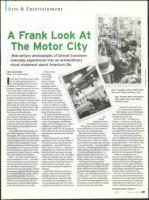
© Ro bert Fran k, from The Amer icans
Mid-century photographs of Detroit transform
everyday experiences into an extraordinary
visual statement about American life.
Above: Drugstore, Detroit, 1955, gelatin
silver print. Detroit Institute of Arts
Left: Assembly Plant, Ford, Detroit,
1955, gelatin silver print. Detroit
Institute of Arts.
and
though
nominally secure in
Switzerland, the rise of pro-
Nazi groups in Zurich led Hermann
to move the family to a town outside of
Geneva for fear of being attacked.
Years later, Robert Frank would say
he decided to leave Switzerland in 1947
because of the lack of opportunity there:
"The country was too dosed, too small for
me he said. Yet Greenough makes clear that
it was more than that — his Jewish identity
mattered, too. Underlying Frank's mature
artistic approach, once he came to America,
is "the recurrent suspicion of power (a
mindset that was widely held by Jews in
Europe) coupled with a steady gaze on the
harsher realities he saw in the States"
Frank gained his footing quickly in
America, finding work at high-paying maga-
zines like Harper's Bazaar, Vogue and Look.
But by 1949 he found himself disgusted by
professional photography's materialism —
"no spirit ... the only thing that mattered was
to make money" — and set out on a four-
year world tour. From it he would publish
three books from the photographs he took
of coal miners in Wales, bankers in London,
benches in Paris and people of Peru.
Soon after he came back to the
U.S., Frank won the Guggenheim.
His Jewishness was not something he
hid, and it probably added to his sense of
alienation once on the road.
On Nov. 9, 1955 — McCarthy-era
America — Frank was arrested, taken
to a local prison and questioned for four
hours. The overriding cause was Frank's
Swiss background. It was, after all, just two
years after Ethel and Julius Rosenberg were
executed for being Communist spies.
But it is clear that Frank's interest lay
not in the plight of Jews in America, but of
blacks. Some of his most arresting images
are ones like Trolley — New Orleans, 1955,
which show a segregated carriage. It is
easy to assume that Frank's intuitive sense
of justice stems in part from the anti-
Semitism he had experienced firsthand.
Further accentuating his view of
America, Frank developed an unconven-
tional photographic style innovative and
controversial in its time. Photographing
quickly, he sometimes tilted and blurred
compositions, presenting people and their
surroundings in fleeting and fragmentary
moments with an unsentimental eye.
His very sense of intuition, his belief in
circumventing the rational mind in favor
of instinct, has a Jewish corollary. The Beat
Generation, most notably Allen Ginsberg,
deeply influenced Frank once he came to
America. Ginsberg's pronouncements on
A Frank Look on page 51
March 11 = 2010
49
Scanned image of the page. Keyboard directions: use + to zoom in, - to zoom out, arrow keys to pan inside the viewer.
March 11, 2010 - Image 115
- Resource type:
- Text
- Publication:
- The Detroit Jewish News, 2010-03-11
Disclaimer: Computer generated plain text may have errors. Read more about this.