

[
Arts & Entertainment
An Oscar Winner For Israel?
Cycle of Israeli Arab-Jewish violence sparks sizzling
Ajami, nominated for an Academy Award in the best
foreign language film category.
Michael Fox
Special to the Jewish News
E
ven by the high standards set by
Israeli films in the last few years,
Ajami is a knockout. A crackling
urban drama shot with unblinking real-
ism and steeped in astringent Middle East
irony, Ajami sinks its hooks in the first
minute and never lets up.
Written, directed and edited by Scandar
Copti (a Palestinian citizen of Israel) and
Yaron Shani (a Tel Aviv Jew), Ajami takes
its name — and its intersecting plotlines
— from the Jaffa neighborhood where
Jews and Arabs live in uneasy proximity.
Melting pot? Try boiling pot.
The story unfolds from a succession
of characters' perspectives, augmented at
times with flashbacks, that grant us entree
to a number of worlds. The kinetic effect
of this 21st-century neo-realism, achieved
via nonprofessional actors and handheld
cameras, is to experience this seething city
at the speed of life.
Ajami has been nominated for the
Academy Award for best foreign language
film and is currently playing in Jewish
film festivals across the country (though
it will not be screened this year at the JCC
Lenore Marwil Jewish Film Festival) and
in select theaters (no date is yet set for
Detroit). Its competitors for the Oscar are
Germany's The White Ribbon, the likely
front-runner after taking the same prize at
the Golden Globes and top honors at last
May's Cannes Film Festival. Also nomi-
nated are the Cannes runner-up, France's
A Prophet; Argentina's The Secret in Their
Eyes; and Peru's The Milk of Sorrow.
Ajami begins with a bang, with a child
gunned down on the street by a duo on a
motorcycle. This gutless revenge killing
turns out to be a case of mistaken identity;
the intended target was an innocent Arab
teenager who's been inadvertently thrown
into the middle of an Arab-Arab dispute.
So Omar (Shahir Kabaha) appeals to a
well-off, well-connected, Christian Arab
restaurant owner, Abu Elias (Youssef
Sahwani), who arranges a cease-fire with
the aggrieved Bedouin gang and a meet-
ing to arrange a settlement. The price is
more than Omar can pay, leaving him sus-
ceptible to illegal and dangerous schemes
to raise the cash.
One of the workers in Abu Elias' kitchen
is a Palestinian, Malek (Ibrahim Frege),
who's even younger and more naive than
Omar. He also has money worries, for his
mother urgently needs major surgery.
The first hour of Ajami is devoted to
the fraught circumstances of these Arab
youths, but their motivations and machi-
nations are designed
not merely to keep
the drama percolat-
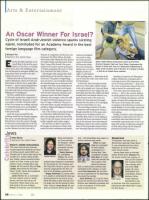
Ajami, made without professional actors by first-time
ing but to illuminate
directors Scandar Copti and Yaron Shani, interweaves the
the hierarchy within
stories of Arabs and Jews in a depressed neighborhood in
the Arab community.
Malek, who is in Israel Jaffa, at the southern end of Tel Aviv. It is largely in Arabic
— a first for an Israeli Oscar nominee.
illegally and has no
rights, is at the bottom
of the pecking order — illustrative of the
Speaking of suspicion, the filmmakers
way in which the wider Arab world views
employ misdirection with great skill to
the Palestinians.
encourage incorrect first impressions and
In due time, Ajami introduces Jewish
arrive at wrong conclusions — that is, for
characters whose paths collide with the
the viewer to experience what it's like to be
Arabs we've already met. Copti and Shani
Arab or Jewish in a mistrustful world.
accomplish this far more organically and
To be clear, Ajami isn't interested in
believably than films like Traffic and Babel violence — that is, the romantic fatalism
handled their interrelated character arcs,
or macho glamour that most movies offer
partly because none of the actors are
— but its crushing consequences, and the
familiar (let alone famous) but largely
ripples of mania and revenge that ensue.
because the story feels as if it's springing
The source of the tension, the Israeli
from the streets before our eyes.
occupation of the Palestinian territories, is
The overriding sensation of the film
rarely alluded to for the simple reason that
is imminent and omnipresent violence,
Israeli and Palestinian moviegoers know
though assuredly not in the quasi-enter-
the backdrop.
taining, nerve-wracking manner of a
Frankly, it would be easier (though less
Tarantino flick, where a scene might gra-
compelling) to watch Ajami if it were set
tuitously skip from conversation to fusil-
somewhere other than Israel. For this
lade at any moment. Every shooting and
remarkably constructed story is also a cat-
stabbing in Ajami is the surface manifes-
alog of the residue of bitterness and grief
tation of the.perpetually stressed charac-
on both sides, along with the thwarted
ters' churning suspicion and frustration.
potential and wasted resources. ❑
Jews
Nate Bloom
Special to the Jewish News
Oscar's Jewish Connections
In This year's best picture nominees
j include Inglourious Basterds (a histori-
Ci
ma
■■ cal fantasy about Jewish WWII com-
a) mandos) and A Serious Man (about the
troubles of a Jewish college profes-
sor). Avatar, James Cameron's block-
buster sci-fi film, is also up for best
picture. It was co-produced by Jon
Landau, 49. His parents, Ely and Edie
Landau, were known for the many
classy "small" movies they produced
– including The Chosen.
James Horner, 56, is nominated
for best original score for Avatar.
Horner, who won two Oscars for
Cameron's Titanic (best score and
best song) is the son of Harry
Horner, an Austrian Jew who fled the
38
March 4 • 2010
JN
Nazis and became
an Oscar-winning
set designer. James'
mother is from a
prominent Toronto
Jewish family.
Randy Newman,
66, and Maury
James Horner
Yeston, 64,•vie for
the Oscar for best
original song. Newman is nominated
for two songs for The Princess and
the Frog while Yeston is up for a new
song he composed for the film ver-
sion of his Broadway musical Nine.
Maggie Gyllenhaal, 32, whose moth-
er is Jewish, is nominated for best sup-
porting actress for her role as a jour-
nalist who helps a down-and-out coun-
try singer turn his life around in Crazy
Heart. Actress Lauren Bacall, 85, was
given an honorary lifetime Oscar this
year – the presentation was made in a
special ceremony last month.
Ethan and Joel
Coen are nominated
for best original
screenplay for A
Serious Man. Their
competition includes
Mark Boal, 37, a jour-
nalist who penned The
Mark Boal
Hurt Locker, a film
about the Iraq war
that is a best picture nominee. Also
nominated in this category is Israel-
raised Oren Moverman, 44, the direc-
tor and screenwriter of The Messenger,
also about the Iraq War.
Jason Reitman, 32, is up for three
Oscars for his film Up in the Air (best
director, best adapted screenplay and
as the co-producer of a film nomi-
nated as best picture).
Wonderland
Tim Burton's new film, Alice in
Wonderland, opening Friday, March
5, uses animated and live action
sequences to re-tell the famous
Lewis Carroll novels.
Johnny Depp stars as the Mad
Hatter. British actor Stephen Fry,
52, whose mother was Jewish, co-
stars as the Cheshire
Cat. Another British
Jew, comedy actor
and writer Matt
Lucas, 35, plays
Tweedledum and
Tweedledee. Helena
Bonham Carter,
whose
maternal
Matt Lucas
grandmother was
an Austrian Jew who converted to
Catholicism after World War II, plays
the Red Queen. Li