

World
More Pressure
JCPA activists face mounting challenges.
Don Cohen
Special to the Jewish News
Dallas
I
srael. Anti-Semitism. Social Justice. Human Rights.
The issues remain the same, but the times are
changing.
This was abundantly clear at the annual plenum of the
Jewish Council on Public Affairs (JCPA), the umbrella orga-
nization of 13 national and 125 community-based groups
that work to identify, analyze and engage on the issues of
day.
Gathering in Dallas last week, 250 participants from
across the nation, including 13 from the Jewish Community
Relations Council of Metropolitan Detroit (JCRC), looked to
meet growing challenges with declining resources.
At a time of budget and staff cuts across the country,
the blunt-talking national director of the Anti-Defamation
League (ADL) Abraham Foxman said the Jewish world is
facing a crisis.
"Last year was the worst year of global anti-Semitism
since the Second World War',' Foxman said, while "the
Jewish state has been vilified and defamed in ways no one
could have imagined."
Adding Iran to the mix, he said, "Never in our lifetime, or
for most of us, has it been so serious:'
Hannah Rosenthal, a former JCPA director who is now
the Obama administration's envoy on anti-Semitism,
agreed and outlined her work at the U.S. State Department,
noting that her transition from an advocate to bureaucrat
meant she had to learn to appreciate "babysteps."
Appreciative but certainly not content, the delegates
worked to understand and counter an ambitious and grow-
ing BDS (boycotts, divestment and sanctions) campaign
seeking to delegitimize and isolate Israel and its supporters
throughout the United States and Europe. Other Israel ses-
sions focused on building interfaith alliances, understand-
ing and strengthening U.S. support, engaging the next
generation of Jews, and providing accurate information in
schools.
Israel Ambassador to the United States Michael Oren
spoke of the Iranian threat, the BDS campaign and the
challenge of making peace.
"Israel is again at a crucial crossroads',' said Oren.
"Support us once again if we have to make sacrifices and
take risks, and support us, too, if we decide there is not a
genuine offer for peace and it is not worth taking [addi-
tional] sacrifices and risks."
He reminded the delegates that Israel's decisions are
being "made by a majority of Israelis in one of the world's
vibrant demo cracies:'
Oren called for banners to be hung that say, "Stop the
Iranian Bomb" and "Support the Sanctions:' and for the
Jewish community to "take to the streets, use your pulpits
and activate your allies."
20
March 4 - 2010
JEWISH COUNCIL
FOR PUBLIC AFFAIRS
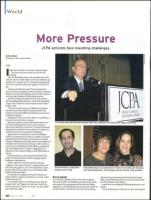
Dr. Conrad Giles urged that the disputes within the community be handled with respect and civility.
Steven Hartman, a Federation
delegate to the JCRC
Hannah Rosenthal, U.S. special envoy to monitor and combat anti-Semitism,
with Wendy Wagenheim, JCPA delegate and past Detroit JCRC president
Broad Agenda
The conference included sessions about human rights in
Africa, Jewish ethics and healthcare, poverty, energy and the
environment, literacy programs and social action. Wendy
Wagenheim, a past JCRC president who represents Detroit on
the JCPA board, co-chaired the resolutions session dealing
with breast cancer awareness and treatment, food sustain-
ability and distribution, paid leave, usury, and sexual orienta-
tion discrimination in the military.
A major focus was dealing with differing opinions in a civil
manner.
"We are gathering as a community to take a stand against