

feature
by Mayer Schneider
M u S h ! Jewish Scouts experience dog sledding Up North.
A
lot of people go south for
winter vacation; Troop
364 went north.
We traveled to the frozen reaches
of Michigan's Upper Peninsula Dec.
27-29, stopping for photos at the Soo
Locks and to see icy Tahquamenon
Falls before arriving at Nature's Ken-
nel Iditarod Sled Dog Adventures in
McMillan.
We were introduced to our guides,
Sam Christman, 26, and Doug Sher-
ry, 19. Sam is a fellow Eagle Scout
and Iditarod hopeful.
They showed the seven of us to our
"accommodations," which is perhaps
too kind a word. It was modeled on
one of the nicer Iditarod checkpoints:
a large canvas tent with 12 bunks and
a wood furnace. The furnace could
keep the tent a toasty 45 degrees if
we kept it going.
That morning, we met the dogs.
I had preconceived notions about
the sled dogs. I feared meeting them
would be like meeting great athletes.
But in the end, they were just dogs;
they loved being petted and played
with. Make no mistake, however;
they were bred to do
one thing — run — and
they loved to do it.
We learned how to
put the harnesses on the
dogs and hook them up
to the sleds. We each got
one two-mile practice
run and then we were
off on our trips.
It is quite a thing to
be on a sled. It glides si-
lently, but you're also moving rather
quickly. Unlike a car or a bicycle, the
Huskies know the way better than
you, and so only basic instruction is
necessary.
And those dogs love to run, even
if you don't want them to. They are
champion athletes; and the way they
nip their snouts into the snow for a
quick drink reminded me of a cham-
pion cyclist going for his water bottle.
That night, after the Huskies had
been taken care of for the night, we
made a fire. As our chicken cooked
in aluminum foil, the guides had us
sample some Iditarod trail food. We
told stories and we learned some
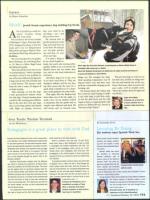
Above right: Boy Scout Tyler Pleasant, a seventh-grader at Warner Middle School In
Farmington Hills, warms up to a Huskle.
Above left: Assistant Scoutmaster Ian Zinderman, 18, enjoys macaroni and cheese in
a canvas tent heated by a wood furnace.
things, too. For example, the dogs'
ideal operating temperature was 10
degrees below zero and they were
perfectly comfortable sleeping in the
howling cold.
We learned about the Yukon and
how unsavory types hoping to strike
it rich stole dogs to pull their sleds.
As the fire died down and the wild
began to howl, we appropriately read
poems by Robert Service, known as
"the bard of the Yukon."
The next morning, we went on our
last sled runs, loaded our things into
the cars and thawed out on the way
home. Next year, when everyone else
goes south, we'll be headed north,
where the huskies howl all night and
run all day.
Eagle Scout Mayer
Schneider, 18, of Oak Park,
Is home schooled. He Is a
member of Boy Scout Troop
364.
dvar Torah/ Parshat Terumah
By Samantha Zwick
by Avi Mendelson
Synagogue is a great place to visit with God.
Parshat Terumah dictates the laws of the construction
which would serve the same purpose.
Learning By Doing
FJA students enjoy Spanish Week fun.
While Frankel Jewish Academy
of the Mishkan, the portable dwelling place (tabernacle)
There's a problem. From the year 70 until 2010,
students are always celebrat-
for the Divine presence. One day there would be a dwell-
there hasn't been a Beit HaMikdash to help us build
ing their own culture, in early
ing for God permanently situated in Jerusalem: the Beit
a meaningful and healthy relationship with God. Our
February, they celebrated Span-
HaMikdash (Holy Temple). One question looms as large
solution is the
as the Mishkan itself: What is its purpose? Did God
Temple where Jews congregate, learn and pray. Shul
Spanish Week was about
need a house so he could stay close to his chosen na-
(synagogue) is the central aspect of every community
fun activities to showcase
tion as they traveled through the desert? Why is the
because it serves as a vehicle to renew our relationship
Spanish traditions and, of
Mishkan needed?
with Hashem.
course, some of the delicious
synagogue, which serves as a mini-
ish culture.
Ramban (Nahmanides) explains that the Mishkan
To paraphrase Rabbi Jonathan Sacks, the chief rabbi
Spanish foods. The week be-
was there to recreate the experience of Mount Sinai,
of England, shul is where we talk to God through the
siddur (prayer book) and listen with the Chumash (To-
gan with a pinata filled with dif-
where the revelation of the Torah took place. This event
was the highest level of connection between Bnei Yis-
rah and commentaries). It's a beautiful thing that every
Tuesday with a nacho lunch, fol-
rael, the Jewish people, and Hashem, their creator. The
weekend, we can rest and spend Shabbat in shul, re-
lowed by Wednesday with a limbo contest and concluded on Thurs-
Mishkan's purpose was to keep that connection strong.
flecting on the past week and the one that is about to
day with a salsa-eating contest.
The Mishkan served as a reminder to the Israelites that
start. Everyone should make it a priority to go to shul,
ferent candies and continued
One good whack and the pinata
spills its candy.
Though Spanish Week demonstrated for many different students
God was with them so long as they were keeping the
to pay God a visit. 11
the various aspects of Spanish culture, it also
mitzvot (commandments). The Tabernacle was built for
Freshman Avi Mendelson, 15, of
showed the importance of learning other customs,
the Jewish People, not God, so their relationship with
Southfield is an editor of Torat
not only through books, but also through immer-
God remained strong.
Akiva, a biweekly Torah-based
sion in that culture. ;
student newsletter at Akiva Hebrew
Samantha Zwick, 15, of Southfield Is a
Day School in Southfield.
sophomore at FJA In West Bloomfield.
The relationship would transform once they entered
the Land of Israel and the Beit HaMikdash was built,
teen2teen February 18 • 2010 TT3