

Brave New World
Sue Fishkoff
Jewish Telegraphic Agency
San Francisco
C
ongregation Ner Tamid in
Henderson, Nev., Webcasts its
bar and bat mitzvah services for
family and friends who cannot attend.
The preschool director at Congregation
Beth Israel in Charlottesville, Va., tweets
from the classroom several times a day
so that parents can feel part of what their
children are learning.
Within this past year, synagogues, reli-
gious schools and other Jewish groups
have been signing on to Facebook, blogs,
Twitter and other social media, eager to
learn how new technology can strengthen
their organizations and improve their
outreach.
Faith-based organizations have been
"the last to the social media party'
say experts at NTEN: The Nonprofit
Technology Network. Now they're jumping
in with enthusiasm — even the pope has
a Facebook page, with nearly 80,000 fans.
What they're finding out is that these
tools are transforming who they are and
how they operate. That can be scary to
leaders comfortable with old organiza-
tional models.
"Social media changes the way people
look at their faith-based institutions:'
says Lisa Colton, founder and president of
Darim Online, a Virginia-based nonprofit
that helps Jewish organizations get over
their trepidation and understand new
media's potential. "Organizations don't
have a monopoly on organizing anymore.
People can talk to each other directly."
When synagogues and religious schools
first turn to new media, Colton says, they
tend to use them to perform typical tasks,
just more efficiently. They send event
invitations by e-mail instead of snail mail,
or create a Web site that clergy and staff
use as an online bulletin board. The mes-
sages arrive quicker at homes, and without
stamps, but it's still one-way, top-down
communication.
By delving deeper, Colton says, Jewish
clergy, educators and others discover that
these media tools demand a different
way of talking and listening, encourag-
ing active participation and grass-roots
involvement.
Photo courtesy of Da r im On lin e
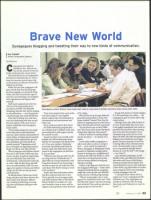
Synagogues blogging and tweeting their way to new kinds of communication.
Participants at Darim Online's social media boot camp on Long Island in October learned to tweet, among other skills.
"Even at the simplest level, social media
tools allow people to come together
around a shared idea and shared goals in
a decentralized and asynchronous way:'
Colton says.
Fancy words, but what do they mean?
For Gabby Volodarsky, program direc-
tor at Temple Sinai in Oakland, Calif., they
mean being able to rally support quickly
for someone in need.
Someone posted a note recently on the
temple's year-old Facebook page saying
that she was "praying for the speedy recov-
ery" of two new members. Volodarsky
wrote back immediately and found out
that the couple, who didn't know many
people in the congregation yet, had been
in a car accident.
"Within an hour they got calls from all
our clergy and me,"Volodarsicy says. "I
asked what our Caring Community could
bring them. Because I saw that posting, I
was able to reach out and make them feel
cared about. Now they're among our most
active members:'
People often share information online
that they would not share face to face.
That's especially true of younger people,
says Rabbi Jonathan Blake of Westchester
Reform Temple in Scarsdale, N.Y., who
uses Facebook to keep in touch with his
religious school graduates when they head
off to college.
When he first set up his page, Blake was
pleasantly surprised that so many of his
former students "Mended" him. Now the
rabbi is an ongoing presence in their lives, a
link to their hometown Jewish community.
"I'm not there to spy on them:' Blake
says. "But I know more about what they're
doing Friday night than their parents:'
If they're involved in anything danger-
ous, he can step in — as a pastor, not a
parent.
Social media enables congregants to
talk to each other as well as to clergy or
staff — a fact used by the Sixth and I
Historic Synagogue in Washington to help
promote its Chanukah cooking contest.
Instead of sending out a straightforward
invitation, the staff used Twitter to create
online buzz, tweeting about the potato
dish one woman planned to bring and
linking to her blog.
Readers of the blog were linked back to
the synagogue's Web page — better adver-
tising than anything else the synagogue
might have come up with, says Meredith
Jacobs, director of family programming.
"Why do young people come to syna-
gogue? For community:' Jacobs says. "With
the Holy Chef contest, I saw them tweeting
back and forth. They could see who else is
going and get the word out fast."
Temple Beth Sholom in Roslyn Heights,
N.Y., did something even riskier — the
congregation gave its senior rabbi a flip
camera phone.
Although many older folks hesitate to
use new media, Rabbi Alan Lucas took
to the gadget immediately. Last week, he
posted his first YouTube video showing
him at his desk discussing the recent
Chanukah song written by Sen. Orrin
Hatch (R-Utah). His video has generated
dialogue even outside his own congre-
gation: One person gently accused him
of taking offense that a Mormon dared
write a Jewish holiday song, to which
Lucas responded he thought Hatch's
decision to write the ditty "a bit strange
— but I love it."
Lucas already is preparing a second
YouTube video, says Rabbi Jeni Friedman,
who works with Lucas at Beth Sholom.
Friedman attended Darim Online's first
Social Media Boot Camp at UJA-Federation
of New York's Long Island office in October,
and is a huge fan of how new technology
can help synagogues stay vital.
"I anticipate these videos will be a
regular part of our congregational life
Friedman says. "Our congregants are
already on Facebook. They are using
these tools, and it behooves us to get on
board." ❑
February 11 . 2010
23