

I
World
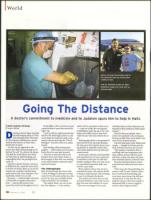
Above: An Israeli paratrooper and Dr.
Elie Schochet team up shortly after
landing in Haiti.
Left: Dr. Schochet scrubs for major
abdominal surgery at a sink with no
running water.
Going The Distance
A doctor's commitment to medicine and to Judaism spurs him to help in Haiti.
Shelli Liebman Dorfman
Senior Writer
D
onning a Detroit Tigers' baseball
cap and bringing along a T-shirt
from Michigan State University,
Dr. Elie Schochet embarked on a recent
medical relief mission to Haiti with a
Jewish edict in mind.
"As Jews, we are supposed to take
action when fellow human beings are in
distress;' he said. "As a doctor, the phrase
`You shall not stand idly by your broth-
ers' blood' has an added meaning and
responsibility that I am privileged to be
a part of"
Schochet, a former Detroiter who lives
in Hollywood, Fla., spent the week of Jan.
25 in Port-au-Prince, Haiti, as one of two
surgeons on a volunteer medical team
sponsored by Holy Cross Hospital in Fort
Lauderdale, where he is on staff.
His group — which brought with them
1,100 pounds of supplies and medica-
tions — joined relief workers from
around the world and throughout the U.S.
18
February 11 • 2010
On the flight to Port-au-Prince, he met
a medical team of nuns who noticed his
Tigers cap.
"I saw one lift her right hand and then
with her left index finger point to a spot
on her hand, the maneuver easily recog-
nized as the universal sign for, `I live in
Michigan:" Schochet wrote in an online
journal.
Upon landing, while awaiting their
supplies — which ended up in San Juan,
Puerto Rico, but were later rerouted
— Schochet reconnected with an old
Brandeis dorm mate. Ruben Cohen, a
facial surgeon in New York, was working
in the Israeli hospital compound repair-
ing facial traumas.
The Unimaginable
After driving through the city, he said,
"I think the biggest realization was that,
except for the destroyed architecture, this
city, for the most part, probably looked
really awful before the earthquake.
"The saddest thing I saw was on the
four-lane highway — in the median
which can't be more than six feet across
— a tent row (with) the vast majority
of inhabitants under the age of 10. I saw
babies and toddlers inches away from
traffic because they had nowhere else to
go:'
Working night shifts on the grounds of
what was left of the Adventist Hospital,
the team spent their daytime hours treat-
ing patients at makeshift medical sites,
some with hundreds lined up before per-
sonnel arrived.
At one center, Schochet said immediate
post-op patients lay on tarps, mattresses
or stretchers in the open air, with their
families tending to them. At a base set up
in a demolished university, desks were
used for exam tables.
Many medical centers were set up in
extremely hot tents, with patients fearful
of being in shaded spaces with overhangs
in case of earthquake aftershocks.
"Everywhere one looks, there are sick
and injured Haitians, some with one ban-
dage, but most with multiple he wrote.
"They were very happy to see us and
definitely need us. Their volume has not
lessened as they continue to battle quake
injuries."
Schochet also saw patients whose
needs were unrelated to the earthquake.
During one shift alone, seven babies were
born, two by cesarean section.
Schochet said many of the children had
coughs — thought to be from particles
from destroyed masonry and concrete.
"The majority of problems that we
could help with were respiratory infec-
tions, asthma, urinary infection, yeast
infections, scabies and aches and pains
from untreated injuries;' Schochet wrote.
They also dispensed diapers, which
some had been without for more than a
week.
"There was a lot of breastfeeding edu-
cation as well:' he said. "Haitian culture
has not embraced breastfeeding and,
even worse, many moms who had been
nursing chose to stop after the earth-
quake for reasons I have been unable to
understand fully. It seems it might be
related to their religious beliefs:'