

Arts & Entertainment
The Cheap
How two middle-class civil servants amassed a world-class art collection.
Allison Hoffman
Special to the Jewish News
50x50
See part of the Vogel
collection in Ann Arbor.
New York (Tablet)
T
he bathroom wall of Herbert and
Dorothy Vogel's rent-stabilized
apartment on Manhattan's Upper
East Side, where they have lived since
1963, happens to have been decorated
years ago with a pencil drawing by the
artist Sol LeWitt. Another piece of his — a
black wooden floor structure — sat in the
living room, next to works by superstars
such as Chuck Close and Donald Judd.
Until a few years ago, when the Vogels
donated the bulk of their artworks to the
National Gallery of Art, the walls in the bed-
room were crowded with pieces by Joseph
Beuys, Robert Mangold and Richard Tuttle.
Whatever fit went up; what didn't,
from a collection of more than 4,000
items, went under the bed or spent years
crammed into closets.
The Vogels' apartment was arguably its
own conceptual installation: a perfectly ordi-
nary, cramped New York space filled with
one of the best private collections of contem-
porary art in the city, or maybe anywhere.
Herbert, 87, and Dorothy, 74, origi-
nally aspired to be artists themselves.
As newlyweds they rented a studio on
Union Square, took classes in Abstract
Expressionist painting, and started buying
art from friends and acquaintances whose
studios they visited.
"We started to take our work down
from the walls and started to put other
artists' works up," Dorothy tells filmmaker
Megumi Sasaki in the documentary Herb
and Dorothy, now out on DVD.
"We thought they were better than we
were, so we gave it up."
The Vogels began collecting at a particu-
larly auspicious time — at precisely the
moment when New York became the capital
of the art world and the son of a Russian
Jewish garment worker from Harlem and
the daughter of an Orthodox shopkeeper
from Elmira, N.Y., could easily befriend the
people who were shaping culture in New
York, many of whom were Jewish emigres
from Europe or upstarts from Brooklyn.
These tastemakers grew up as part of a
generation that was encouraged, thanks to
New Deal programs that subsidized art-
ists, to take art seriously, and they became
adults in the wake of World War II, just as
New York was replacing Paris and Berlin
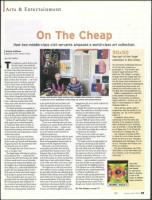
Herbert and Dorothy Vogel achieved every middle-class collector's fantasy:
a collection of art, assembled on the cheap, by artists who became famous.
as the global hub for art and ideas. And
while not explicitly Jewish, the American
avant garde was to a great extent shaped by
Jewish collectors, dealers, artists and crit-
ics — not least by curators at the Jewish
Museum, who mounted a series of influen-
tial shows for New York School artists like
Jasper Johns starting in the late 1950s.
"If you were collecting, what you were
valuing was, to a great extent, what Jewish
critics told you to value — abstract art,
color',' said Catherine Soussloff, a profes-
sor of art history at the University of
California, Santa Cruz.
The Jewish identification with the avant
garde wasn't new, of course; early on the
Nazis had marginalized Jewish artists in
Europe with the "degenerate" label.
"Jews took a role in the American
avant garde, and within that role they
maintained their identity as Jews," said
Margaret Olin, an art historian at Yale
University "Part of the pride that they
took in their place in society was that they
didn't have to just collect Jewish things —
in the 1950s and 1960s, we became a part
of the mainstream of American culture."
The Vogels met in 1960 and married in
1962. Herbert, known as Herby, worked at
the post office; Dorothy was a librarian at the
Brooklyn Public Library. Down in the Village,
where Herby went to hang out with Abstract
Expressionist painters at the Cedar Tavern
on his way to the graveyard shift, no one
cared about what anyone did for a living.
Their first purchase together, after a
Picasso vase Herby bought Dorothy as an
The University of Michigan Museum
of Art has been chosen as a
participant in "The Dorothy and
Herbert Vogel Collection: Fifty
Works for Fifty States," a project
through which the Vogels gave 50
works to an institution in each of
the 50 states. Each institution will
contribute to the task of cataloguing
and researching these works and
making the information public via
the Web site www.vogel50x50.org .
UMMA is displaying its collection
in the exhibit "An Economy of
Means: The Dorothy and Herbert
Vogel Collection," running Jan. 30-
May 2 in the museum's A. Alfred
Taubman Gallery II.
engagement gift, was a metal sculpture by
John Chamberlain.
There will be a gallery talk in
Quickly they arrived at a simple arrange-
conjunction with the exhibit 2 p.m.
ment: They would live on Dorothy's income
Saturday, Jan. 30, in the Taubman
and buy art with Herby's salary.
Gallery II.
Their budget constrained their pur-
In addition, there will be
chases; they could afford only the edgi-
screenings of the film Herb and
est, most "difficult" pieces from artists
Dorothy in the museum's Helmut
who were already getting notice or work
Stern Auditorium 3 p.m. Sundays,
by unknown artists who welcomed the
Jan. 31 and Feb. 7,14 and 28; 9:30
Vogels' cash-and-carry policy. (Literally
p.m. Fridays, Feb. 5,12,19 and 26;
— they didn't buy things they could not
and
9:30 p.m. Tuesday, Feb. 23.
cart home on the subway.)
The
museum is located at 525
"The artists were really very appre-
S.
State
St. in Ann Arbor. Museum
ciative of people looking at their work:'
hours
are
10 a.m.-5 p.m. Tuesdays,
Dorothy told Tablet.
Wednesdays and Saturdays, 10 a.m.-
The Vogels weren't the only people col-
10 p.m. Thursdays and Fridays and
lecting on a shoestring in the postwar
12-5 p.m. Sundays.
era. Dorothy recalled crossing paths in
For more information, call (734)
the early 1960s with Sam Hunter, the
764-0395 or (734) 763-UMMA (24-
former New York Times art critic who, in
hour hotline); or go to www.umma.
his capacity as director of the Rose Art
umich.edu .
Museum at Brandeis University — an
institution financed by a mattress manu-
facturer — had a mandate to spend no
more than $5,000 on any single piece
Inure Self
he acquired for the fledgling museum.
(1984, acrylic
(The cheapest was a Claes Oldenburg
and thread
he picked up for a couple hundred dol-
on canvas) by
lars, Hunter recalled last year.)
Martin Johnson
But the couple quickly gained notice
is one of 50
among other dealers and collectors for
works in UMMA's
the amount of time and energy they
Vogel collection.
spent getting to know artists' work —
though some dealers objected to their
INURE Skil.F.
On The Cheap on page 37
Janua . y 28 2010
35