
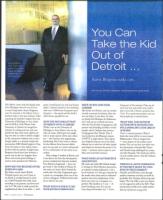

Aaron Bragman:
"Now, if you have
constructive criticism
to give, its viewed as
valuable input and is
put to good use.'
Aaron Bragman talks cars.
WRITTEN BY JEFFREY HERMANN I PHOTOGRAPHS BY ANGIE BAAN
His father's career took the family away
from Michigan when he was 12, but
it wasn't long before Aaron Bragman,
now 34, returned to the Motor City to
find his niche in the auto industry. After
acquiring his bachelor's degree from the
University of Michigan in Ann Arbor
and his M.B.A. from Wayne State
University in Detroit, he merged his
interests in writing and cars and now
spends his days (and some nights) por-
ing over data in order to deliver insight
to the automotive industry and a news-
hungry public as a research analyst for
Automotive IHS Global Insight in Troy.
From his home in Ann Arbor, where
he lives with his partner of eight years,
Bragman found some time between a
recent visit to the Los Angeles Auto
Show and several press briefings to
answer some questions for Platinum.
HOW DID YOU BECOME INTER-
ESTED IN CARS?
My father owned classic British
Triumph sports cars, so it's been in
my blood. I actually learned to drive
on a 1960 Triumph stick shift. And,
according to my parents, my first word
was "car." We used to walk around the
neighborhood when I was little — and I
P 14 •
JANUARY 2010 •
JI\T platinum
guess I would point out and read license
plates. I always wanted to do something
with cars. I didn't have the grease mon-
key gene — the speed and the thrill is
what always appealed to me.
HOW DID YOU PARLAY THAT
INTEREST INTO A CAREER?
While I was at the University of
Michigan in Ann Arbor, I was on the
solar car team, which gave me insight
into so many aspects of the auto indus-
try — the business end, engineering,
fundraising. But I also wrote a column
for the Monroe Street Journal, which
gave me my start as a writer and proved
to be a critical piece of my career as an
analyst.
After college, I worked at Bosch, and
I was able to see how the development
process worked, how factories worked,
how deliveries happened — how cars
got made. I also worked at Nissan for
two years as a buyer. But I missed the
media side. One day, I happened upon
a quote in a newspaper from one of my
current colleagues. I followed that inter-
est to where I am now
WHAT KIND OF IMPACT DID
YOUR JEWISH UPBRINGING
HAVE ON YOU AND YOUR
CAREER?
My family was Reform, and my mother
actually converted to Judaism after she
met my father. I was about 12 when
my family left Michigan for Baltimore,
but I had my bar mitzvah back here
with the Troy Jewish Congregation. My
parents were founding members of that
temple, which I believe then became
Congregation Shir Tikvah. Then I
was involved in the Missouri chapter
of NFTY in high school. That experi-
ence helped bring me out of my shell,
allowed me to meet lots of other people
and helped me become the person I am
today — someone who is open to new
ideas and untraveled avenues.
WHAT DOES AN AUTOMOTIVE
ANALYST DO?
My main role with HIS Global Insight
is writing for World Markets Automotive,
an industry-insider publication. I do a
lot of research, so I also get contacted by
the media when they need an informed
opinion about the implications of the
latest auto news on a company or a
product. My deadline is 7 a.m. — if
there's breaking news, I'm up late.
I eat, sleep and breathe cars — I love
being part of the industry. They say, do
what you love and you'll never work a
day in your life. I found a position that
I love. It's a passionate product and one
that people get so excited about.
WHAT WILL THE DETROIT
AUTOMOTIVE MANUFACTUR-
ING LANDSCAPE LOOK LIKE IN
10 YEARS?
That's a colossal question. What I
think the trend will be is more toward
Balkanization. That is, fragmented
— more players in the market, more
brands. You can see that now with even
the domination of brands like Toyota
and Honda being challenged by compa-
nies like Hyundai. The whole pie will be
cut into smaller pieces. And the Chinese
will be here soon.
WHICH U.S. AUTO COMPANY IS
IN THE BEST SHAPE TO COM-
PETE IN THAT MARKET?
Chrysler and GM have come through
perilous situations and they can both be
profitable. But Chrysler still has big chal-
lenges. The way I like to put it is, they're
out of surgery, but still in the ICU. They
need product health and a stable market
Kid Out Of Detroit on page P16