

to put together a film. And it was a lot of
fun on top of that:' he said.
"We hope the new school will help us
tap into the state's new film industry, but
we're also closely watching the budget
developments in the state Legislature he
adds.
Some legislators have threatened to cut
the 42 percent tax credit made available to
moviemakers because they claim the corn-
panies have not created enough local jobs
as they promised.
Assisting Liebman as he did Specs for
more than 37 years is Dick Kernen, vice
president of industry relations.
"We have a great environment here
among our students, which Specs cultivat-
ed over 40 years," he said. "Twenty of our
80 employees have been here longer than
10 years and several of our employees are
former students."
Added Howard: "People start here at the
entry level — they learn from the bot-
tom up. They just don't quickly become a
national radio anchor. We put about 800
students a year through here. After more
than six decades in the industry, I still find
it most rewarding to help aspiring profes-
sionals to learn and embark on productive
careers:'
Becoming Specs
Running a broadcast school was probably
the farthest thing from the mind of young
Jerry Liebman when he was growing up in
the late 1920s-early 1930s in one of about
50 Jewish families in Kittanning, near
Pittsburgh.
Despite a bout with polio that left him
with a weakened leg, he graduated from
Allegheny College with a degree in his-
tory and political science and considered
attending law school.
"But I also took speech and dramatics
classes and chose a radio career, starting as
an announcer on a small Kittanning sta-
tion:' he says. "Then I got the same type of
job in Sharon, Pa., before moving on to an
NBC-owned station in Cleveland.
"Celia was making public service
announcements there and a station execu-
tive practically ordered me: 'This girl is
pretty. You should date her. So I did and we
got married a year later"
Still known as Liebman, he auditioned
for both radio and TV jobs and admits he
did "fantastically bad" in TV, but was hired
for the combination position by program
director Lawson Deming, also known as
Sir Graves Ghastly, who later brought his
popular horror show to Detroit. "I was
really a soprano compared to those deep-
voiced announcers:' he recalls.
"The executives didn't think Liebman
was an announcer's name and, because
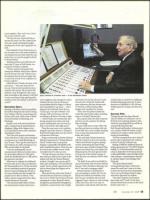
Specs Howard in a familiar seat — in the broadcast studio.
of my eyeglasses, they changed it to Specs
Liebman:' he says, "but not for long. A
vice president stuck his finger in a phone
book and pointed to any name — and it
happened to be Howard. From then on,
52 years ago, I was Specs Howard. I was
among a staff of announcers who did
everything at all hours of the day or night
— station breaks and commercials, intro-
ducing national music shows and soap
operas, anything that came our way on a
shift. I even hosted a late-night movie'
There also were some on-air incidents
along the way, better known as "bloopers':
that Howard laughs about now, but weren't
so humorous at the time.
Doing a commercial for Roman Cleanser
Bleach, he pronounced it "Roman Bleanser
Cleach." Another time, he purposely
dropped a supposedly unbreakable radio
and it smashed into pieces. There also was
the time he just couldn't remove "easily
removable doors" to clean an oven.
"We had real stern executives in those
days and I got called on the carpet by the
station boss after the 'Roman Bleanser'
incident; I thought I was a goner and I'd
better start looking for a new job': Howard
recalls, "but he actually supported me. He
told me those things just happen and to
forget about it:'
When Jewish disc jockey Alan Freed of
Cleveland became famous by coining the
term rock 'n' roll for the new form of music
sweeping the country, Howard's station,
having been purchased by Westinghouse,
switched to a music format. One of eight
announcers, he was the only one to audi-
tion and win a DJ job. He worked with
some unknowns who later became such
TV favorites as Phil Donohue, Mike
Douglas and comedian Tim Conway.
"Then came the payola scandal that
rocked the nation's disc jockeys, including
many in Cleveland': Howard says.
DJs accepted under-the-table compensa-
tion from record companies for playing
their recordings.
"A guy would come in, have coffee with
you, then just leave an envelope with cash
on the table. But I never accepted anything.
I was so clean they nicknamed me the
kosher disc jockey."
A few years later, Howard teamed up
with Harry Martin to form the morning
"Martin and Howard" program, playing
records, chitchatting and interviewing
such music stars as Barbra Streisand, Tony
Bennett and Chuck Berry and athletes like
Muhammad Ali. The show garnered close
to 50 percent of the station's revenue. In
1967, the team was enticed to WXYZ radio
in Detroit.
"We didn't do too well in an all-talk for-
mat and we lasted only two years," Howard
laments. "Other obstacles at that time were
the '67 riots and a newspaper strike."
Howard returned to Cleveland for a
year, commuting to another job,"but my
family loved Detroit and wanted to stay
here he says, "and that's when a friend
suggested I open a hands-on radio training
school. Back then, there were only cor-
respondence-style schools. After that first
small location, we moved to a building at
Northland Shopping Center for 24 years,
then here in Southfield in 1995. We have
56,000 square feet of space and three ten-
ants."
Success Rate
Through the years, the Specs Howard
School of Media Arts fashioned a rate of
80-90 percent in placing students in jobs,
which has surprisingly held up well for an
economically depressed state.
Both Howard and Jonathan Liebman point
out a number of laid-off workers in other
industries are trying to switch careers by
turning to broadcasting.
"Detroit's unemployment rate is about 25
percent and our placement rate continues
at about 70 percent': Liebman says.
Hoping to fulfill his childhood dream of
being a sportscaster for TV's ESPN, Michael
Fenkell, 22, of West Bloomfield, joined the
school in September. He broadcast hockey
on Bloomfield Hills Cranbrook High School
radio and got a communications and pub-
lic relations degree from Michigan State
University
"The Specs Howard school
[www.specshoward.edu ] is well known
around the world, and I want to be close
to home and also learn from its graduates.
Also, I can use broadcast industry equip-
ment there right away': he explains.
"Like other students, I'm passionate
about radio and TV, and I'm sure Specs
Howard himself and everyone at the school
feel the same way."
December 24 • 2009
13