

▪
•■■■•-•■•
HOME
helping the environment
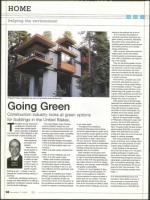
A "green" home is built into the side of a mountain in the western U.S.
Going Green
Construction industry looks at green options
for buildings in the United States.
T
he eighth annual Greenbuild
conference in Phoenix last
month drew 28,000 partici-
pants, hundreds of speakers
and more than 1,000 exhibitors to dis-
cuss the state of green building and
showcase the
latest products,
processes and
projects.
Does the con-
tinued growth of
green building
during a severe
recession become
a matter of hope
or hype? There's
a little of each, of
course, but the
growth of green
building is real — indeed, it may be
keeping the overall building industry in
business.
Additionally, retrofitting buildings for
energy and water efficiency is making a
significant contribution towards meeting
environmental challenges.
58
D ecember 17 • 2009
The United States Green Building
Council (USGBC) reveals the over-
whelming impact the built environment
has upon our natural environment, our
economy and human health. According
to the USGBC, in the United States
alone, buildings account for:
• 39% of all total energy consumption;
• 70% of all total electricity consumption;
• 12% of all total potable water con-
sumption;
• 39% of all total carbon dioxide emis-
sions;
• 40% of all raw materials use; and
• 30% of all total waste output.
While a shift towards sustainable
building practices is gaining steam,
the information above confirms that
a majority of buildings in the U.S. are
very inefficient and that significant work
needs to be done.
Emphasis on building more energy
efficient, sustainable buildings will not
be enough to positively impact our
environment. Much of the discussion at
this conference centered on the need to
retrofit the majority of existing buildings
in our urban areas.
Throughout the conference,
Greenbuild attendees learned about
numerous opportunities for green build-
ing to positively impact global warming
and increase human health while add-
ing thousands of green collar jobs to
the U.S. economy. Several speakers
emphasized it was within the attendees'
power to make choices that will funda-
mentally change the environment, and
people's lives, for the better.
Such changes run the gamut from
employees turning off their electronics
at night to the Empire State Building
owners in New York City spending sev-
eral million dollars to retrofit for energy
efficiency, cost savings, waste reduction
and greater sustainability.
Former U.S. Vice President Al Gore
was the event's keynote speaker. He
called on the audience to make the
choices required to ensure we leave a
better earth for our children. His mes-
sage reiterated several times that we
have all the resources we need to solve
this global climate challenge; all we are
lacking is the political will to do so.
At an Executive Roundtable of
corporate executives discussing the
green building movement, attendees
discovered many corporations are
adopting green policies involving their
real estate portfolios and buildings'
energy performance.
Most company executives acknowl-
edged public opinion has shifted
towards greater environmental aware-
ness. Many corporations are respond-
ing to this change.
They are becoming greater environ-
mental stewards because technology
has improved, costs for new building
retrofits have decreased, tax incen-
tives have increased and the return on
investment has shortened dramatically
in certain instances.
Arne Sorenon, president and COO
of Marriott, articulated his corpora-
tion's interest in being a green leader
in the hospitality industry: "The green
hotel prototype gives Marriott a com-
petitive edge with guests who prefer
a green hotel experience and with the
growing number of owners and fran-
chisees who want to provide it."
Hotel guests have overwhelmingly
approved and embraced easy access
to public transportation, in-room recy-
cling, light sensors in guest rooms,
reminders to lower thermostats, turn
off lights and re-use towels, all attri-
butes of a green hotel experience.
Marriott Courtyard Settler's Ridge
in Pittsburgh, scheduled to open next
summer, will be the first hotel built
based on the new green hotel proto-
type. The green hotel will save owners
approximately $100,000, six months'
design time and reduce the hotel's
energy and water use up to 25 percent
based on national averages.
With many jurisdictions also offer-
ing tax incentives, such savings could
provide a two-year payback on hotel
owners' green building investment.
Green building is the economic
story that has all eyes on it. The green
building landscape is rapidly evolv-
ing in spite of tough economic times.
Forward-thinking companies are lever-
aging green, sustainable practices to
gain a competitive advantage. Many
new jobs and professions will be nec-
essary for this "new economy." The
future for this budding industry looks
bright. I I
Go to www.greenbuildexpo.org for more
information. Robert Mattler is director of
green brokerage at Armada Real Estate
Services in West Bloomfield: bmattler@
armadarealestate.com or (248) 855-1221.