

World
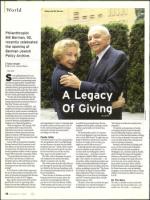
Madge and Bill Berman
Philanthropist
Bill Berman, 92,
recently celebrated
the opening of
Berman Jewish
Policy Archive.
Tamar Snyder
New York Jewish Week
New York
S
ome philanthropists focus on
Jewish continuity. Others devote
themselves to promoting Jewish
educational opportunities. Mandell (Bill)
Berman, a Jewish philanthropist based in
suburban Detroit, gives generously to both of
the aforementioned causes. But what makes
him unique among Jewish philanthropists is
his love of data, particularly Jewish data.
"I'm the only Jewish philanthropist who
has a real interest in Jewish data, and the
storage, dissemination and preservation of
that date Berman said recently.
More than 20 percent of Mandell L. and
Madeleine H. Berman Foundation's budget
is allocated to Jewish research, including the
funding of Jewish educational research at the
Jewish Education Service of North America
and the Myers-JDC-Brookdale Institute's
Center for Research on Disabilities and
Employment of Special Populations.
While serving from 1987 through 1990
as president of the Council of Jewish
Federations (now known as the Jewish
Federations of North America), Berman
helped to fund the 1990 National Jewish
Population Survey (he later funded the 2000-
2001 survey as well).
And in 1987, he founded the Mandell L.
Berman Institute North American Jewish
Data Bank, now housed at the University
of Connecticut. The data bank houses the
Jewish population studies as well as approxi-
mately 200 local Jewish community studies.
"I'm particularly interested in the min-
ing of date says Berman, a builder and
developer who is a Harvard Business School
graduate. "How do you make policy for a
community if you don't know what's hap-
pening?"
At 92, Berman is still actively supporting
the use of data to inform Jewish policy deci-
sions. In November, he launched the Berman
Jewish Policy Archive @ NYU Wagner.
Bjpa.org, the online portal of the archive,
provides free access to a growing online
library of more than 4,000 policy-relevant
publications from leading Jewish journals
18
December 17 • 2009
and organizations. It aims "to stimulate hi
level policy debate and discussion" and "to
be the central meeting point for everyone
interested in Jewish communal policy'
according to its Web site.
Family Affair
"Dad always used to say, 'You need quantita-
tive and qualitative data:" says Bill's daugh-
ter, Ann Berman, who took over the family
foundation last year. "I think what he meant
by that is that you need to get the raw data,
but not everybody can use the raw data.
They want to see the printed word:'
The BJPA, with its thousands of reports,
will complement the Jewish Data Bank,
which is a repository for raw data.
The archive spans from the early 20th cen-
tury through the present day and is funded
two-thirds by the Berman Foundation, with
the remaining third funded by the Charles H.
Revson Foundation.
"Since the days of Abraham and Sarah,
being Jewish has been, in part, about dis-
course that is meaningful and effective,'
says Steven M. Cohen, the director of BJPA.
"Unfortunately, until recently, we have had
no way of preserving and making readily
accessible the growing literature that has
enlightened Jewish policy-making in North
America, particularly over the last three
decades."
The Jewish policy archive is "a treasure
trove at your fingertips:' says Ann Berman,
who is on the BJPA board. "It might take you
longer to find these artides if you searched
for them on Google. And even then, you
might not even be able to access it:'
In placing historical and contemporary
resources together in one database, "we
can learn how our thinking has evolved
on certain issues — and where it hasn't,"
says Mordecai Walfish, BJPAs content man-
ager."This could be very instructive — for
researchers, online and print journalists and
Jewish communal professionals of all ages."
Walfish shared some fun tidbits about the
archive, including its raciest title: "The Future
of Foreskins" by Daniel S. Brenner. BJPAs
oldest publication? "Report Concerning
Suffering Jews in San Francisco Earthquake
and Fire" written by Nathan Bijur and pub-
lished in January 1907.
"My dad is aware that everybody else goes
to [fund] the sexy stuff, like Birthright or
sending kids to camp," says Ann Berman.
"He believes in all that, but nobody else is
doing this."
To train the next generation of Jewish
sociologists, Berman funds the Mandell
Berman Fellowship Program, which sup-
ports two to three doctoral students working
with Len Saxe at Brandeis University in the
social scientific study of the contemporary
American Jewish community.
Berman is still involved in funding stud-
ies, too. At the recent Jewish Federations
of North America General Assembly in
Washington, D.C., the latest study he funded,
titled "Moving: The Impact of Geographic
Mobility on the Jewish Community' was
released. According to the study, when Jews
move from one city to another, their giv-
ing to Jewish causes goes down, with the
Jewish federation system taking the biggest
hit. Ritual observance, such as attending
synagogue, connecting with Israel, or raising
children to be Jewish, are affected much less,
if at all.
On The Move
The data is valuable because the Jewish
community has historically been a very
mobile one. The study — a joint proj-