

Metro
ON CAMPUS
Fine Art Appraisers and Auctioneers — Since 1927
December Auction Dates
Friday the 1 ith
Saturday the 12th Sunday the 13th
At 6:30 p.m
At I 1:00 a.m.
Where Was God?
At Noon
Photos by Art Alsne r
Priest, Shoah expert discuss God
and Holocaust at EMU event.
SALVADOR DALI,
COLOR LITHO, C. 2o" X 16"
SALVADOR DALI,
COLOR LITHO, C. 20" X 16"
ii•M111111111111,
.20
CT. DIAMOND
14KT GOLD
PENDANT
JOAN MIRO
40 1/2" X 26"
FABERGE, 14KT
YELLOW GOLD
CIGARETTE CASE
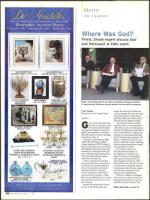
Father John Pawlikowski, Dr. Guy Stern and Eastern Michigan University
Professor Martin Shichtman discuss whether God survived the Holocaust.
Art Aisner
Special to the Jewish News
Ypsilanti
ROBERT HARVEY,
1966 48" X 60"
IGOR CARL FABERGE,
GOLD ON STERLING,
"IMPERIAL WEDDING COACH",
H 21/2",L 4"
ANDRE LHOTE,
0/C, 21" X 25"
STEUBEN AURENE &
DOMINICK &HAFF
STERLING SHERBETS,
EIGHT
TIFFANY & CO..
STERLING COFFEE
, SET, 1907
MINTON SLIP PAINTED
MOON FLASKS
TWO, H 12 lie", w 9"
409
JrutsoN,
FRoir Mi 48226
TEL, 313.963.6255 wv w.ntimoAR. --1.(
20
December 10 .09
G
od survived the Holocaust,
but was not the same in the
eyes of the millions follow-
ing organized religions around the
globe, said panelists at a rare inter-
faith discussion at Eastern Michigan
University on Nov. 23
The event, co-sponsored by Hillel
at EMU, the Holy Trinity Catholic
Student Parish and EMU's College of
the Arts and Sciences, drew more than
200 students, faculty and community
members for a sometimes frank, but
non-confrontational discussion about
God's role while millions perished
under Nazi Germany rule.
"Some conceptions of God did
not survive the ashes of Auschwitz:'
said Father John Pawlikowski, pro-
fessor of social ethics at Catholic
Theological Union in Chicago.
"Those conceptions where God is
all-powerful, ever present ... those
had to be modified, but not in a way
that eliminates God from our every-
day existence."
Instead, the notion that God was
present in the death camps and
shared the suffering of Holocaust
victims emerged, he said, and simul-
taneously exposed a much deeper
spiritual connection between man's
free will and his religious beliefs.
"The idea that God, even while
standing with us, cannot automati-
cally remove pain and suffering on a
massive level placed the responsibil-
ity in human hands to a degree that
perhaps we never appreciated fully
before," Pawlikowski continued. "We
began to understand that we're not
going to eliminate massive suffering,
massive human degradation simply
by shouting God's name."
Dr. Guy Stern, director of
the International Institute of
the Righteous at the Holocaust
Memorial Center in Farmington
Hills, agreed that perceptions of
God changed as the horror of the
Holocaust became clear. But he took
it a step further, saying the absence
of humanity within the Nazi regime
and those that supported it also
exposed God's imperfection.
"If there is a failure of mankind,
it also must be a failure of God," the
distinguished professor of German
and Slavic studies at Wayne State
Where Was God on page 22