

Arts & Entertainment
Musical Wunderkind
DSO, with clarinetist David Krakauer, will debut
klezmer-inspired work by 23-year-old composer.
Suzanne Chessler
Special to the Jewish News
A
n upcoming Detroit Symphony
Orchestra concert is a dream
come true for 23-year-old com-
poser Wlad Marhulets.
His new piece, Concerto for Klezmer
Clarinet, will have its premiere Dec. 10-
13 by the DSO and David Krakauer, the
internationally acclaimed clarinetist who
inspired the composer's career.
The Orchestra Hall program also
includes Haydn's Symphony No. 67 and
Hoist's tone poems The Planets. Composer
Andrew Litton will replace DSO Music
Director Leonard Slatkin on the podium.
Slatkin suffered a heart attack on Nov. 1.
Marhulets' piece, described as wild and
crazy in parts, also has a slow and lyrical
movement preceded by a cadenza similar to
a cantor's singing. The second cadenza, based
on the same idea, ends the slow movement
and gradually develops toward an emotional
peak on which the final movement begins.
Punked!
Michael Fox
Special to the Jewish News
M gybe it was Vietnam, or
Watergate, or Iran-Contra, or
Abu Ghraib that shook your
faith in high-ranking officials. For Andy
Bichlbaum, it was a childhood revelation
about his Belgian grandfather's death in
World War II.
"I thought, 'That's like you're on a battle-
field, and you're holding a gun, and I've
seen that in the movies:' Bichlbaum recalls.
"But at a certain point it dawned on me
that that wasn't it. There was always confu-
sion about where he died and how he died,
and it was only about five years ago that we
found out he died at Auschwitz!'
Long before the official notification,
Bichlbaum had concluded that govern-
ment-sanctioned racism had taken his
grandfather's life.
"It was formative for me in that I couldn't
trust power at all, and there was this unre-
solved distrust for powerful historical rea-
sons," he confides. "We all have our different
reasons for distrusting power and for know-
ing that things can go amiss. In my case, it
48
December 3 • 2009
"My concerto has a long story behind
it:' Marhulets says. "Seven years ago
in Poland, I happened to listen to one
of David Krakauer's recordings, which
changed my life completely.
"At that point, I knew nothing about
music, but this CD made me fall in love
with it immediately. I shortly made up
my mind to become a clarinetist and play
klezmer music.
"Thus, out of the blue, at the age of 16,1 start-
ed my musical education, studying clarinet
and trying to compose. At first, I composed
klezmer tunes, but later I would write more
serious pieces inspired by klezmer tradition
and elements of Jewish culture."
The admiration for Krakauer continued
as Marhulets came to New York in 2007 to
study at the Jnilliard School.
"I tried to get in touch with David,
and that filially happened:' explains the
composer, who will be in Detroit for the
program. "We met for a quick lunch, and
I told him my story. I also gave him a CD
with my music. A few days later, David
contacted me and asked that I write the
concerto for him!'
Krakauer, 52, who has a long career with
the classics and updated klezmer, took to
the piece instantly.
"The concerto is amazing, quirky, funny,
surprising and terrifying. This is not at all
a pops piece says Krakauer, "but its also
not at all a forbidding piece of contempo-
rary music. It's just delightful from begin-
ning to end, and I'm absolutely thrilled
that Leonard Slatkin accepted to do it at
the suggestion of John Corigliano, Wlad's
teacher at Juilliard."
Krakauer, who is debuting with the
Detroit Symphony, thinks the times are
interesting for klezmer because it attracts
mainstream attention.
The musician has been involved with
the performance style since its revival in
the 1970s, its reinvention in the 1980s and
its developing connections to contempo-
rary sounds and dance.
"My interest in klezmer led me to an
exploration of my Polish-Jewish roots:'
Composer Mad Marhulets
Marhulets says. "Although I was raised by
my Jewish grandmother, I didn't find out
much about Jewish culture as a child.
"The concerto not only tells my
story, but it also tells the story of David
Krakauer. Although we come from dif-
ferent generations and two sides of the
ocean, we share Jewish-Belarussian roots
and a passion for music." II
Subversive Yes Men is the latest
in a line of Jewish pranksters.
was very strong, immediate family reasons!'
That's the serious motivation under-
pinning the seriously funny work that
Bichlbaum and fellow Jewish activist Mike
Bonanno do under the guise of the Yes Men.
The duo exposes the bad behavior of multi-
national corporations by masquerading as
company representatives at conferences and
on television.
In the prank documented at the begin-
ning of their bitingly funny new documen-
tary, The Yes Men Fix the World, Bichlbaum
passes himself off as a Dow Chemical
spokesman and announces on a BBC
newscast that his firm is finally taking
responsibility and picking up the tab for the
1984 Bhopal catastrophe at a Union Carbide
plant. (Dow bought the firm in 2001.) The
story goes worldwide instantaneously,
sending Dow's stock price plummeting.
"Making fun of adversity, and making
humor in adversity in order to fight it is,
I think, a very Jewish trait:' acknowledges
Bichlbaum, who's also gay. "Ifs also a very
black trait. Any group that knows oppres-
sion knows humor because there's no alter-
native. At a certain point, you have to laugh
and hope that there's power in the laughter!'
The Yes Men Fix
the World screened
last summer at the
San Francisco Jewish
Film Festival, where
Bichlbaum participated
in a panel titled "Social
Justice As a Jewish
Value." He admitted in
our interview that he
hadn't thought of either
the film or his work as
Jewish before the fes-
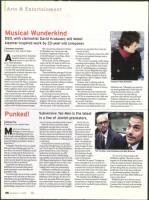
The Yes Men: Andy Bichlbaum and Mike Bonanno.
tival invitation, though
he was happy to explore
"It's sort of an obvious thing to do:'
points of connection.
Bichlbaum explains. "You have to make
"In the film',' he muses, "I change my
laughter out of terrible things and you have
name constantly to fit in, to be part of a
to feed the media. You have to find devious
noxious society, a noxious group of people,
ways to communicate to the rest of human-
a noxious force, to kind of undermine it.
ity these things that you care about. A lot of
And of course, that's what a lot of Jews have people have come to the same conclusion
had to do at various times — not for fun,
— [professional prankster] Alan Abel;
not to make a point, but just to survive."
[pie-thrower] Aron Kay; Abbie Hoffman, of
The Canadian-born Bichlbaum and
course; Lenny Bruce."
Bonanno (an American based in Scotland)
Bichlbaum grew up in Tucson, earned
are the latest in a long line of gutsy Jewish
a master's degree in creative writing from
activists who've mocked the powers-that-be Louisiana State University and was unhap-
in outrageous ways.
pily working as a computer programmer