

Arts & Entertainment
'Oh, What A Ride!'
As Jersey Boys comes to the Fisher Theatre, a Jewish member
of the 1970s Four Seasons picks up where the play leaves off.
including Shapiro. Their 1975 Warner
Bros. album Who Loves You contained
two soon-to-be classic hits, the title song
(which hit No. 3) and the No. 1 smash
"December 1963 (Oh, What a Night)."
"I was driving in Paramus, N.J., when I
first heard 'Who Loves You' on the air:' said
Shapiro. "I had to pull over; I was shaking. I
couldn't believe it was me on the radio."
The Tony Award-winning musical "Jersey
Boys," which opens Thursday, Dec. 17, at
the Fisher Theatre in Detroit, tells the story
of the legendary singing group the Four
Seasons in the 1950s and '60s. In the '70s,
lead singer Frankie Valli performed with
four new members, including New Jersey-
bred Lee Shapiro. In a Detroit Jewish News
exclusive, Shapiro, "the Jewish kid" of the
group, for the first time tells his own story
about the latter years of the Four Seasons.
David Sachs
Senior Copy Editor
I
n the mid-1960s, 11-year-old Lee
Shapiro and his mother sat in their
Glen Rock, N.J., living room, watch-
ing the Four Seasons perform on The Ed
Sullivan Show.
But what especially caught the eye of
Lee, a prodigious young pianist, was that
the Four Seasons' key musical player was
their keyboard player, Bob Gaudio.
The Beatles, Lee's fave at the time, fea-
tured no piano — just John and George on
guitar, Paul at bass and Ringo on drums.
Excited and intrigued by the Four
Seasons' keyboardist, Lee pointed at the TV
and said, "See, Mom, someday I could play
piano and be in a rock band just like this!"
Little could the talented sixth-grader
imagine that only eight years later he
would live out his fantasy and become the
Four Seasons' new keyboardist — and the
legendary Italian American rock group's
first Jewish member.
"It was beshert," mused Shapiro, looking
back.
It could only have been destiny that
made his dream come true. In 1973,
Shapiro was a college sophomore at the
prestigious Manhattan School of Music,
where his interest was orchestration (corn-
posing the musical text for each instru-
ment in a song's arrangement).
A musician whom Shapiro had played
club dates for heard the Seasons needed
a keyboardist and recommended him to
their road manager. He, in turn, dropped
in to hear Shapiro's Buddy Rich-style jazz
gig at a New Jersey nightspot. Impressed,
he tipped off lead singer Frankie Valli.
"At my audition:' Shapiro remembers,
"I began by playing the first chord of the
intro of 'Dawn and Frankie began sing-
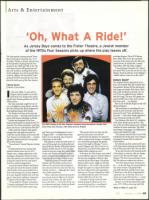
The 1975 version of the Four Seasons, clockwise from the bottom: Frankie Valli,
Gerry Polci, Don Ciccone, John Paiva and Lee Shapiro.
ing,`Pretty eyes of midsummer's morn ..:
I stopped cold — I couldn't believe that
before me was the great voice I heard so
many times on the radio:'
Valli offered to make the fresh-faced 19-
year-old the group's new keyboardist and
musical director. Besides all his piano talents,
Shapiro had the smarts to write arrange-
ments for any new songs they added while
on the road. Gaudio, the band's creative
genius, remained the group's producer and
songwriter, but no longer wished to tour.
"I told my parents of Frankie's offer:'
Shapiro said. "My father wanted me to
take over his electrical contracting busi-
ness. But my mom was more into the arts,
and she was for it — although she wanted
me to finish school first.
"When I asked my orchestration profes-
sor, a classical music follower, if I should
join the Four Seasons, she said, don't
know who that is — but if they'll pay you
to orchestrate and play, I think you should
leave. You can always go to school.
"She seemed old to me then, but she
gave me some pretty cool advice!"
On his first day, Shapiro was asked by
Valli to compose and arrange a completely
new orchestral opening for the group's
concert that night in Chicago. "I was so
scared," Shapiro said. "But I wrote it; we
rehearsed it; we played it that night; and
Frankie didn't change one note'
At the time, the Four Seasons were mired
in rock oblivion, signed to Detroit's Motown
Records and struggling to find the right
sound to hit the charts again. The group's
Motown efforts never caught on and they
left the label — but on their way out, they
bought the rights to a song recorded there
but never released. The track rejected by
Motown was "My Eyes Adored You',' which
on a different label in early 1975 became
Frankie Valli's first solo No. 1 hit.
A number of songs written by Bob
Gaudio during the Motown era were
recorded afterward by a reconfigured
group of Valli and four new Seasons,
Culture Clash?
The original Seasons depicted in Jersey
Boys were Frankie Valli, Bob Gaudio, bad-
boy guitarist Tommy DeVito and moody
bass singer and player Nick Massi. When
Massi quit the group (a pivotal scene in
Act II), he was replaced by Joe LaBacio
(aka Joe Long). The new 1975 group con-
sisted of Valli, Gerry Polci, Don Ciccone,
John Paiva and ... Lee Shapiro.
How in the world did Shapiro mesh will
all those Italians?
"My Jewishness is something I'm very
proud of, and I fit in fine with the Four
Seasons',' he said. "Jews and Italians are
the same — they value family, aggressive-
ness in business, loyalty and music.
The Fairlawn-Glen Rock, N.J., neighbor-
hood where Shapiro grew up was a mix-
ture of the two ethnic groups and a boiling
cauldron of future musicians. "My child-
hood began a long legacy of collaboration
of Jews and Italians:' he said.
"The Seasons used to refer to me as 'the
Jewish kid. One of the guys even changed
my name to `Leesha Piro' to make me
sound Italian:'
But what about all the underworld types
in the Tony Award-winning musical's depic-
tion of New Jersey life in the '50s and '60s?
"Jersey Boys became a hit because there's
a fascination in America with two things:
music of the '60s and the Mafia',' said
Shapiro. "The Four Seasons' history reads
like The Sopranos without the violence.
"The Four Seasons knew all those peo-
ple — in the old days, the record industry
was made of them. The group had to
play ball with them, and they knew how.
I didn't know who those of questionable
reputation were at the time. They were
always very respectful and nice — maybe
that's why they're even more dangerous."
Shapiro was with the Seasons for eight
years, 1973-1980, performing with Valli
What A Ride on page 46
December 3 • 2009
45