
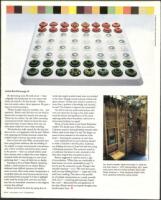

HADAS KRUK AND ANAT STEIN, STU DIO ARMADILLO.
flo
Artists Revel from page 18
P20 •
DECEMBER 2009 •
JN platinum
works that simply mocked rituals were not included
in the show. Though several works do criticize reli-
gious customs. "If they were critical, I wanted it to
come from a position of knowledge and sincerity,"
he said. "It's criticism to improve the community."
Nor did he rule out works made by Jews who
were non-observant. So long as the artist under-
stood the history and significance of the ritual,
exploring within those boundaries could serve to
democratize Judaism, he argued.
Plenty of works dwell on the Israeli-Palestinian
conflict. The Israeli team of Elan Leor and Eran
Lederman created a sleek gold-plated mezuzah, titled
Gideon, made in the shape of a nail. The design was
meant to focus attention on the actual act of the
ritual — fastening the ornament on one's door.
Leor explained how he and Lederman decided
to make a mezuzah in the first place. Lederman
was building his home in Israel and had been using
a Palestinian contractor. The contractor stood by
as Lederman was about to nail a mezuzah on his
door, then stopped him and asked to join in.
Belasco suggested it could be read as a sign
of reconciliation. "When Jews are comfortable in
their homes, we can be comfortable in ours," is
how he put the contractor's words. Though a less
amicable meaning — as in, "We won't have peace
until you stop building homes" — might also work
with Leor's retelling. That there is the possibil-
ity of multiple interpretations to a small, powerful
work of art — a beaming gold mezuzah, shaped
like a nail — illuminated the real significance of
the show. Rituals should not impede thoughts; they
should inspire them.
■
O
COURTESY OF RONALD FELDMAN FINE ARTS,
By showcasing some 60 works of art — from
a digitally wired phylactery set to an apron with
tzitzis, all created in the last decade — Belasco
does not merely make a clever argument. He goes a
long way toward proving it.
"People thought ritual was mindless, rote ... just
repetition," Belasco said. But that was not what he
found when he began his research two years ago.
"Ritual can be creative," he said. After canvassing
contemporary Jewish Culture, he found the seem-
ingly banal topic of ritual objects (how sexy can
seder plates really be?) more richly rewarding.
"Postmodernism really opened the idea that that
there can be a re-engagement with the past," Belasco
said, explaining the broader historical context that
enabled rituals to become ripe artistic territory.
Since at least the mid-1990s, communities have
been using Jewish traditions, like the building of
the sukkah, to inspire environmental conscientious-
ness. A bevy of artistic material has been created
in the process — laser-cut matzah holders made
from stainless steel; a sukkah that meets religious
standards while also functioning as a year-round
gardening shed — many of which are on display.
Standing in front of Allan Wexler's Gardening
Sukkah, a small wooden but on wheels, Belasco
addressed some difficult questions his exhibit
seems to invite. How much artistic interpretation is
acceptable before the ritual becomes devoid of any
particularly Jewish meaning? Is it fair to highlight
works made by secular Jews, and even non-Jews,
who have no immediate connection to the religious
customs they address?
Belasco answered the latter by saying that art-
Top: Studio Armadillo: Hadas Kruk (Israeli, b. 1970) and
Anat Stein (Israeli, b. 1972), Hevruta-Mituta, 2007, plastic
chess board, thirty-two knitted skullcaps. Above: Allan
Wexler (American, b. 1949), Gardening Sukkah, 2000,
wood, gardening implements, eating utensils.