

Great Reviews
Birthright Israel funders look to upbeat study to boost fundraising.
Jacob Berkman
Jewish Telegraphic Agency
New York
B
irthright Israel is hinging a
major fundraising push on a
new study that says the pro-
gram, which sends young Jews on free
10-day trips to Israel, has a major impact
on Jewish continuity.
The study, released Oct. 26 by Brandeis
University's Cohen Center for Modern
Jewish Studies, found that those who
participated on Birthright trips are more
likely to have stronger connections to
Israel, raise their children as Jews and
belong to a synagogue than their peers
who have not made a Birthright trip.
Titled "Generation Birthright Israel:
The Impact of an Israel Experience on
Jewish Identity and Choices:' the study
is based on interviews with some 1,200
young people who applied for Birthright
trips between 2001 and 2004 — two-
thirds of whom went on the trips. The
applications of the others were denied.
The survey compared the answers of the
two groups.
Of the 500 or so interviewed who are
now married, 72 percent who made the
trip married Jews, while 46 percent of
those who did not married Jews. This
means that Birthright participants were
57 percent more likely to marry within
the faith, according to Len Saxe, the head
of the Cohen Center and the researcher
who oversaw the survey.
When the study's results were pre-
sented last week, the head of the Boston
federation hailed Birthright as the only
successful recent big idea in the Jewish
community.
"People are looking for the next big
thing; we ain't finding no other big thing
at this level:' said Barry Shrage, the CEO
of the Combined Jewish Philanthropies
of Boston.
North American Jewish federations are
partners in Birthright with the Israeli
government and the private philan-
thropists who fund the majority of the
project.
One requisite for launching the pro-
gram in 1999 was that it incorporate rig-
orous controls to gauge if it was working;
the study is part of that effort.
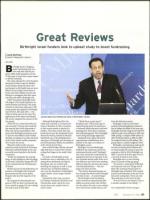
Leonard Saxe led a briefing last week on Birthright's results.
Although Birthright paid for the
study, Saxe said that as a tenured pro-
fessor at Brandeis, he felt no pressure
to find certain results to placate his
funders. The Cohen Center that Saxe
heads also houses the Steinhardt Social
Research Institute, funded by Michael
Steinhardt, one of the philanthropists
who gives to Birthright and chairman of
Jewish Renaissance Media, the publisher
of the Detroit Jewish News.
Saxe and Birthright officials acknowl-
edge that there is a great deal of fund-
raising that hinges on his study's find-
ings.
A number of Birthright's private
benefactors were in attendance Oct. 25,
among them Steinhardt and Charles
Bronfman, who are credited with
founding the program, as well as Lynn
Schusterman and Michael Bohnen,
who runs the foundation of Birthright's
largest funder, casino mogul Sheldon
Adelson.
Immediately after Saxe presented
his findings, Steinhardt, Bronfman and
Schusterman made a pitch for more
money from more people based on
Saxe's results.
"I think this is a great report:'
Bronfman said. "Thirty years ago we
started hearing about the importance
of informal Jewish education, and noth-
ing happened. Then about continuity,
and nothing happened. Then Birthright
comes along and change happened."
Steinhardt took a dig at the Jewish
organizational establishment as he
pointed to the report as evidence of
Birthright's success.
Birthright "was overwhelmingly
disliked by the midstream and by the
institutional Jewish world:' Steinhardt
said. "Jews around the world should be
appalled by the level of education in the
non-Orthodox Jewish world. It has to be
very different, and I don't hear anything
different today. You ask about the impact
of Jewish philanthropy — well, the
impact has been gornisht.
"This study is important because we
have changed the Jewish world. Birthright
and what we did — it created change."
The Birthright Israel Foundation,
which oversees the approximately $80
million in private money that will flow
into the project this year, is now seeking
more money from smaller donors, and
from the federation system.
Birthright is still one of the best-
funded Jewish philanthropic endeavors,
but its budget has fallen in the past year.
Birthright received a huge boost with $70
million in gifts from Adelson in 2007 and
2008, giving it a budget of $80 million in
2007 and $100 million in 2008. In 2009,
the budget fell back to $80 million. The
group expects a similar budget for 2010.
Birthright is attempting to make up for
the drop in funding from Adelson and
to bring enough new money to grow the
program so that by 2016, Birthright can
offer 51 percent of all Jews aged 18 to 26
a free trip to Israel at some point.
Birthright says it is now reaching
about 25 percent of that age group.
"Our job No.1 is don't leave 20,000 kids
on the ground each year," Shrage said of
those who cannot go because spots on
Birthright trips are limited. "How can fed-
erations look themselves in the eye? These
kids aren't coming back. This is our shot.
This study gives us the tool to do that.
"If we act now, we are blessed. If not, it
is another example of our failing." H
See a related Editor's Letter on page 5.
114
November 12 • 2009
21