

Recessionista
Fashionistas
Second-hand is first choice for chic shoppers.
WRITTEN BY GABRIELLA BURMAN I PHOTOGRAPHS BY ANGIE BAAN
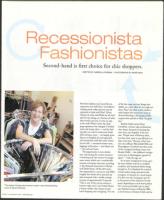
"The stigma of buying second-hand is gone," says Wendy Birnberg,
owner of Second Showing.
P 1 0 •
NOVEMBER 2009 • JN
platinum
Recession fashion may sound like an
oxymoron, but walk into a secondhand
clothing store today, .and you may be
surprised at what you'll find. Tahari,
Theory, St. John and Prada are all avail-
able for the taking, at a fraction of what
they would cost new, or even on sale,
at the mall. What's more, the shop-
ping experience has changed. Crowded
racks and musty odors — and the feel-
ing that you need to wash your hands
after leaving a store — are largely gone.
Spaces are brightly lit and organized,
and manned by staff who know what's
hot for fall — oversized sweater vests,
leggings and booties — and what's not
— fur and rain boots.
The opportunity to turn clothes
into cash during the current recession
is factoring into the success of consign-
ment stores, which saw a considerable
increase in business this year, according
to the National Association of Resale
and Thrift Stores. Of the 263 stores
that responded to a survey in mid-2009,
roughly two-thirds (64.1 percent) say
sales increased with a sizable average
increase of approximately 31 percent.
"This is one of the success stories in
business right now," says Vickie Panter,
a former retailer who enjoys second-
hand shopping and consigning. "It's one
of the few ways you turn things into
dollars, at a time when it's so tough out
there. Plus," she adds as she cinches a
wide leather belt around her waist at
Second Showing, a Farmington Hills
outpost that opened in May, "it's great
fun."
Restyle Child owner Diane
Crawford, a former sales professional
who always dreamed of opening her
own store, says frugality is the new
chic. "People want a Burberry dress,
but they don't want to pay full price, so
they come here." Because of her loca-
tion near affluent Bloomfield Hills and
Birmingham, Crawford says that much
of the consigned clothing comes into
Restyle Child — the children's consign-
ment store in Birmingham opened in
April — "with the tags on."
As at most consignment stores, gen-
tly worn clothes must be in excellent
condition and laundered before being
brought in. It is displayed for a period
of time before being returned to the
consignor or donated to a local charity
if it does not sell. Consignors get 40
to 50 percent of the sale price of sold
items, depending on each store's policy.
"It's a more personable way to shop,"
says Heather Larson of Beverly Hills,
as she browses at Restyle Child and her