

I
I World
Journalist's
Perspective
Moving Federations
Toward Change
JTA bureau chief describes tight
U.S.-Israel bond.
Can new leader revamp the system?
Jacob Berkman
Jewish Telegraphic Agency
New York
erry Silverman, who took over the
helm of the UJC/Jewish Federations
of North America about a month
ago, sat down to talk about his task of helping
the federation system begin to evolve.
A first step: United Jewish Communities
(UJC) has just changed its name to the Jewish
Federations of North America (JFNA).
Jerry Silverman
to the very beginning of the system.
How are the federations' campaigns doing,
and how are the smaller federations
doing? That is where the real concern was
last November as the recession began.
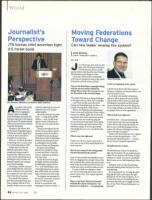
Ron Kampeas addresses his Shaarey Zedek audience.
A
n audience that nearly
filled the adult cha-
pel at Congregation
Shaarey Zedek in Southfield
heard Washington journalist Ron
Kampeas expound on the relation-
ship between U.S. President Barak
Obama and Israeli Prime Minister
Benjamin Netanyahu.
Kampeas is the bureau chief
for the Jewish Telegraphic Agency
(JTA) in the nation's capital. Prior
to that, he was a journalist in
Jerusalem for several years.
At his Oct 15 talk, he described
a mixed bag when it comes to the
U.S.-Israel relationship in 2009.
Despite some tensions, the
bilateral relationship is deep
enough and strong enough to
transcend the differences extant
in the current administrations in
Washington and Jerusalem and,
Kampeas stated, is the strongest
since Israel's founding.
Presenting a contrast, Kampeas
acknowledged that the settlement
issue is contentious, but noted that
the countries are very dose on the
issue of the threat from Iran.
He reminded the audience
that Obama brought Britain and
France together with the U.S. to
strongly condemn Iran in a public
24
October 22 • 2009
statement following the acknowl-
edgement of a secret Iranian
nuclear facility.
He said the previous two presi-
dents — George Bush and Bill
Clinton — were actually more
against Israel's settlement poli-
cies, but were less public in their
opposition.
Kampeas downplayed the dif-
ficulties of personalities, dismiss-
ing rumors about the ill effects
on Middle East peacemaking of
White House Chief of Staff Rahm
Emanuel, and stating that there
is unfamiliarity but no dislike
between Obama and Netanyahu.
Kampeas acknowledged
Obama's low popularity rating
in Israel and joined a chorus of
voices in urging the president to
visit Israel soon.
He also declared that, despite
the highly partisan atmosphere
in Washington, support for the
U.S. – Israel relationship is over-
whelmingly bipartisan in nature
and, unlike health care and other
issues, remains noncontroversial.
The program was presented by
the Jewish Community Relations
Council of Metropolitan
Detroit in cooperation with
Congregation Shaarey Zedek.
JN
The smaller federations are being challenged
as the larger ones are, where their campaigns
— and I won't say this across the board
because you hear bright spots out there — are
actually running flat or a little ahead ...
There is new thinking and programming.
There is new work being done trying to figure
out how we stabilize, given that we are in an
uncommon time and an uncommon period.
There is even new creativity going into
the way funds are being raised. We are going
to major investors and major donors to the
federation, saying, "If you can, give double
your pledge this year so we can still drive the
servicee
What is your role right now?
I believe our role is to add as much value in
every way we can to the Jewish federations of
North America.
How do you connect to the young people
who feel alienated by the system?
Some of those portals may already be there.
We're not digging deep enough to know that
they are already there, and we just need to make
them wider and understand where they are.
And in some cases, we need to create new ones.
It means a whole new dialogue, a whole
new way of connecting and in some cases, it
means a grass-roots, more organic approach
to connecting.
That is a way that I think a lot of people
wish that the system worked, but a way
that it never really has — even going back
It doesn't mean that it can't. These types of
things are evolutions, not closed societies or in
any way locked in a box.
As we listen very intently to federations,
and as we talk to more and more lay leader-
ship and talk to JDC [American Jewish Joint
Distribution Committee] and JAFI [Jewish
Agency for Israel], there are some things that
we are really starting to get clarity on that we
are going to focus on as an organization.
What is your focus right now?
My belief is that ... first and foremost has
to earn respect and earn trust through the
actions that we take. Across the system, we
have to earn it. And that is going to be our
mantra. We will earn it through our actions
and not through our speech.
I believe that if and when we start to deliver
action, we have the opportunity — ((we))
meaning the federation system — of being
the pre-eminent nonprofit organization.
The infrastructure is there.
The infrastructure is there. We should be a
light unto the nations. We are steeped in great
values. We are steeped in the beauty of Torah,
and that as a vision can carry us, specifically
the five areas we are really beginning to hone
in on.
We believe in the concept of positioning
and really thinking about the future in terms
of positioning.
Are we positioned? Are we using the right
language, the right conversation, the right
dialogue? Is our tent wide enough? In 10, 15,
20 years from now, are we handing this to a
generation that will want to engage and own
this and say, "Wow This generation gave us a
diamond."