

World
Politics By Bulldozer
Demolitions are at center of battle over Jerusalem.
Dina Kraft
Jewish Telegraphic Agency
Jerusalem
D
eep in a valley below Jerusalem's
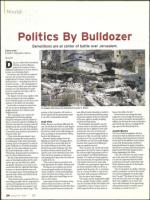
Old City, a narrow alleyway
leads to the remains of three
bulldozed Arab homes in an area slated to
become an archeological park.
The homes, now just slabs of collapsed
concrete, are in the eastern Jerusalem
neighborhood of Silwan. Despite interna-
tional protests — including from the U.S.
secretary of state — the remaining 85 or
so houses there, which were built without
permits, are to be demolished to make
room for a park the city hopes will be a
major draw for tourists.
The dispute over the area, together with
recent evictions in the Arab neighbor-
hood of Sheikh Jarrah, are the most recent
markers in the battle over Jerusalem.
Israel seeks to cement its control over
the city in part by altering the demo-
graphic character of its eastern, Arab
neighborhoods.
"Our sovereignty over it cannot be
challenged:' Israeli Prime Minister
Benjamin Netanyahu told his Cabinet in
July, in comments aimed at rebuffing U.S.
criticism over plans for turning a hotel in
Sheikh Jarrah into a Jewish housing proj-
ect. "This means, inter alia, that residents
of Jerusalem may purchase apartments in
all parts of the city."
Critics claim the government is pur-
posefully boosting the Jewish presence
in traditionally Arab eastern Jerusalem,
creating "facts on the ground" in order to
make it difficult to ever divide Jerusalem
as part of a two-state solution to resolve
the Israeli-Palestinian conflict. The
Palestinians demand eastern Jerusalem as
part of a future Palestinian state.
But the Israeli government insists that a
series of development plans for the city's
eastern part are not driven by a politi-
cal agenda. The plans, in an area in and
around the Old City called the Holy Basin
because it is dotted with holy sites, call
for more green space, better parking and
repaved roads. Silwan and Sheikh Jarrah
are both in that area.
"Government policy is governed by one
overriding principle: that it is important to
continue developing the city for the ben-
efit of all inhabitants of Jerusalem," said
Netanyahu spokesman Mark Regev. "The
24
October 15 • 2009
3N
An illegally built house was demolished recently in Silwan.
position is that Jerusalem will remain a
united capital and the government wants
to see all its communities flourish:'
Arab View
Maher Hanoun sees things differently. He
was evicted from his home in early August
after the Israeli Supreme Court ruled that
the land on which it was built belonged to
Jews, according to documentation dating
back to the Ottoman era.
Hanoun's family, refugees from the
fighting in Israel's War of Independence
in 1948, lived in a house built there by
the United Nations in the 1950s, when
the land was under Jordanian rule. Now
homeless, Hanoun and his family have
opted to stay on the sidewalk across from
their old house, sleeping on mattresses
and passing their days under the shade of
a small olive tree.
"They want to destroy our homes and
build apartments for settlers; Hanoun said.
The house's new residents are Jewish.
An armed guard watches the front gate,
which is locked. A small Israeli flag flaps
in the wind from the rooftop. Across an
adjacent valley, more Israeli flags are vis-
ible on other homes.
Israel captured eastern Jerusalem, along
with the entire area known as the West
Bank, in 1967 during the Six-Day War. When
Israel later annexed eastern Jerusalem, the
state offered Israeli citizenship to Arabs liv-
ing there. Most refused, instead becoming
permanent residents of the city with some
of the same rights as Israelis, including
Social Security payments.
The Jerusalem municipality says all
eviction orders in Jerusalem are lawful,
and that the law is applied to both Arab
and Jew. But critics say evictions and
demolitions are pursued aggressively in
Arab parts of the city and only rarely in
Jewish parts of the city, and that Arab
Jerusalemites are forced to build illegally
because their requests for building per-
mits are regularly rejected.
"This is a proxy war carried out by the
government of Israel by means of agents:
the extreme right-wing groups active in
east Jerusalem:' said Daniel Seidemann,
founder of Ir Amim, an Israeli organiza-
tion that advocates the equitable sharing
of Jerusalem between Jews and Arabs.
"Virtually every government organ, from
the Prime Minister's Office on down, is
involved and the goal is, No. 1, territorial.
This is a conscious effort to ring the his-
toric basin with messianic settlements:'
The city rejects such charges.
"The mayor and the municipality apply
the law equally," Stephen Miller, a spokes-
man for Jerusalem Mayor Nir Barkat, said
of demolition orders. "Anyone is free to
build, expand and live as they desire as
long as they follow the law."
American Jews are among the main
supporters of increasing the Jewish pres-
ence in eastern Jerusalem, donating $25.4
million over the past five years to purchase
and build homes there, according IRS fil-
ings reported by Bloomberg News.
Jewish Buyers
The City of David Foundation, which in
recent years built an elaborate visitor's cen-
ter in Silwan where King David is believed
to have laid the foundations for Jerusalem,
is one of the Jewish groups involved in
buying Arab homes in eastern Jerusalem.
Known by its acronym, Elad, the group has
helped settle 500 Jewish Israelis in those
homes beginning in the 1990s.
"The City of David is not only a muse-
um, in the sense that one feels the past;
it is also the expression that the Jewish
people have returned to their land:' said
Doron Spielman, director of the founda-
tion's overseas division.
"One of our goals is to enable a thriving
Jewish community to exist in the ancient
City of David alongside our Arab neigh-
bors," he said. "The desire of Jews to buy
land and live in the area is so high, and
their Arab neighbors are at times will-
ing to take advantage of the opportunity
and purchase homes in another area of
Jerusalem or outside the city."