

'f
1 Health & Fitness
RESEARCH
Hope For ALS
U-M neurologist's research leads to first clinical trial
of stem cell treatment for Lou Gehrig's disease.
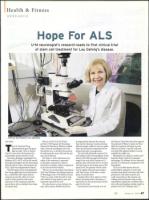
U-M's Dr. Eva Feldman in her laboratory
Ann Arbor
T
he U.S. Food and Drug
Administration gave the green
light on Sept. 18 for a clinical
trial of a new stem cell treatment for
amyotrophic lateral sclerosis (ALS).
University Michigan neurologist Eva
Feldman, M.D., Ph.D., will be the overall
principal investigator for the first human
clinical trial of a stem cell treatment for
ALS, a fatal neurodegenerative disease.
The FDA approved an Investigational
New Drug application from Neuralstem,
Inc., a Rockville, Md.-based biotech
company, to test the safety of a treat-
ment in which patients will receive
injections of the company's patented
neural stem cells at multiple sites along
the spinal cord.
Director of the U-M ALS Clinic
and the U-M Program for Neurology
Reserach & Discovery, Feldman worked
with a team of neurologists and with
Neuralstem Inc. to develop the protocol
for delivering the stem cells into the spi-
nal cord of patients.
The Phase 1 trial to determine the
safety of the treatment is expected
to take place exclusively at Emory
University in Atlanta, subject to approval
by its Internal Review Board.
"We are very excited about this clinical
trial;' said Feldman, the DeJong Professor
of Neurology at the U-M Medical School.
"This is a major stride forward in what
still could be a long road to a new and
improved treatment for ALS:'
ALS, also known as Lou Gehrig's dis-
ease, affects about 30,000 Americans.
It progressively destroys the neurons
that control voluntary muscles, leaving
affected people unable to move or speak.
There are no known treatments for the
disease that slow its progression.
The trial will ultimately consist of 18
ALS patients with varying degrees of the
disease. The FDA has approved the first
stage of the trial, which consists of 12
patients who will receive five to 10 stem
cell injections in the lumbar area of the
spinal cord. The patients will be exam-
ined at regular intervals post-surgery,
with final review of the data to come
about 24 months later.
Jonathan Glass, M.D., director of the
Emory Neuromuscular Laboratory, is
expected to be the site principal investi-
gator for the trial.
Institutional review boards at U-M
and Emory University must first approve
the protocol. If Phase I results are favor-
able, the treatment will need to prove
effective in Phase II and III trials and
win final FDA approval before it can be
available for public use.
Neuralstem, Inc. plans to conduct and
fund the Phase I trial of its patented
technology. Dr. Feldman has no financial
interest in or financial arrangement with
Neuralstem.
"ALS is a terrible disease that ulti-
mately kills by paralysis. In work with
animals, these spinal cord stem cells both
protected at-risk motor neurons and
made connections to the neurons con-
trolling muscles. We don't want to raise
expectations unduly, but we believe these
stem cells could produce similar results in
patients with ALS," Feldman said.
October 8 2009
47