

Spirituality
The Family Sukkah
Martha and Ross
Goldberg and their
children love
spending time
in their sukkah.
Sukkot
The Festival of Booths
does more than just
celebrate the harvest.
4
The Holiday: Sukkot.
Why We Celebrate: A divine man-
date, as expressed in the Torah:
Leviticus 23:33-43, Numbers 29:12-
38, Deuteronomy 16:13-15.
Elizabeth Applebaum
Special to the Jewish News
Name of the Holiday: In Hebrew,
sukkot means "booths" or "huts"
(sukkah is the singular form).
In English, the holiday is called
"Booths" or "Tabernadec
••cli I% occurs: The first day
of Sukkot is the 15th of Tishrei,
which this year begins at sundown,
Friday, Oct. 2. The holiday lasts for
eight days, but nine days outside of
Israel. For us, that is until Sunday
evening, Oct. 11.
I
t took a few years for Ross and
Martha Goldberg's sukkah to find
its true identity. There were the
quiet, lonely days as a kit, waiting to be
purchased and brought to a good home;
the hippie phase, with the cool sides that
flapped about a bit too much; and the lean--
years beforp ,i,:i..k.,„Laiions.
Now, at last, the sukkah has found
itself: a happy-and-bright place for the
entire family, a place of much happiness, a
home-away-from-home where neighbors
like to come and visit, maybe sit on a bale
of hay and have a cup of coffee.
Last year, the Goldbergs and their
children Noah, 7, Maya, 5 and 3-year-
old Abigail moved from Ohio to West
Bloomfield. With them came their sukkah,
purchased as a kit from the men's club at
their synagogue.
Ross is an engineer, so putting the suk-
kah together wasn't the memorable —
and not in a good way — experience it
might have been for the average person.
"It came with some 2x4s that were pre-
drilled and brackets to hold it together:'
he says casually.
That first year, the couple decided to
make bed sheets that Martha had tie-
dyed for the sukkah's sides. "They were
decorative and earthy, a bit hippie-look-
ing," Ross says.
Nearby was a construction site: a
large, open area where the wind whipped
through. The sheets flapped about end-
lessly."It was kind of hard to have a meal
there:' Ross says.
So the Goldbergs bought some lattice
and constructed more solid sides. And
they brought in a few bales of hay and
made a roof of cornstalks.
But what is a sukkah without children's
art?
Each year, the Goldbergs fill their suk-
kah with drawings and paintings and
18
October 1 • 2009
Elizabeth Applebaum
Special to the Jewish News
What It Celebrates: Sukkot recalls
the temporary shelters that the
Israelites used after the exodus
from Egypt and their sojourn
through the wilderness on their
way to the Land of Israel. Some
Torah scholars interpret sukkot to
mean protective, divine clouds that
enveloped the Jewish people on
their journey.
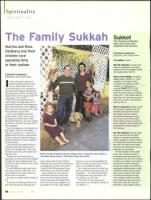
Martha and Ross Goldberg with their children, Noah, 7, Maya (top with stripes), 5,
and Abigail (purple dress), 3, With them is their dog, Charlie.
paper chains made by their children.
Noah and Maya attend Keith Elementary,
and Abigail is a student at the Sarah &
Irving Pitt Child Development Center.
Both schools are in West Bloomfield.
Ross and Martha, who works for
the Women's Division of the Jewish
Federation of Metropolitan Detroit,
love the wide, open area behind their
home. No fences mean neighbors can
get together for Friday-night Shabbat
potlucks or can meet during Sukkot for
dessert. Or they can meet for just conver-
sation in the Goldbergs' sukkah.
Yes, it takes time to get the sukkah up,
place the children's drawings inside and
hang lights — the Goldbergs like theirs
in pomegranate and grape shapes. But
it's a pleasure, too, Ross says.
"We do this," he says, "because it's
important for us to instill the tradition in
our children." fl
How We Celebrate: Strictly speak-
ing, we must live for the entire
holiday in a temporary dwelling
called a sukkah. A sukkah consists
of at least three walls and a perme-
able roof. The walls can be made
of almost any material and can be
temporary or permanent.
The key feature of the sukkah
is the roof. It must be made of
harvested plant material not still
connected to the soil. This is known
in Hebrew as s'chach. The material
can be dried or fresh. Examples
include corn stalks, tree branches,
evergreens, bamboo poles or slats,
unfinished wooden furring strips,
vines, grass or leaves. The mate-
rial must be laid across the top
of the sukkah so that it provides
more shade than light, but not so
thick that a hard rain could not
penetrate it. One rabbinic opinion