

World
•
Tug Of War
Alastair Gee
Jewish Telegraphic Agency
Moscow
I
t was late 1939, and Rabbi Joseph
Isaac Schneersohn was stranded in
war-torn Poland.
Germany had invaded. Warsaw was
being bombed. There seemed little hope
for Schneersohn, the venerated sixth lead-
er of the Chabad-Lubavitch movement, or
his family and followers.
Nor, too, for his valuable collection
of historical and religious documents:
lectures on Torah portions, treatises on
Jewish practices, manuscripts and copies
of correspondence, including recollections
of how Lubavitch had provided Russian
soldiers with kosher-for-Passover food.
Schneersohn, the father-in-law of
the seventh and last Lubavitcher rebbe,
Menachem Mendel Schneerson, eventually
would escape to New York after an unusual
back-and-forth between German officials,
the U.S. State Department and Jewish lead-
ers. But the collection was left behind; it fell
into German and, later, Soviet hands.
Now these documents, and another set
that was lost at the time of the Russian
Revolution, are the subject of a U.S. lawsuit.
To recover them, Lubavitch is pursu-
ing a case against Russia, which inherited
the collection after the collapse of the
Soviet Union. Lawyers for Lubavitch say
that Russians have offered some items for
sale on the black market. Russia told the
Washington court handling the case that it
has no jurisdiction in the matter.
The documents "are much more than
just intellectual property:' said Eliezer
Zaklikovslcy, who co-authored a history of
Schneersohn's escape from Europe. "They
have great spiritual significance for the
movement as well. They're like a soul, you
might say, to the books and manuscripts,
and it's in exile
Officials at the Russian State Military
Archive in Moscow, where the documents
left in Poland are stored, say they aren't
very attached to them but that a lawsuit is
the wrong way to determine ownership.
Russian archives hold a treasure trove
of materials that the Red Army seized as
it battled through Eastern Europe and
conquered Berlin. They range from Reich
Chancellery and Gestapo documents to
Auschwitz construction records.
The Soviets plundered records that the
34 September 24 • 2009
Photo cour tesy C ha be d.org
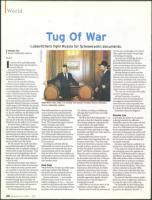
Lubavitchers fight Russia for Schneersohn documents.
Rabbi Berel Lazar, right, in a meeting with Russian President Dmitry Medvedev,
favors a diplomatic solution.
Nazis had looted from occupied nations,
such as archives from destroyed Jewish
communities. Some have been returned,
including records from the French Ministry
of War and the British Expeditionary
Forces. The Schneersohn papers, however,
remain in Russian state hands.
Schneersohn was born in Lyubavichi,
Russia, the home of the Lubavitch move-
ment. After the Russian Revolution in
1917, Schneersohn defied persecution by
the atheistic Communist government to
continue his outreach work, and in 1927
he was arrested.
According to Lubavitch officials,
Schneersohn was sentenced to death but
his sentence was commuted after inter-
national protests, and he was expelled
from the Soviet Union. Some scholars say
Schneersohn was never sentenced to death
and that he decided to leave on his own to
avoid another arrest.
Nazi Help
When World War II broke out, Schneersohn
was living in Poland. What followed,
researchers say, was an atypical interven-
tion by the Germans that saved his life.
German authorities — most notably
Wilhelm Canaris, head of the German
military intelligence service — were per-
suaded to help Schneersohn leave Warsaw
after a flurry of letters and telegrams from
and phone calls with Jewish leaders and
U.S. officials, according to Zaklikovsky,
although their motives have never fully
been explained.
First they had to find Schneersohn — no
easy task, as local Jews feared the invaders.
The Germans deployed a half-Jewish offi-
cer, Ernst Bloch, who spoke Yiddish.
After negotiations, Schneersohn was
evacuated to Berlin, and then on to Riga,
Stockholm, and finally New York, where he
arrived in early 1940.
Schneersohn's documents were left
behind. Rather than destroying them, the
Germans stored them. "They were inter-
ested in Jewish archives, masonic archives,
socialist archives, certain key archives
of what they labeled 'enemies of the
Reich:" said Patricia Grimsted, a Harvard
University expert on Russian archives.
The Soviet army eventually captured
the documents and took them to Moscow.
Some books and manuscripts were left
in Poland. With the help of the U.S. State
Department and an introduction by
businessman Edward Piszek, the Polish
authorities returned six crates of mate-
rial to Lubavitch in 1977, said Abraham
Shemtov, currently head of the Lubavitch
umbrella organization Agudas Chasidei
Chabad and one of the key figures in
arranging the transfer.
Legal efforts to secure the return of the
documents in Russia began in 2004.
Shemtov said he could not comment on
why the case was brought in the United
States rather than Russia because legal
proceedings are ongoing.
Since the case was brought, the direc-
tor of the Russian archive, Vladimir
Kuzelenkov, has locked away the docu-
ments as a precaution, and researchers have
not had access to them. Recently, however,
Kuzelenkov granted access to JTA.
Walking through the sterile corridors
of the Russian State Military Archive to a
shadowy room where thousands of boxes
sit on shelves, Kuzelenkov took a brown box
and opened it to reveal a handful of folders.
Inside were yellowing sheaves of typewrit-
ten Hebrew texts and official documents in
elegant German and Russian script.
"You can't say we look after them badly,
can you?" Kuzelenkov said.
Marshall Grossman, a lawyer for
Lubavitch, said an international police
investigation was launched after docu-
ments from the archive reportedly were
put up for sale on the black market, most-
ly in Israel. He declined to provide details.
Kuzelenkov denies the allegation.
Russian Law
In principle, the archive is not opposed
to giving Lubavitch the collection,
Kuzelenkov said. But the archive will only
consider claims made according to the
terms of a 1998 Russian law that provides
for the nationalization and occasional
restitution of documents; the archive will
not respond to a U.S. lawsuit. Another key
element, he said, would be compensation
for the money the archive has spent pre-
serving the materials.
Grossman said Russia is unlikely to be
receptive to a claim based on the 1998 law.
In the same suit, Lubavitch lawyers also
are seeking the return of a separate col-
lection of 12,000 books held in a Moscow
state library. According to Lubavitch, the
fifth rebbe, Sholom Dovber Schneersohn,
had stored them in a Moscow warehouse
and they were seized by the Bolsheviks
after the Russian Revolution. Their status
was first contested in the early 1990s,
when a Soviet court ruled that they were
the property of Lubavitch. But a later deci-
sion nullified the ruling.
The head of Lubavitch in Russia, Rabbi
Berel Lazar, favors a diplomatic solution to
securing the return of the collections.
"We personally feel that finding diplo-
matic avenues is probably more efficient
to convince the Russians:' he said. fl