

.arlith11.1.11
Special Report
INSPIRED RESEARCH
Ten Years Of Hope from page 11
Doreen Hermelin:
Searching For A Cure
"The driving force for the Hermelin
Brain Tumor Center for my husband
and me was, if the doctors couldn't
find something soon enough to cure
him, we wanted to help others in
the future. Although David knew the
prognosis for brain cancer patients,
he maintained a positive mental atti-
tude. It's about giving hope to other
people.
"We had confidence in Mark
Rosenblum and the research center
that something good would come
from our involvement. He told David
and me about the research being
done and we were hopeful that
something would come along that
would be a
cure. I feel
that it's most
important for
patients to
participate
in the latest
research and
clinical trials
to make the
most progress.
Mark remains
hopeful that
Doreen Hermelin's
brain cancer
tribute message
can become a
chronic, manageable disease.
"When a person who is known in
the community goes public with his
or her disease, people react and
often this means contributions to
research. Funding for the Hermelin
Brain Tumor Center allowed for addi-
tional researchers to be hired and
their important work to continue. I
am very grateful to those whose con-
tributions have made such a positive
impact on the work being done.
"I have received so many cards
and letters from people saying
'thank you for giving us hope that
we didn't have before.' I receive calls
from many parts of the country from
people diagnosed with brain cancer,
which I refer to the center.
"The staff at the Hermelin Brain
Tumor Center gives such compas-
sionate care to each patient. That's
part of what makes it a very special
place.
"It's my prayer that this research
comes to fruition. We're still 'shoot-
ing for a cure."'
Doreen Hermelin is a Bingham Farms
resident.
12
September 24 • 2009
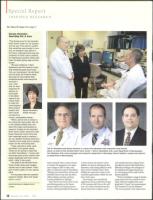
Top: Dr. Rosenblum and Doreen Hermelin in a Henry Ford laboratory with researcher Chad Schultz.
Above: co-chairs of the Hermelin Brain Tumor Center — Mark L. Rosenblum, M.D., chair, Department of Neurosurgery;
Tom Mikkelsen, M.D., neuro-oncologist and researcher, Department of Neurology; Steven Kalkanis, surgeon and research-
er, Department of Neurosurgery
ways to identify when a tumor returns
or whether the appearance of a suspi-
cious change on MRI is only a side
effect of treatment," says Dr. Rosenblum.
"Taking it one step further, we have also
identified ways to stop this side effect,
called radiation necrosis, and have
recently published our findings."
Henry Ford is one of the top U.S. sites
contributing patients to the Cancer
Genome Atlas at the National Cancer
Institute. Having identified all the genes
in brain tumors, the tumors' vulner-
abilities can now be understood. New
laboratory staff is being added to study
these tumors' Achilles' heels:' These
findings are expected to result in new
treatment opportunities within the next
three to five years.
Gene therapy uses scientifically
engineered viruses, made from strains
of the common cold virus or the cold
sore virus. When introduced into the
human body, they recognize cancer
cells and destroy them, without harm-
ing adjacent normal cells. Preliminary
laboratory findings with colleagues in
the Radiation Oncology Department
are encouraging, with a novel trial for
patients planned.
"We have developed a range of studies
using tissues from our extensive tumor
bank, which has samples from cases
going back 15 years," says neurosurgeon
and researcher Dr. Steven Kalkanis.
"We can now predict what makes some