

1
----......... ...ammaswiaway1100116111111111.
!World
Seeking Support
Getting a yes on Iran Advocacy Day.
Eric Fingerhut
Jewish Telegraphic Agency
Washington
M
ore than 300 Jewish communal
leaders came to the nation's
capital last week to push for
increased pressure on Iran — and they
were pleased by what they heard.
The chairman of the House Foreign
Affairs Committee said he would move
on Iran sanctions legislation next month
"absent some compelling evidence why I
should do otherwise"
Speaking Sept. 10 at the National Jewish
Leadership Advocacy Day on Iran in
Washington, U.S. Rep. Howard Berman,
D-Calif., said he will mark up the Iran
Refined Petroleum Sanctions Act and
"begin the process of tightening the
screws on Tehran" if Iran "does not reverse
course:'
The legislation would allow the sanc-
tioning of companies that help Iran
import or produce refined petroleum,
which is seen as potentially having a large
impact on Iran's economy because the
country imports 40 percent of its refined
oil products.
Berman said the clock has "almost run
out" on Iran.
"If the Iranians are going to engage in a
meaningful and significant way that will
spell the end of their nuclear enrichment
program, we'll open a new chapter with
them:' Berman said.
The Obama administration has signaled
that it will reconsider its efforts to engage
Iran on its pursuit of nuclear weapons if
no progress has been made by the end of
September.
In addition to Berman, Jewish commu-
nity leaders heard House Majority Leader
Steny Hoyer, D-Md., and House Minority
John Boehner, R-Ohio, both say they were
ready to proceed with sanctions legislation
as well. Hoyer said he told Berman that
"once you move it, my intention is to bring
it to the floor shortly thereaftet"
Jewish Power
If anyone had any doubts about how
important the Iran issue is to the leader-
ship of the mainstream American Jewish
community, the powerful lineup at the
Sept. 10 panel discussion during advocacy
day should have erased them.
58
September 17 6 2009
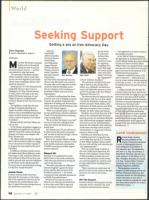
American
Israel Public
Affairs Committee
Executive Director
Howard Kohr,
Anti-Defamation
League National
Director Abraham
Foxman, American
Jewish Committee
Executive Director Rep. Berman
David Harris
and B'nai B'rith International Executive
Director Dan Mariaschin were seated at
the same table on the stage next to panel
moderator Malcolm Hoenlein, execu-
tive vice chairman of the Conference of
Presidents of Major American Jewish
Organizations.
In addition to talking about the threat
posed by Iran with its building of nuclear
weapons, the panelists emphasized the
importance of making sure that the entire
Jewish community and all Americans were
aware of the threat's urgency.
"There is no national sense of urgency"
on Iran, said Foxman, who then outlined a
"Catch-22" facing the Jewish community
in the coming months.
"We do not have the luxury to not lead"
on Iran, he said, but in taking the lead,
some may dismiss the threat as just a
Jewish issue.
Still, Foxman said, "the job will have to
be done beyond the Jewish community"
and "we have to lead even though it will be
perceived as a Jewish issue."
Hoyer in his remarks offered a talking
point on Iran that had no relation to Israel
or the Jewish community, warning that
"250,000 Americans are within range of
Iranian weaponry"
Dissent Hit
Hoenlein, as he moderated the panel,
blasted those in the Jewish community
"who seek to get attention by sowing dis-
cord" on the Iran issue.
"We need to put aside our differences
and stand together" against the threat
of Iran, said the chief executive of the
Presidents Conference — the Jewish
community's main umbrella organization
on Middle East-related issues.
Hoenlein did not specify exactly to
whom he was referring, and declined he
to do so when asked. But he appeared
to be reacting to a statement released
the day before
by Americans
for Peace Now,
a Presidents
Conference mem-
ber, opposing
"crippling" sanc-
tions "that target
the Iranian people
rather than their
Rep. Hoyer
leaders" and back-
ing "engagement"
without "arbitrary deadlines."
The statement contradicted the mes-
sage of advocacy day, during which
leaders were calling for increased eco-
nomic and diplomatic pressure on Iran
and for the passage of the Iran Refined
Petroleum Sanctions Act.
The advocacy day was organized by the
Inter-Agency Task Force on Iran, which
is led by the Presidents Conference, the
Jewish Council for Public Affairs, UJC/
Federations of North America and NCSJ:
Advocates on behalf of Jews in Russia,
Ukraine, the Baltic States and Eurasia.
Hoenlein stressed that there was wide
unity in the community that increased
pressure on Iran was necessary, citing the
nine rabbinical and synagogue organiza-
tions from across the denominational
spectrum that released a joint statement
on the issue a few days earlier and the
representation of a huge array of Jewish
groups at advocacy day.
Hoenlein also noted that the term
"crippling sanctions" in regard to Iran
was actually first used by U.S. Secretary
of State Hillary Rodham Clinton earlier
this year, and said that such sanctions are
not targeting people."
That was a point made by others at
the event. Rabbi David Saperstein, the
director of the Religious Action Center
of Reform Judaism, pointed out in an
interview that advocates looked at how
past sanctions placed on countries such
as Iraq worked before deciding how to
handle Iran.
"These sanctions are much more tar-
geted," he said, and were selected because
they were not aimed at the Iranian
people.
((
Off The Record
President Obama said during the election
campaign that he would have the most
transparent administration in history
— but apparently not when it comes to
discussing Iran policy.
At the Sixth & I Historic Synagogue,
the appearance by top National Security
Council official Dennis Ross and Assistant
Secretary of State for Political Affairs
William Burns was declared off the record,
and reporters were told to leave the syna-
gogue sanctuary for the duration of the
administration's presentation.
Organizers wanted the session to be
open to reporters — indeed, they had
sent out a news release inviting reporters
to the Sept. 10 event — but were told of
the administration demand the previous
evening.
A couple of people who did hear the
remarks of Ross and Burns said the two.
men stressed that the engagement process
with Iran is "not open-ended" and that
they had no illusions about the Iranians;
with Ross at one point saying the process
with Iran was "not about trust."
One person noted that there was noth-
ing particularly fresh or new, with much
of what Ro4 and Burns said having
been said Obama in earlier speeches
and news conferences. They apparently
avoided specifically saying whether
the administration would support the
passage of the Iran Refined Petroleum
Sanctions Act.
Local Involvement
ichard Nodel, recently
elected president of the
Jewish Community Relations
Council of Metropolitan Detroit,
led a delegation from Detroit to
the advocacy day. The delegation
met with U.S. Rep. Gary Peters, D-
Bloomfield Township, and with key
staff members in the offices of U.S.
Rep. Thaddeus McCotter, R-Livonia,
U.S. Rep. Candice Miller, R-Shelby
Township, and U.S. Rep. Carolyn
Cheeks Kilpatrick, D-Detroit.
The delegation pressed for
support of swift passage of the Iran
Refined Petroleum Sanctions Act,
expressed thanks for the members':'
recent yea votes on this year's
foreign assistance package for Israel
and discussed prospects for Israeli%
Palestinian peace. I I
R