

-41111111111111.111101111116‘, .
Special Report
JN STOR Y
ARKS REUNION
'Christian Angel'
My Yiddishe
Mama reunites
with her
family's
godsend
following
World War
Joel Storchan
Special to the Jewish News
L
ithuanian Sisters Reach USA
Through Efforts of Detroit GI."
That was the title of an article
appearing in the April 19, 1947, issue of
the Detroit Jewish News.
For 62 years, that clipping, now yel-
lowed by the passing of time, remained
in the care of my mother — one of the
Lithuanian sisters whose journey to
Detroit from Europe by way of Hitler's
hell was chronicled in the article. She kept
it tucked in a drawer all these years, not
because of its historical relevance or fam-
ily value to the children she would one day
bear. She kept it because of the light ...
after so much darkness, there was light
— a light she treasured enough to keep it
always within reach for 62 years.
My mother is Bell (Fivosh) Storchan.
She and her sister, Freda (Fivosh)
Goldman, survived the unimaginable hor-
rors of the ghetto, concentration camp,
forced labor and death march — and
the murder of their mother, brother and
extended family. She knew darkness.
She felt it, saw it, breathed it and lived it.
After liberation from Nazi rule, she and
her sister, just 21 and 24 years old, found
themselves in a displaced persons camp in
what is now Austria.
Safe but emotionally lost, they were
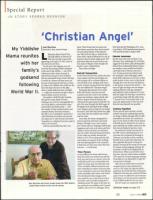
Bell Storchan and Victor Ayoub review the 1947 Detroit
Jewish News article at the June 9 reunion.
alone. Their former life now gone and
their future uncertain, they stood strand-
ed in the dark shadow of the silenced
war. They had one hope: a relative's last
name and a vague recollection of a city in
America where a future might await. The
girls knew they had an aunt with a mar-
ried name of Shapiro. They thought she
lived in a place called Detroit.
Then, there was light.
Detroit Connection
In the Detroit Jewish News article, the story
of my mother and her sister begins not
with a phone call to a distant relative or
even the Red Cross. It begins with Victor
Ayoub, a Syrian-American GI from Detroit
who was dubbed the "Christian Anger
Young and determined, Victor made
Bell's and Freda's cause his own and
reached across the ocean to his mother,
Agnes, for assistance. Agnes Ayoub, who
lived on Tuxedo Street in Detroit, also
embraced the opportunity to help the two
girls. She went through the thick pages of
the phone book and spent hours calling
every Shapiro until, at long last, she found
the match. And with that connection, light
came back into the world for my mother
and her sister.
Soon after, the sisters immigrated to
Detroit and lived with their aunt, Ruth
Shapiro. Though it was a new country,
new culture and new language, both found
happiness and went on to marry and have
children. Freda married Leon Goldman
and my mother married Samuel Storchan.
In fact, when my mother married my
father in 1951, Victor along with his wife
and mother, were guests at the wedding
and even photographedat the reception.
It had been just four years since they had
last met — a world away.
Time Passes
In my mother's new home with her hus-
band, the article was tucked away, still rela-
tively new and crisp, in a drawer where she
would often pull it out and remember her
angel. Over time, their busy life paths took
Victor and Bell in different directions and
they eventually lost contact with each other.
It was during these early years that Bell and
Freda eventually made contact with Peshel
(Fivosh) Mamulis their younger sister
who ended the war on the Russian side of
the border and eventually immigrated to
Ashkelon, Israel. The union of the three sis-
ters produced seven children and 15 grand-
children, who now live in Michigan, Israel,
New York and the Washington, D.C., area.
Leon died in 1970; Samuel passed away in
1985 and Freda died in August 2008.
Fateful Interlude
But the story does not end there. Last
February, Troy cardiologist Dr. Joel Kahn
suggested that Sylvan Lake photographer
Monni Must of Naturally Monni contact
my mother so she could be included in
a portrait book of Detroit-area survi-
vors. During an interview, Monni and
her assistant, Linda Schlesinger, asked
about Bell's experience in the war so they
could include a short story in their book.
Though she is now 85 years old, Bell ran
to the drawer to retrieve the article — the
story of light and hope, now an antique
clipping yellowed with age. Intrigued
and inspired, Linda promised to try and
find her angel. The next day, I received an
e-mail from Linda with the subject line,
"I Found Victor." For the first time in 62
years, the opportunity to hear the story
from the man himself was possible.
Coming Together
Victor, now 86 years old and a retired
Antioch University anthropology profes-
sor living in Yellow Springs, Ohio, vividly
remembers the sisters. At a reunion on
June 9 at his home in Ohio, Victor shared
with Bell and our family how he came to
meet and help my mother and aunt at the
Bad-Gastein displaced persons camp.
He pointed out some inaccuracies in
the 1947 article, clarifying that he was
a private, not a sergeant, his heritage is
Lebanese, not Syrian, and he considers
himself more secular than Christian. He
also explained that prior to being dis-
patched oversees by the Army, he was sent
for intense Arabic language training. He
assumed it would be for deployment in
North Africa. When he arrived for train-
ing, there were no Arabic classes available
so he opted for German language training.
Eventually, he was dispatched to fight the
Axis powers in Europe.
After the war ended, Victor served the
occupation forces and volunteered to
work in a DP camp. His superiors held a
preference for Jewish GIs who could speak
Yiddish for this duty, but could not fill their
quota. Victor was allowed to serve because
of his fluency in German and its similarity
to the Yiddish spoken by the survivors.
The DP camp was comprised of five
Christian Angel on page Al2
July 2 • 2009 All