

World
EXTREMISTS
The Wild West
Israel wrestles with settler conundrum.
Dina Kraft
Jewish Telegraphic Agency
Tel Aviv
W
hen two top Israeli army com-
manders in the West Bank
received threatening letters in
early June, the suspects weren't the army's
traditional enemies in the territory.
Instead, Israeli Jews angry about the
army's recent demolition of several illegal
settlement outposts appeared to have sent
the letters.
One compared the soldiers to Nazis, call-
ing the officers "a gang of Jews with wretch-
ed souls, reminiscent of the Judenrat"
Another said, "We know where you live.
We will get to both you and your family."
Rampages by settlers against
Palestinians, private property and Israeli
security forces have brought into stark
focus the problem Israel is likely to face
as it moves to evacuate more illegal
West Bank outposts and confront Jewish
extremists. The challenge may become
more acute in the months ahead due to
new pressure from Washington to freeze
Jewish settlement growth.
In recent years, the Israel Defense
Forces' demolition of illegal outposts has
been met at times with settler violence.
More often than not, settlers have returned
to rebuild their illegal outposts.
Yizhar Beer, director of a watchdog
group on extremism called Keshev, says
the problem for authorities is that radical
settlers use guerrilla tactics, spreading out
and exhausting traditional forces.
"Being in many places necessitates fac-
ing off with them with a large amount of
forces:' he said. "That's very difficult?'
Some blame a lack of political will.
Successive Israeli prime ministers have
failed to follow through on promises to
demolish illegal outposts, and a 2005
government report by former state pros-
ecutor Talia Sasson found that $18 million
in government funds had been directed
toward illegal settlement building between
1996 and 2004.
Sasson found that regional councils in
the West Bank were able to use funds from
the Ministry of Housing and Construction
to pave roads, connect water lines and hook
up the outposts to local electricity grids
by misleadingly earmarking the funds
as infrastructure for new neighborhoods
within existing settlements.
A14
June 25 2009
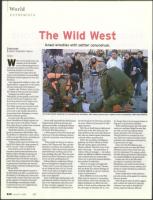
An Israeli border policeman is evacuated last December after being injured near a Hebron house occupied by right-wing settlers.
Sasson held responsible the World Zionist
Organization's settlement division and
government bodies, including the Defense
Ministry, which has overall responsibility
for Israel's West Bank presence.
A 2006 report by Peace Now found that
40 percent of Jewish settlement territory
was built on privately owned Palestinian
land.
"When people see there is no enforce-
ment of law," Sasson said, "they can take
land that is not theirs and establish new
settlements without government approval
and build houses on them, and no one
does anything afterward. They can come
and hit and shoot Palestinians, and they
see no one does anything about it."
Defense Ministry spokesman Shlomo
Dror said things have changed recently.
"Today, where we can stop such actions
we are doing our best to do so," he said.
"There was a lack of oversight in some
places in the past, but in the past three
years it has improved?"
Until recently, high-ranking police offi-
cials blamed a dearth of resources for the
lack of law enforcement. But police now
say they are better equipped: Last year,
the police established a headquarters in
the West Bank for the first time, and there
are more vehicles and personnel to effect
rapid responses.
Yesh Din, an Israeli human rights group
that focuses on the West Bank, says one
major problem is the rarity with which set-
tlers who use violence against Palestinians
or Israeli soldiers are prosecuted.
There's also a problem of intelligence
gathering, say former officials of Israel's
Shin Bet security agency and Defense
Ministry officials. Close knit, wary of out-
siders and young — the perpetrators of
violence often are teenagers — the radical
settlers are difficult to infiltrate. Sometimes,
when radical youths are arrested, they
refuse even to give their national identifica-
tion numbers to authorities.
"Theirs is an insular and inherently
suspicious society," Dror said. "Because
they are driven by a fanatic ideology, it's
extremely difficult to convince members
to pass on information?'
About 280,000 Jews live in the West
Bank, many for reasons of convenience
and economics rather than ideology. The
largest settlements are filled with com-
muters to Israel, and the settlements offer
the advantages of suburban life at a cost
far cheaper than in Israel proper, thanks in
large part to government subsidies.
Under international law, all of the settle-
ments are considered illegal because they
are built on land Israel captured from
Jordan during the 1967 Six-Day War.
Though Israel never annexed the terri-
tory, aside from eastern Jerusalem, Israel
maintains that settlements authorized by
its government are legal.
Israel views the West Bank as unas-
signed territory left over from the British
Mandatory period whose final status has
yet to be determined. The outposts, which
are built without government authorization,
are considered illegal by the government.
Israelis who live in the West Bank
are subject to Israeli law. West Bank
Palestinians come under Israeli jurisdic-
tion for criminal or security matters, and
mostly are under Palestinian jurisdiction
for civil matters.
Despite tough talk by Israeli politicians
past and present, action against the outposts
has been sporadic.
When the government decided to aggres-
sively confront the outposts by enforcing
a Supreme Court order to demolish the
Amona outpost in February 2006, the