

World
NEWS ANA i VS S
On Condition
Will Bibi's speech be enough for Palestinians, Americans?
Leslie Susser
Jewish Telegraphic Agency
Ramat Gan
A
fter two months of intense
American pressure, Israeli
Prime Minister Benjamin
Netanyahu finally uttered the magic
words: two states for two peoples.
"In my peace vision, there are two free
peoples living together, side by side in our
small land, with good neighborly relations
and in mutual respect — each with its
own flag, its own national anthem and its
own government;' he said.
Netanyahu made the declaration in a
much-anticipated speech Sunday at Bar-
Ilan University: Alan Zekelman, president
of the Bloomfield Township-based Detroit
Friends of Bar-Ilan University took pride
in the choice of venue for the speech.
"Bar-Ilan University and its worldwide
network of friends are proud that Israel's
prime minister, when addressing the
world with a major policy address, chose
to deliver it on Bar-Ilan's campus under
the auspices of its Begin-Sadat Center for
Strategic Studies," said Zekelman. "It is a
recognition of the depth and quality of the
center's work!'
Regarding the effect of Netanyahu's
speech, the question is, will it be enough
to kick-start a genuine negotiating process
with the Palestinians?
The prime minister set numerous con-
ditions for a Palestinian state.
The Palestinians first would have
to recognize Israel as the state of the
Jewish people; Jerusalem would remain
Israel's undivided capital; a solution for
Palestinian refugees would have to be
found outside Israel's borders; and the
United States would have to guarantee
that the Palestinian state would remain
demilitarized and not sign treaties with
countries hostile to Israel.
"If we get this guarantee for demilitar-
ization and necessary security arrange-
ments for Israel, and if the Palestinians
recognize Israel as the state of the Jewish
people, we will be willing in a future peace
agreement to reach a solution of a demili-
tarized Palestinian state alongside the
Jewish state Netanyahu pledged.
The White House called the statement
"an important step forward!"
The initial signs that Netanyahu's
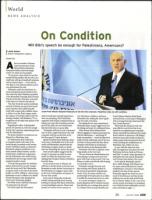
Israeli Prime Minister Benjamin Netanyahu for the first time endorsed a Palestinian state, but with conditions.
speech would spur renewed negotiations
were not promising. Chief Palestinian
negotiator Saeb Erakat complained that by
taking core issues like Jerusalem and refu-
gees off the table, the new Israeli leader
had closed the door on peace talks.
"Netanyahu will have to wait a thousand
years to find a single Palestinian who will
cooperate with him on the basis of his
Bar-Ilan speech;' Erakat declared.
Egypt's President Hosni Mubarak, whose
views carry considerable clout in the Arab
world, said Netanyahu's demand that the
Palestinians recognize Israel as a Jewish
state was "destroying the chances for peace
Some Israeli analysts suggest that the
strong U.S. pressure on Israel in recent
weeks has lulled the Palestinians into
thinking that President Obama will deliver
Israel for them.
So the next key move is Obama's. He
will have to decide whom to pressure now:
Netanyahu to make further concessions or
the Palestinians to engage in peace talks
on the basis of Netanyahu's acceptance of
the two-state model.
In his speech, Netanyahu studiously
avoided saying anything about freezing
building in existing West Bank settlements
or removing illegal outposts. Obama had
insisted on a freeze for two reasons: to
win Palestinian confidence and press
Netanyahu into making the more signifi-
cant two-state concession.
By making the two-state commitment,
Netanyahu hopes to gain wiggle room over
the timing and scope of a settlement freeze.
When former Prime Minister Ehud
Olmert engaged in a vigorous peace process
with the Palestinians — and George W
Bush was president — Israel was allowed to
build in Jewish settlements west of the secu-
rity fence on the grounds that they almost
certainly would remain in Israel proper
under the terms of any final peace deal.
Netanyahu will want to negotiate some-
thing similar, at the very least.
The new American administration has
been playing a strong carrot-and-stick
game with Israel, trying to give it the con-
fidence to make concessions while leaning
on it heavily to do so.
Netanyahu emerged from his mid-
May meeting with Obama shaken by
the American president's dispassionate
resolve. Twice the prime minister dis-
patched high-level emissaries in an effort
to mollify the Americans, but to no avail.
At a recent meeting in London, an
Israeli delegation led by Cabinet minister
Dan Meridor got no change from special
U.S. Mideast envoy George Mitchell, and
Israeli Defense Minister Ehud Barak
returned from a recent trip to Washington
with a message from the Americans that
they "meant business!'
What made the American stick even
more effective was the fact that it was
backed by an ambitious peace timetable:
Obama reportedly has informed the Israelis
that he intends to announce a full-fledged
American peace plan in July and hopes to
achieve peace between Israel and the Arab
world, including the establishment of a
Palestinian state, within two years.
In sync with the American time-
table, the Egyptians have given the rival
Palestinian factions, Fatah and Hamas,
until July 7 to reach a unity agreement. In
making his Bar-Ilan speech, Netanyahu
tried to keep Israel ahead of the curve.
In the speech, Netanyahu entered
into a subtle dialogue with Obama over
the causes and justification for Israel's
establishment. Contrary to what Obama
implied in his June 4 Cairo speech,
Netanyahu argued that Israel was not a
result of the Holocaust and that Jewish
suffering was not the main justification
for its creation. Rather, it was a case of an
ancient people returning to its homeland,
over which they have inalienable and mil-
lennia-old historic rights.
June 18 • 2009
A25