

Spotlight
Looking Back
A fascinating 500 years of Jewish life revealed in antique art prints.
David Sachs
Senior Copy Editor
A
t 83, author and art his-
torian Constance Harris
continues to find enlighten-
ing perspectives on Jewish history to
share.
Connie, who splits
her time between
Birmingham and
Los Angeles, has
blended her affinity
for art and her love
of Judaism into a
new 469-page tome
Connie Harris
complete with 377
prints displaying
everyday Jewish
life from the year 1456 to the present:
The Way Jews Lived — Five Hundred
Years of Printed Words and Images
(McFarland & Co., $95).
"Before I
started on this
project over
decade ago,
I knew very
little about
Jewish his-
THE WAY
tory from this
EVVS 1.1VT.D
era; I knew
there was an
Inquisition
and a
Holocaust," said Connie, who authored
Portraiture in Prints in 1987. She dis-
covered that the only visual medium
that contemporaneously captured the
full 500-year span was prints on paper
or as illustrations in books.
Before the invention of photography
in the mid-19th century, art images
printed from woodcuts, engravings,
etchings and lithographs were the
only way visuals could be widely and
cheaply distributed to the masses.
This process preceded even Johannes
Gutenberg's development of movable
type around 1439.
Remarkably, the first 300 years of
prints about Jews were created almost
exclusively by gentile artists; Jews, for
the most part, were not allowed to
enter artist guilds. As a result, much of
the art reflected the bigotry and inhu-
manity of medieval societies.
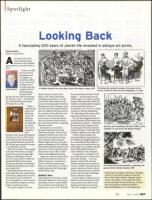
The earliest example in Connie's
A Shabbat Kiddush from Song Book, Grace After Meals, Prague, 1512 The Wicked Son defiantly smokes at the seder in this
version of the Four Sons from New Haggadah, U.S., 1851
book is Massacre of Jews by Jean
Mielot, 1456. It shows Frenchmen
worshiping piously before a crucifix
in one house while Jewish men and
women were being hacked to death by
Christians next door. Although a good
deal of the artwork by gentiles depicts
and even celebrates the persecution of
Jews, Connie cautions that there were
stretches of time where Jews pros-
pered in peace. Torture and violence
were not exclusively aimed at Jews; it
also was prevalent between competing
Christian societies.
Burning Jews is a woodcut by
Hartmann Schedel from his book
Nuremberg Chornicles, 1493, the best-
selling non-biblical book of the 15th
century. The print depicts Germany
about 100 years earlier during the
Bubonic Plague when Jews were scape-
goated and slaughtered. Half a millenni-
um later, these medieval massacres were
repeated on a better-organized, much
more massive scale in the so-called
modern and enlightened Germany.
Prague was a place in Europe where
books where printed for Jewish use.
Kiddush Ceremony, a woodcut from
Zimirot u-Birkat Ha-mazon (Song
Book, Grace After Meals), 1512, shows
a family gathered at the Friday night
Shabbat dinner table.
Athletic Hero
Surprisingly, some of the first realistic
and positive depictions of Jews for gen-
eral audiences were of Jewish athletes.
The Jewish Boxer Daniel Mendoza, by
gentile artist J. Grozer, 1789, celebrates
the renowned and innovative British
pugilist — at 160 pounds the only
middleweight to win the heavyweight
championship. Meanwhile, rabid anti-
Semitism was still prevalent in England,
as demonstrated in Houmors of
Houndsditch or Mrs. Shevi in a Longing
Condition by Thomas Rowlandson,
1813, depicting Jewish women exhibit-
ing amorous attraction to swine.
The 1851 New Haggadah reflected a
bit of the disorder that had entered some
Jewish homes in America — illustrating
the Passover story of the Four Sons
by showing the Wicked Son defiantly
pointing his finger at the family while
smoking a cigarette at the seder table.
Connie is a practicing Jew who
transmitted the duty to give charity to
her children; her daughter Marcia died
in an automobile accident while serv-
ing as a nurse in Ecuador, and her son
and daughter-in-law Stephen and Ruth
Harris of Bloomfield Township are
active volunteers in the community.
Connie's goal in writing this book
is to enable young Jews to learn more
about their heritage — so it's not
forgotten. Already, 200 university
libraries have purchased Connie's lat-
est book. In 2005, Connie donated her
massive collection of Jewish cultural
artifacts gleaned from her worldwide
travels to the University of Michigan
Special Collections Library.
Connie's rabbi in California, Steven
Weil, formerly of Young Israel of Oak
Park, praises her new book as both
inspiring and bittersweet, showing
"the heroic struggle of our people." .—
71
Burning Jews, Nuremberg, Germany, 1493, and the
slaughter of Jews during the Bubonic Plague.
The Jewish Boxer Daniel Mendoza, celebrating the
popular British athlete, England, 1789
Connie Harris will speak 4-5:30 p.m. Thursday,
June 25, in the Library Gallery on the first
floor of the Harlan Hatcher Graduate Library
on the U-M campus in Ann Arbor. Her book
can be purchased at the U-M lecture, or direct
from the publisher at (800) 253-2187 or
www.mcfarlandpub.com , or at amazon.com .
June 2009
B27