

rim
a on
The Insider
NEW
sEWS
dth k at
www.jarc.org
both in the Negev and built with
JNF support.
srael's freshwater shortage is acute. The crisis has
triggered the need for alternative water sources as
well as forcing farmers to face water quotas.
Israel is in the throes of its worst water shortfall in
years. Reservoirs have hit a 10-year low. And Israel's main
freshwater supply — the Kinneret — is at its lowest level in
40 years because of four straight dry winters.
Other possible freshwater sources include purified sew-
age water (for agricultural use), captured floodwater and
desalinated seawater. Such sources would significantly
boost Israel's supply of available freshwater.
Enter Israel's venerable environmental watchdog: The
Jewish National Fund. JNF is the cog for partnering the
land and people of Israel. Michigan Region President Jim
Hiller of Hiller's Markets has kicked off
"31 Days in May, Water for Israel."
The inspired drive, co-chaired by JNF
board members Allan Gale and Jeff
Mark, is aimed at raising awareness of
and money for new freshwater sources.
JNF — a legend in tree planting and land
purchases — provides vital freshwater
resources to Israel through its reservoirs
Jim Hiller
and treatment plants.
Over the past year, Israel's popula-
tion has grown by 200,000 to 7.4 million. By 2020, it's
expected to grow by another 3 million. That means the
Jewish state will require another 80 billion gallons of
drinking water, according to JNF.
By any standard, Israel must build more reservoirs to
increase the amount of recycled water available for farm-
ing and to prevent pollution resulting from insufficiently
treated water reaching rivers and streams.
At the same time, the diaspora must applaud cleanup
of Israel's polluted waterways. Like JNF says, let us vigor-
ously support "the work of Israel's top scientists on new
water recycling techniques to maximize every precious
I
drop of water."
JNF operates 204 reservoirs across Israel. They have
added 66 billion gallons of treated water and floodwater
to Israel's national water economy. That flow irrigates
112,000 acres of orchards and field crops — about 40
percent of Israel's farming demand. Consider what impact
lack of this network would have on Israel's drinking water.
More than 70 percent of the wastewater in Israel is
purified, the highest concentration anywhere. Spain is
second with just 17 percent of its wastewater recycled.
Still, almost 90 billion gallons of wastewater in Israel are
not recycled. Thank you, JNF, for committing to building
another 40 reservoirs over the next five years. JNF res-
ervoirs do not just hold recycled wastewater. Some cap-
ture rainwater and flood runoff; the intake is redirected
for irrigation and to bolster aquifers.
Israel already is a world innovator when it comes to
desalination. The Ashkelon facility is the largest such
plant in the world. Israel's Water Authority has set an
ambitious goal of desalinating 200 billion gallons of
water by 2015 to furnish most of the nation's household
freshwater needs.
Water is only part of JNF's life-sustaining work in the
State of Israel. Over 107 years, the independent chari-
table agency has planted 240 million trees, built 1,000
parks, built security roads, taught students around the
world about Israel, created new communities for immi-
grants, discovered new ways to grow plants in arid condi-
tions and brought green to the desert.
But let there be no mistake: Increasing the freshwater
supply, as underscored by the Michigan Region's "31
Days in May, Water for Israel" campaign, may be JNF's
top priority today. 7_
— Robert Sklar, editor
Campaign connection: Giving levels and more background,
www.jnf.org/31daysinmay.
Our JN Mission
The Jewish News aspires to communicate news and opinion that's useful, engaging, enjoyable and unique. It strives to reflect the full range of diverse viewpoints while also
advocating positions that strengthen Jewish unity and continuity. We desire to create and maintain a challenging, caring, enjoyable work environment that encourages creativity
and innovation. We acknowledge our role as a responsible, responsive member of the community. Being competitive, we must always strive to be the most respected, outstanding
Jewish community publication in the nation. Our rewards are informed, educated readers, very satisfied advertisers, contented employees and profitable growth.
clusive Safari-Inspired Family Evening at The Detroit Zoo!
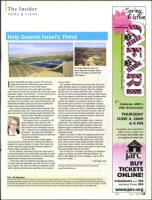
The Arad Reservoir, left, and
Besor Reservoir Complex, above,
Celebrate JARC's
40th Anniversary!
THURSDAY
JUNE 4, 2009
6-9 PM
SpringElation Safari funds 8D% of
JARC's services to children with
any disability. Our families need
your support more than ever.
lac
BUY
TICKETS
ONLINE!
SPONSORSHIPS From 1 150
Individual Tickets $20
www.jarc.org.„
May 7 • 2009
A5