

I
Special Report
HILL OF SPRING
Tel Aviv from page All
A Native Daughter
Local woman recalls the "little Tel Aviv" of her childhood.
Rachel Kapen
Special to the Jewish News
n 1910, when the first families
moved into their new homes in the
new settlement by the sea, the
name was changed to Tel Aviv, hill of
spring, This was the Hebrew version
of Aitneuland, Binyamin Zeev Herzl's
famous book in which he underlined
his idea of a Jewish state in Eretz
I
Yisrael.
The jewel in the crown of Tel Aviv
was Gymnasia Herzlia, the country's
first all-Hebrew high school, which
was founded a few years earlier in
Yaffo. The street where it was built
was named for Herzl, the founder
of Zionism who died suddenly in his
prime in 1904.
As Herzlia's reputation spread
beyond the borders of Eretz Yisrael,
then still under oppressive Turkish
rule, Jewish parents throughout the
world started to send their teenage
sons to learn there.
Herzlia was much more than a
first-class Hebrew high school. It
soon became the heart and soul of
the cultural life of little Tel Aviv, as it
was called fondly. Every Friday night,
local authors such as Hayim Nachman
Bialik or Shaul Tchrnichovsky read
from their latest work at the Oneg
Shabbat held in the school's audito-
rium.
My mother, Sarah, who had made
aliyah in 1921, was a regular at these
weekly events and sang in the choir.
It was there where she met the hand-
some Litvak named Yosef Garber;
they were married by Tel Aviv's chief
rabbi in 1929.
On April 21, 1939, my mother gave
birth to her second daughter in the Tel
Aviv Hadassah hospital. At the same
time, news arrived that her mother,
Rahel-Leah, passed away in her shtetl
of Sapotkin in White Russia, now
Belarus; this is how I got my name,
Rachel.
Recalling Old Tel Aviv
The Tel Aviv of my childhood was one
of camaraderie and shared goals. The
following story occurred in 1945 and
is deeply imprinted in my memory as
a testament to life then. The Bialik
school, which I attended for first
grade was, no doubt, the largest in
Tel Aviv and the country as a whole;
therefore, classes ran in two shifts.
My class was in the second, while my
sister Shula's was in the first.
One day, she was supposed to pick
me up after school and was late. When
school was out, she was not there; all
alone, I stood there on the sidewalk
and cried. A man on a bicycle stopped
by and asked why I was crying and I
told him. There were no telephones to
call my parents so he put me on his
bike and was going to take me home.
There on Herzl Street near our
house, we passed by my sister waiting
at the bus stop. She couldn't believe
her eyes seeing me with this unfamil-
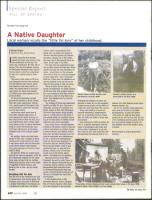
Rachel Kapen in Kikar Kondon near
Rachel's mother, Sarah, at a
iar person. I told him that this is my
the beach in Tel Aviv, 1949
Purim ball in Tel Aviv, 1923
sister; she thanked him for me and
took me home.
firsthand the masters of whom we
The holiday of Purim was especially
learned in class; for us, the unsophis-
Hebrew city with Hebrew street signs,
exciting in little Tel Aviv. The yearly
ticated young Israelis of the 1950s, it
Hebrew theater, etc.
Adloyada, carnival of costumes and
could very well have been the Louvre.
As for me, besides being impressed
floats, began in 1921. Meir Dizengoff,
Today, the building is known as
each year by Tel Aviv's incredible
Tel Aviv's first mayor, would usually
Heichal HaAtzmaut, Independence
developments, its glitz and glitter,
ride on a white horse at the head of
Hall, for it was there that on Friday,
I still prefer to walk the less glitzy
the parade while the residents stand-
May 14, 1948, the State of Israel was
streets of the old Tel Aviv, the Tel Aviv
ing at the two sides of Allenby Street
proclaimed.
of my childhood and my youth, the Tel
welcomed him enthusiastically.
Now marking its 100th birthday, Tel
Aviv my parents helped to build, the
Also, every Purim, Barukh Agadati,
Aviv is a vibrant metropolis with its
first Hebrew city in the modern State
a famous folk dancer, used to organize
share of skyscrapers and malls and
of Israel.
a Purim ball where my mother, Sarah,
all the other trappings of a big city;
a natural beauty, was always invited.
yet it has its very own character, not-
Rachel Kapen is a West Bloomfield
One year, she went dressed up as her
withstanding the obvious that it is a
resident.
biblical namesake and unbeknownst
to her a well-known photographer
took her picture and displayed it in
his photo shop on Allenby Street.
My surprised mother went in and
confronted him. He gave her the
picture, which is one of the trea-
sured ones in the family album,
which I inherited from my parents.
Speaking of first mayor Meir
Dizengoff, he and his wife, Tzina, for
whom the famous Dizengoff Square
is named, had no children. So they
bequeathed their beautiful home
on Rothschild Boulevard near the
corner of Herzl Street to the city of
Tel Aviv; it became the city's first
art museum.
It was located close to the
Gymnasia Herzlia, where I studied.
Our art history teacher often took
Three newly arrived Litvaks do their wash outside their house in Tel Aviv, 1925.
Rachel's father, Yosef Garber, is in the middle.
us to the museum to get to know
Tel Aviv on page A14
Al2
April 23 . 2009