

Special Report
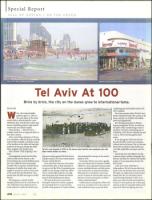
Modern-day Dizengoff Center
Tel Aviv At 100
Brick by brick, the city on the dunes grew to international fame.
W
hen a few dozen families
gathered April 11, 1909, on
the sand dunes of the beach
outside Jaffa to allocate land for a new
settlement, they took the first critical step
toward establishing what is today Israel's
commercial and cultural capital.
These families — Tel Aviv's first —
couldn't decide how to assign the plots, so
they held a lottery.
Akiva Arieh Weiss, chairman of the lot-
tery committee, collected 60 gray seashells
and 60 white seashells, writing the names
of the families on the white and land plot
numbers on the gray. Pairing the shells,
Weiss assigned each family a plot.
Thus, Tel Aviv ("Hill of Spring") was
born.
As immigrants poured into the Holy
Land in what become known as the
Second Aliyah, the ancient Mediterranean
port city of Jaffa became increasingly
crowded. The newcomers included many
Europeans of middle-class origin who
sought to reconstruct in the Levant some
of the world they had left behind. They
turned from old Jaffa and began to build
Tel Aviv.
What began as a suburb of Jaffa
emerged quickly from the sand dunes. By
1921, following severe clashes between
Arabs and Jews in Jaffa, the British man-
A10
April 23 2009
Tel Aviv was founded in 1909 on the dunes when families were assigned lots with
their names written on shells.
date government granted Tel Aviv formal
self-governance. The local council named
the new suburb Tel Aviv.
At the time there were just a few streets
surrounded by piles of deep sand and cit-
rus groves, but the Tel Aviv population grew
rapidly as Jews fleeing violent inter-ethnic
riots in nearby Jaffa looked for new digs,
and immigrants from Poland and Russia
arrived on the Mediterranean shores.
The head of the local council, Meir
Dizengoff, realized he needed a program
for expanding Tel Aviv, so he hired the
Scottish urban planner Sir Patrick Geddes,
who presented his concept to the munici-
pality in 1925.
In his plan, Tel Aviv was to be a garden
city, as envisioned by its founders. Geddes
called for a clear separation between main
streets, residential streets and leafy pedes-
trian boulevards. An important element,
reflecting the social climate of the time,
was the creation of shared public spaces in
the form of parks and squares as well as
within residential blocks.
Geddes placed small gardens filled with
fruit trees and other trees in the center of
each residential cluster to provide both
a gathering spot and healthy fruit for Tel
Aviv's children.
His vision persists today. Tel Aviv's tree-
lined boulevards bustle with activity at all
hours, and the city is filled with hidden
parks and playgrounds.
Jews fleeing persecution in Europe
began pouring into Tel Aviv en masse in
the early 1930s, transforming a town of
42,000 in 1932 into a flourishing city of
130,000 by 1936. Tel Aviv officially became
a city in 1934, with Dizengoff its first
mayor.
It was during the 1930s that Tel Aviv
became the Holy Land's true economic,
cultural and social center. The city became
known for its modern cafes, hotels, con-
cert halls, nightclubs, boutiques and the-
aters.
And in this new city, Hebrew was the
common tongue, making a language that
had lain dormant for centuries the mother
tongue of a new generation of Jews: the
first Israelis.
At the start of the 1948 War of
Independence, Tel Aviv became the focal
point of the war between Jews and Arabs.
The fight over Jaffa's future started imme-
diately after the U.N. decision in favor
of partitioning Palestine in 1947. As in
other areas where Jewish and Arab forces
clashed in close quarters, the civilian pop-
ulations in Tel Aviv and Jaffa suffered, and
many fled. When the fighting was over,