

Health & Fitness
Going Green
Washtenaw JCC makes environment
a top priority in renovations.
Karen Kohn
Special to the Jewish News
Ann Arbor
G
reen is the color of the day, and
the Jewish Community Center of
Washtenaw County is brimming
with it. "The JCC is embarking on an effort
to go as green as possible," says Leslie Bash,
director of the JCC. The green initiative is
much more than just recycling paper or
turning down the thermostats at night. In
fact, several recent building renovations
include state-of-the-art green technologies
that are making the JCC more environmen-
tally friendly.
"We often think about saving energy by
driving energy-efficient cars, but the energy
used in buildings exceeds the energy used
to operate cars by about three to four
times',' says Seth Penchansky, vice president
of the JCC board and a member of the
facilities committee for the last five years.
As a principal of Penchansky Whisler
Architects, a firm which specializes in sus-
tainable architecture, Penchansky oversaw
the design and installation of the recent
renovations at the JCC.
Energy-efficient building design is not
a new concept for the JCC. Since the JCC
purchased its current home in 1987— a
former Ann Arbor public school building
built in 1969 — several upgrades have
been necessary. The largest expansion,
completed in 1998, added significant class-
room space to the building, but only met
the minimal energy-efficiency standards
of the time.
Four years ago, the gym was renovated
and featured the first energy-efficient
rooftop heating and air-conditioning unit
with fresh air exchanges to reduce carbon
dioxide levels inside. In the construction
completed last fall, which updated the Maas
Lounge and staff offices and added a con-
ference room, the JCC went even further.
The renovation included the latest
energy-efficient lighting. In the Maas
Lounge, 21 fixtures with four lamps each
were replaced by eight fixtures with three
lamps each, which also use lower-wattage
bulbs. The result was a lighting system that
uses one quarter of the energy previously
required. The conference room features the
new lighting, as well.
Maas Lounge floors were replaced
with more sustainable and longer-lasting
building materials, such as Marmoleum,
a natural linoleum flooring made from
linseed oil. In areas where carpeting was
needed, carpet tiles made from recycled
nylon were used so that small sections can
be swapped if needed without replacing
the entire area. Some of the carpet tiles are
held in place by friction to lower harmful
fumes from glue.
New insulation was added in the lounge
where drywall was used so the heating and
cooling system doesn't have to work as hard.
Wails were painted with low VOC (volatile
organic compound) paint, which reduces
the risk of respiratory and other illnesses.
Shatter-proof, insulated windows
were installed in the conference room.
They also will be installed across the
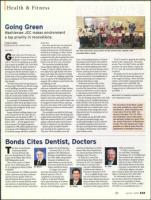
The Kids' Konnection group shows off the artwork they created in the
renovated Maas Lounge.
front of the building thanks to a Federal
Homeland Security grant. The windows
offer added safety and increased energy-
efficiency Insulated glazing and tinted
glass reflect the sun's heat during warmer
weather and keep heat inside in winter.
The most ambitious of the JCC's green
initiatives, however, is the installation of
geothermal heating and cooling in the
overhaul of the Maas Lounge.
Geothermal systems send coolant
through piping buried underground
to extract the natural heat. A minimal
amount of electricity is used to operate
a compressor, pump and fan. In warm
weather, the system is reversed.
The new heating system also works with
an energy recovery ventilator, drawing in
fresh air from a vent in the roof. The unit
runs only when a carbon dioxide sensor
indicates fresh air is needed, and it recov-
ers 70 percent of the energy that would
otherwise be lost by conventional air cir-
culation systems.
The system can pay for itself within
five years in recouped energy costs.
Geothermal heating is twice as efficient
as standard equipment, has twice the
life span, and requires less maintenance.
According to Penchansky, it just makes
good business sense.
The JCC intends to upgrade the building
further in the coming years. The spring
auction "Raise the Roof," which was held
on March 28, raised funds to replace the
JCC's 23-year-old roof and install thicker
insulation.
Eventually, the JCC must replace the 40-
year-old boiler that heats the main part
of the original building. "When the boiler
expires, we'd consider using geothermal
heating again," says Leslie Bash. The
geothermal heating system in the Maas
Lounge serves as a pilot project for that
possibility. _
Karen Kohn is a marketing consultant for the
JCC of Washtenaw County.
The renovation of the Maas Lounge
was made possible by a grant from
the Benard L. Maas Foundation and
funds raised from the 2007 JCC
Auction fundraiser. The JCC office
and conference room construction
was partially funded by a grant from
the Jewish Federation of Washtenaw
County. The new windows are made
possible by a federal grant from the
Department of Homeland Security.
Bonds Cites Dentist, Doctors
T
Sackler School of Medicine.
he State of Israel Bonds
Dr. Berris, D.D.S., is a 1974
Professional Health
graduate of the University of
Services Division will
Michigan Dental School a mem-
honor Dr. Ronald Berris, Dr. Miles
ber of the Alpha Omega Dental
Singer and Dr. Jeffrey Zaks with its
Fraternity In addition to his
2009 Maimonides Award.
family dentistry practice, he has
They will be cited at a tribute
been team dentist for the Detroit
dinner 6 p.m. Wednesday, April
Pistons and Detroit Shock.
29, at Congregation Shaarey Zedek Dr. Berris
Dr. Singer, D.O., gradu-
Southfield.
ated from Des Moines University
Event chairmen Drs. William Leuchter,
Medical School in 1990. He
Arthur Lieberman and Harris Mainster
completed his internship and
said the keynote speaker will be Dr.
residency at Botsford Hospital
Gabriel Barbash, director general of the
and a spine fellowship at Southern
Tel Aviv Ichilov Sourasky Medical Center
Illinois University. He is in private
and professor of epidemiology and pre-
practice at the Michigan Spine
ventative medicine at Tel Aviv University's
Institute in Waterford, on staff at
Huron Valley Sinai Hospital and
is a clinical assistant professor at
Michigan State University.
Dr. Zaks, M.D., earned his
medical degree from Wayne State
University in 1973. He completed
his residency in internal medi-
Dr. Zaks
cine and a fellowship in
cardiovascular disease at
Providence Hospital in 1978.
He is an affiliate faculty mem-
ber at the University of Detroit-
Mercy and a clinical associate pro-
fessor at Wayne State University.
He has authored and co-authored
numerous articles, papers and sci-
entific presentations.
Dr. Zaks is in private prac-
tice with Heart Cardiology
Consultants, P.C. in Southfield and
Novi and has been a member of
the Providence Hospital medical
staff for 35 years. Within the St.
John Health System, he has been
corporate vice president for clini-
cal decision support, vice presi-
dent of medical affairs and chief medical
officer at Providence from 2000-2007.
For information about the event or
the securities offered by Development
Corporation for Israel/State of Israel
Bonds, contact (248) 352-6555, or (888)
352-6556 or www.israelbonds.com .
April 16 • 2009
A33