

Spotlight
Hungering For Freedom
The Jewish work of fighting poverty.
New York
A
s we sit at our Passover tables
and talk of our nation's trajecto-
ry from oppression to freedom,
there are nearly a billion people in the
world who struggle for survival every day.
They are the slum dwellers in Mumbai,
who lack basic services like water and
sanitation; migrant laborers in Mexico,
who work for pennies while their children
don't get nearly enough to eat. They are
sex workers and women with HIV/AIDS
and refugees from
Darfur.
These people's
suffering predates
our current reces-
sion. Long before
Lehman collapsed
or Madoff left us
bereft, before we
began to worry
about our jobs and
Ruth
our homes, the
Messinger
world's poor were
Special
getting poorer, and
Commentary
death rates due to
malnutrition and
disease were climbing.
Yet the deaths of the poor are rarely
considered newsworthy, nor are they often
considered Jewish problems. The world's
poor labor quietly, hunger wordlessly, and
die silently as we sit at our tables eating
our "symbols" of oppression, comfortable
in our knowledge that most of us will
never really experienced the real thing.
This year, let these symbols of suffer-
ing—the matzah, the bitter herbs, the
charoset —move us to act. When we get to
the point of our seder when we invite the
poor to join us, saying all who are hungry,
let them come and eat, let us remember
that this statement is not just a metaphor.
It is telling us that global poverty is our
problem. We learn from Pirkei Avot, The
Ethics of Our Fathers, that "without sus-
tenance, there is no Torah." We can infer
from this that wherever we allow people to
go hungry, there can be no education, no
equality and no justice.
We must step in, both as a community
and as individuals, to bolster grassroots
and community-based groups around
the world that help quell the hunger that
stifles progress. Especially this year, with
recession gripping even
the most developed
nations, the poor and
marginalized need our
help now A recession
is a time for our com-
passion, contribution
and action, because no
matter how grim the
news is on Wall Street,
Main Street and in
Washington, people in
the developing world
are far worse off than
we are.
As a community,
the Jewish people have
long understood that
we must stand up
for the poor and the
stranger, that we must
pursue justice. That is
why American Jewish
World Service (AJWS)
supports nearly 400
community-based
organizations in the
world's poorest regions
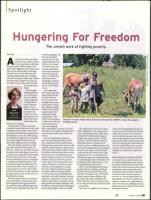
Children from Kenya Orphans Rural Development Programme (KORDP), a group that supports
in Africa, Asia and Latin HIV/AIDS orphans
and Central America.
They are mobilizing
their communities to educate, train and
This organization is just one of many
seders, and the Hagaddah beseeches us
advocate for their rights and dignity. Their NGOs changing lives one community at
to open our arms to those who have less
successes prove that we can make a dif-
a time, from the ground up. There are an
than we do, let us do so in action, and
ference.
estimated 963 million people living in
not just words. Because it is up to us to
One such organization, Fundacion
hunger today, dying at a rate of 25,000
demand that injustice cease in the devel-
Denis Ernesto Gonzalez (FDEG), saved
a day due to lack of sufficient nutrition.
oping world today, so that people around
the communities of Yucul and El Horno,
AJWS funds dozens of projects in 36
the world will experience the freedom of
Nicaragua from starvation when the coffee countries in that are addressing this prob-
which we speak: This year we are slaves,
industry, which employed a large percent
lem by promoting indigenous farming and next year we will be free. If we all work
of the population, collapsed there in 1999.
land and water rights, so that local soil
together, we can make this aspiration a
Left jobless and destitute, peasants lacked
can be used to feed communities. These
reality.
the resources to start independent agri-
strategies save lives. It is estimated that
cultural ventures of their own to feed their widespread support and implementation
Ruth W. Messinger is president of the New
families. FDEG provided them with the
of sustainable agricultural methods in the
York-based American Jewish World Service,
tools to plant small family garden tracts
developing world could increase current
an international development agency provid-
and the facilities to store their harvests
food production by 180 percent.
ing support to 400 grassroots social change
until they could bring them to market.
AJWS is also funding grassroots orga-
groups. She has been honored by major Jewish
Over time, FDEG has built the capacity
nizations that are working to challenge
organizations for her tireless work to end
of many hundreds of farming families
poverty's other ills that are both causes
the genocide in Darfur, Sudan. On March 31,
to cultivate their land independently for
and effects of hunger, such as HIV/AIDS,
she addressed Beth Israel Congregation in
sustenance and profit, creating a thriving
violence against women, illiteracy, dis-
Ann Arbor on ':Jews as Global Citizens: Our
cooperative agricultural economy. Today,
placement and human trafficking. We
Responsibility in the World." On April 2, she
FDEG is renowned for its popular sustain- believe that this work is Jewish work, that
spoke at a symposium on Jewish communal
able agricultural training workshops, and
we are doing the mitzvah of pikuach nefesh issues at the University of Michigan. She also
is helping communities around Nicaragua — saving lives.
appeared at a parlor meeting at Florine Mark's
learn to quell hunger in their own fields.
This week, as we gather at our Passover
Farmington Hills home.
April 9 2009
B1