

World
The New Bibi
Taking office, Netanyahu continues balancing act.
Uriel Heilman
Jewish Telegraphic Agency
Jerusalem
T
30
P
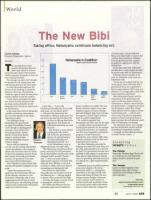
Netanyahu's Coalition
he warnings from Israeli
27
25
pundits and foreign observers
alike came almost as soon as
20
Israeli President Shimon Peres picked
Likud's Benjamin Netanyahu to form the
15
next Israeli government.
15-
The message was clear: Don't forsake
13
the pursuit of Arab-Israeli peace and
10
risk isolating Israel on the world stage.
So when Netanyahu addressed the
5
Knesset at his swearing-in ceremony
March 31, observers were listening
closely for signs of where the new prime
0
Likud
Yisrael.
minister intends to lead his country.
Beiteinu
"Israel always, and today more than
ever, strives to reach full peace with
the entire Arab and Muslim world,"
A later line — "I say to the
Netanyahu said. "We do not want to rule
Palestinian
leadership that if you really
the Palestinians!'
want
peace,
we can achieve peace"
At the same time, however, Netanyahu
—
both
gives
the impression that
carefully avoided any endorsement
Netanyahu
is
willing
to make peace, but
of a two-state solution to the Israeli-
also
leaves
the
door
open
for the prime
Palestinian conflict.
minister
to
sidestep
final-status
The challenges facing
negotiations
if
he
deems
the
Netanyahu's new government
Palestinian
leadership
not
ready
are clear, if formidable: Steward
for
peace.
Israel through a crippling global
Ron Dermer, a senior adviser
economic crisis; prevent Iran
to
Netanyahu who said he
from going nuclear; contain
will
be the new government's
threats to Israel from Hamas
director
of communications
along its southern border
and
policy
planning, said
and from Hezbollah along its
Benjam in
Netanyahu's
position vis-a-
northern border.
Netany ahu
vis the Palestinians is not so
But as with his statements
different from that of Israel's allies.
over the past few months, Netanyahu's
"The Palestinians should have all the
careful articulations in his inaugural
powers necessary for self governance,
address left uncertain where he stands
but not the handful of powers that could
on the most contentious issue in Israel,
endanger Israel's security," Dermer
and between Israel and governments
said — such as an army, airspace
overseas: the pursuit of a two-state
rights, heavy weaponry or treaties with
peace deal with the Palestinians.
states like Iran. Whether or not such
Even Talmudic scrutiny cannot fully
an entity is called a state is an issue of
elucidate Netanyahu's ambiguity on this
terminology,
not ideology, he said.
point.
Now that he has taken office,
"Under the permanent-status
Netanyahu may not be able to keep up
agreement, the Palestinians will have
his balancing act — offering nuggets
all the authority necessary to rule
to placate critics on the left and right
themselves," Netanyahu said, at once
— for long. But doing so may be crucial
suggesting that he will pursue Israel-
Palestinian peace but indicating through to keeping his coalition intact.
Even before the February election,
omission that statehood for Palestinians
Netanyahu made clear he wanted as
might not be the end result.
Seats in 120-member Knesset
United
Torah
Judaism
broad a coalition as possible if he won.
But his refusal to support a two-state
solution or agree to a power-sharing
deal with Kadima's Tzipi Livni cost him
the support of Israel's largest political
party in coalition negotiations.
For a while it appeared that
Netanyahu's only allies were on the right
— enough to form a government and
become prime minister, but not enough
to keep him safe from a no-confidence
vote if he were interested in substantive
progress in Israeli-Palestinian
negotiations. And a narrow, right-wing
coalition certainly would not have won
Israel much favor overseas.
But when Netanyahu succeeded in
bringing the center-left Labor Party into
his camp and promised to be a "partner
for peace," his government became more
palatable to left-wingers in Israel and to
allies abroad. Others, however, blasted
Labor for providing what they described
as a fig leaf for a right-wing Netanyahu
agenda.
Netanyahu has yet to publicly endorse
a two-state solution to the Israel-
Palestinian conflict — putting him
somewhere to the right of both Ariel
Sharon and George W. Bush. The new
foreign minister, Avigdor Lieberman,
wants to redraw Israel's borders to
exclude Israeli Arab population centers
and require loyalty oaths to the Jewish
state in a bid to limit the voting power
of Israeli Arabs. And the Orthodox
Shas party, which holds 11 seats in the
coalition, has promised to withdraw
from any government that includes
Jerusalem in negotiations with the
Palestinians.
At the same time, both Lieberman
and Shas have voiced support for land-
for-peace swaps with the Palestinians.
In Europe, leaders say there is no
room for ambiguity on the issue of a
Palestinian state.
"Let me say very clearly that the way
the European Union will relate with a
government that is not committed to
the two-state solution will be very, very
different," E.U. foreign policy chief Javier
Solana warned in mid-March.
Given Netanyahu's history and the
composition of his government, the
onus is on the new prime minister to
demonstrate to skeptics abroad that his
new government — comprised of Likud,
Yisrael Beiteinu, Labor, Shas, United
Torah Judaism and the religious Zionist
Jewish Home party — will not shift
course away from the pro-negotiation
policies of Israel's last government or
adopt positions that will alienate Israel's
allies in Washington and Europe.
"On substance, there is not a big gap
between Netanyahu's position and the
international community's position
— certainly not those that are friends
of Israel," Dermer insists. E
Answering
Israel's Cr itics
The Charge
Venezuelan President Hugo Chavez said
at a conference last week that Israeli
leaders should be detained for geno-
cide.
The Answer
Chavez is a blind supporter of the
Palestinian cause, who is wrong,
duplicitous and insulting in making
such statements.
- Allan Gale,
Jewish Community Relations Council
of Metropolitan Detroit
a Jewish Renaissance Media April 9, 2009
April 9 • 2009
A23